

Fully Automated Algo Trading for Prop Firm Accounts: Reality Versus Hype
The dream is simple: activate a profitable trading robot, allow it to trade a prop-firm account unattended and collect regular payouts without emotion, discretion or ongoing work.
The reality is considerably more complicated. A fully automated trading system can be profitable over time and still be completely unsuitable for the restrictive drawdown rules, trailing-loss limits and operational conditions commonly associated with retail futures prop accounts.
What Is a Fully Automated Trading System?
A fully automated trading system normally makes every major trading decision according to its programmed rules:
- When to enter the market.
- Whether to trade long or short.
- Which instrument to trade.
- How many contracts to use.
- Where to place the stop loss and profit target.
- How to manage the position after entry.
- When to exit the trade.
- Whether to continue trading as market conditions change.
Once activated, the system follows its instructions until its internal rules tell it to stop or a human operator intervenes.
World Cup Advisor describes an AutoTrade service through which followers can select professional traders and have corresponding trades executed automatically in their accounts. It also states that its performance records include trade-by-trade histories and detailed performance reports.
A Trading Robot Is Usually Built Around a Specialized Edge
A credible automated system is not normally a magical machine that performs equally well in every market, instrument, trading session and volatility environment.
Most systems are designed around a particular trading premise, such as:
- Trend following.
- Mean reversion.
- Momentum continuation.
- Session breakouts.
- Volatility expansion.
- Statistical relationships between instruments.
- Long-only or short-only market behavior.
When market conditions align with the system’s rules, the strategy may perform well. When those conditions disappear, the same system may enter a losing sequence or an extended drawdown.
The long-term premise is that profitable periods will eventually outweigh losing periods over the trader’s chosen measurement period, whether that is monthly, quarterly, annually or over several years.
However, the system must survive long enough to reach those profitable periods.
A Fully Automated System is a Blunt Instrument
A robot does not naturally understand that the market feels unusual, liquidity has deteriorated, correlations have broken down or an unexpected event has changed the trading environment unless those conditions have been anticipated and programmed into its logic.
It simply executes the rules it has been given.
This can make a fully automated system comparable to a blunt instrument. It may require substantial capital, sufficient margin, a large safety buffer and enough drawdown capacity to continue operating through unfavorable market phases.
A trader never knows whether a newly activated system will move immediately into profit or begin with its worst historical losing sequence.
The system may:
- Enter drawdown immediately after activation.
- Produce a strong profit before giving part of it back.
- Remain stagnant for weeks or months.
- Experience a market phase that was poorly represented in its historical testing.
- Reach a new maximum drawdown before recovering.
One of the most common mistakes is stopping a system after accepting most of its losses, only to miss the profitable sequence that follows. Conversely, continuing to trade a deteriorating system indefinitely can create even greater losses.
Knowing the difference requires experience, research, monitoring and judgment. Fully automated trading does not remove the need for professional decision-making; it moves many of those decisions from individual trades to system selection, allocation, supervision and risk management.
Automation Does Not Remove Trading Psychology
Automation may reduce hesitation, impulsive entries, revenge trading and manual execution errors, but it does not eliminate psychology.
The emotional pressure simply changes form.
The operator must decide whether to:
- Continue after several consecutive losses.
- Reduce position size during a drawdown.
- Pause the system when market conditions change.
- Restart a previously paused strategy.
- Accept that a system may have permanently lost its edge.
- Trust a black-box model that the operator may not fully understand.
Many traders discover that they cannot remain committed to a system during a significant drawdown, particularly when they do not understand why the strategy is winning or losing.
Becoming proficient in fully automated trading can take months or years. The trader must find or create a model that fits the available capital, risk tolerance, operational infrastructure and personal psychology while accepting that the market phase supporting the system may eventually change.
The Mule Carrying Gold Up the Mountain
Imagine a mule carrying a sack of gold to a hut at the top of a mountain.
The mule must travel through forests, narrow paths, steep slopes, dead ends, falling rocks, snow, rain, wind and predators. It must reach the summit without losing its load or falling into a crevice from which it cannot recover.
Sending one mule along one path creates a concentrated risk of failure.
A professional operator might instead send several mules along different routes. Some may fail, some may be delayed and only a few may reach the summit. The successful journeys must produce enough value to outweigh the unsuccessful ones.
In systematic trading, this is known as diversification.
Rather than relying on one supposed “Holy Grail” robot that claims to work in all market conditions and across every instrument—an unrealistic and fundamentally flawed premise—professional automated portfolios may combine:
- Multiple trading strategies.
- Different instruments and markets.
- Long-biased and short-biased models.
- Trend-following and mean-reversion systems.
- Different holding periods and timeframes.
- Different volatility profiles.
- Uncorrelated or less-correlated markets and strategies.
This approach requires deeper pockets, more sophisticated infrastructure, extensive research and significantly greater ongoing management than simply activating one robot on one small account.
The Advertised Prop-Account Size Is Not the Real Risk Capital
A nominal $50,000 prop account does not normally provide $50,000 of usable loss capacity.
The practical account size is determined by the permitted drawdown.
For example, a nominal $50,000 account with a $2,000 maximum-loss allowance gives the trader approximately 4% of the headline account value as total loss capacity.
The usable drawdown is the real account.
The effective allowance may be even smaller after accounting for:
- Commissions and exchange fees.
- Slippage.
- Previous trading losses.
- Daily-loss limits.
- Trailing-drawdown movement.
- Open-trade equity calculations.
- The safety buffer required to prevent an accidental rule breach.
A robot designed for a normally capitalized brokerage account may therefore be completely unsuitable for a tightly constrained prop account.
What Published Automated-Trading Results Really Show
World Cup Advisor publishes performance information for selected professional traders and allows qualified subscribers to follow certain lead accounts automatically.
The following figures were recorded in the ATS source material after the market close on July 9, 2026:
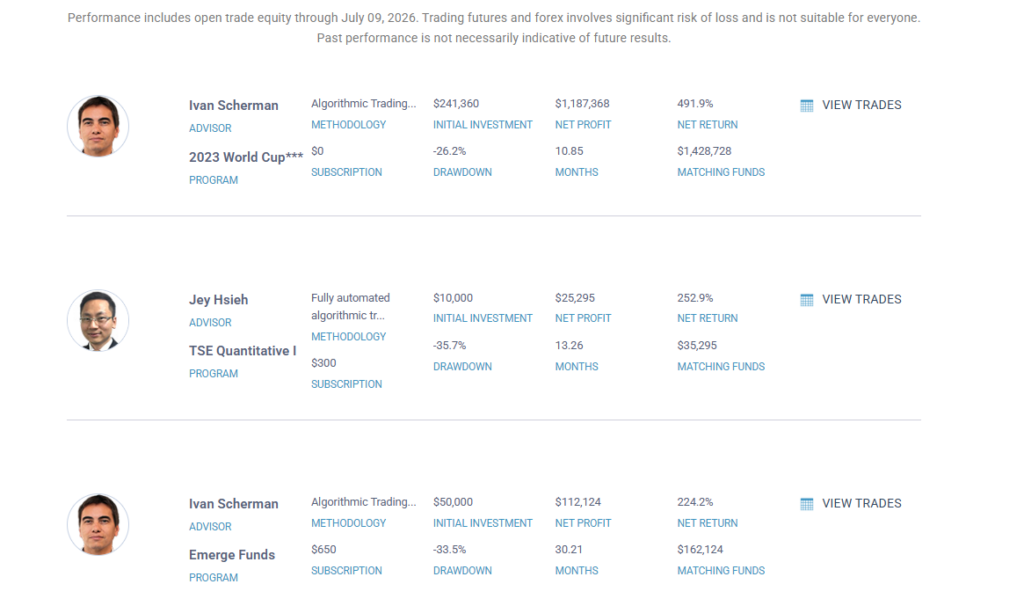

| Featured Program | Methodology | Net Return | Published Drawdown | Period |
|---|---|---|---|---|
| Ivan Scherman — 2023 World Cup | Algorithmic trading | 491.9% | 26.2% | 10.85 months |
| Jey Hsieh — TSE Quantitative I | Fully automated algorithmic trading | 252.9% | 35.7% | 13.26 months |
| Ivan Scherman — Emerge Funds | Algorithmic trading | 224.2% | 33.5% | 30.21 months |
| Daniele Sambataro — Momentum Selection | Systematic trend following and mean reversion | 202.2% | 36.17% | 40.8 months |
These are substantial published returns and should not be dismissed as poor trading, quite the opposite. The figures demonstrate that profitable professional systematic trading can still involve material drawdowns.
World Cup Advisor states that its published peak-to-valley drawdown represents the greatest cumulative percentage decline in month-end net equity during the life of the account. It also warns that followers may experience a larger percentage drawdown depending on their funding level, entry date, execution, and other factors.
The World Cup Trading Championships states that traders have participated in its events since 1983 and that competitors may use discretionary methods or computerized trading programs.
A profitable automated strategy can still be completely unsuitable for a tightly constrained prop account.
Performance figures are historical, may have changed since July 9, 2026 and should be independently verified before being relied upon for any trading decision.
Automated Drawdown Versus Prop-Account Drawdown
The published automated-system drawdowns in the examples range from approximately 26% to 36%.
By comparison, a hypothetical $50,000 prop account with a $2,000 maximum-loss allowance provides approximately 4% of the advertised account value as usable loss capacity.
| Published Drawdown | Compared with a 4% Loss Limit |
|---|---|
| 26.2% | Approximately 6.6 times the allowance |
| 35.7% | Approximately 8.9 times the allowance |
| 33.5% | Approximately 8.4 times the allowance |
| 36.17% | Approximately 9 times the allowance |
This does not mean the professional strategies are bad.
It means they were not necessarily designed for an environment in which a relatively small peak-to-trough movement can terminate the account.
To fit a strategy with a historical 30% drawdown inside a 4% maximum-loss allowance, the position size would normally have to be reduced substantially and an additional safety margin would still be required.
Reducing position size also reduces expected monetary returns. Trailing-drawdown mechanics may create additional path-dependent risk that cannot be solved by position sizing alone.
Return Without Drawdown Is Only Half the Story
Retail marketing frequently concentrates attention on:
- Percentage returns.
- Profit screenshots.
- Winning months.
- Smooth backtested equity curves.
- High win rates.
- Short prop-evaluation passes.
A percentage return has little meaning without understanding the risk, capital and time required to produce it.
A strategy producing a 100% return with a 35% drawdown might be acceptable to one properly capitalized investor and completely unusable for a prop trader with a 4% maximum-loss allowance.
The most important question is not:
“How much did the robot make?”
More useful questions include:
- What maximum drawdown did the system experience?
- How was the drawdown calculated?
- Did it include real-time open equity or only closed trades?
- How long did recovery take?
- What happened during unfavorable market phases?
- What was the longest losing sequence?
- How much capital and margin were required?
- Would the system survive the intended prop-firm rules?
- How frequently must it be reviewed, paused or reoptimized?
- Could the operator financially and psychologically continue trading it?
A strategy can eventually recover and still destroy a prop account long before that recovery occurs.
Why Trailing Drawdown Can Be Especially Dangerous
A trailing drawdown may move upward as the account reaches new equity highs.
Depending on the firm’s rules, the threshold may be calculated using the closed balance, end-of-day balance or intraday unrealized equity.
Under an intraday trailing model, a trade can move strongly into profit, raise the drawdown threshold, retrace and then fail the account even if the original trade would ultimately have closed profitably.
A robot designed around normal live-account fluctuations may therefore be unsuitable unless it has been developed and tested specifically around the exact drawdown mechanics of the intended account.
The system must not merely produce an eventual net profit. It must survive every step of the equity path required to reach that profit.
Prop-Firm Rules Can Restrict Professional Diversification
Professional systematic traders may reduce portfolio risk by combining multiple models, markets, parameter sets, timeframes and directional biases.
A prop firm may restrict or impose conditions on practices such as:
- Fully unattended automated trading.
- Account-copying technology.
- Replicating identical trades across multiple accounts.
- Holding opposing positions.
- Hedging between related accounts or instruments.
- Using different long-only and short-only models across allocations.
- Trading during specified news events.
- Holding positions outside permitted sessions.
- Using third-party signals or shared systems.
These restrictions can prevent an automated trader from using the diversification normally required to operate a robust systematic portfolio.
The trader may instead be forced to run one concentrated strategy inside a very small drawdown allowance.
Rules vary between firms, account types, and trading platforms, and they may change. Traders must verify the current policy before using automation, multiple accounts, hedging, opposing positions, trade copiers, or third-party technology.
What Fully Automated Prop Trading Would Require
A trader considering fully automated trading on prop accounts should realistically expect to need:
- A prop firm that expressly permits the intended form of automation.
- A system developed around the firm’s exact drawdown rules.
- Position sizing small enough to accommodate historical and unseen drawdowns.
- A substantial safety buffer above the official loss threshold.
- Accurate modeling of commissions, slippage, and rejected orders.
- Controls for internet, platform, data-feed, and server failures.
- Emergency shutdown and daily-loss controls.
- Continuous performance monitoring.
- A process for pausing, reviewing, and restarting systems.
- Potentially several complementary systems rather than one robot.
- Enough capital to tolerate failed evaluations and account resets.
- Extensive forward testing under realistic execution conditions.
- Extensive effort and time, monitoring, and hours spent on R&D
The strategy would need to perform materially better on a risk-adjusted basis than many professionally operated systems while remaining inside a much smaller drawdown envelope.
That is an exceptionally demanding objective.
Why the Failure Risk Can Be Extremely High
A generic automated strategy placed onto a typical, tightly constrained prop account without specific adaptation faces a high probability of breaching the account rules.
The risk increases when:
- The strategy has not been designed for the account’s drawdown calculation.
- The trader relies on one robot and one market.
- The historical drawdown is close to the account’s entire loss allowance.
- The system begins with a losing sequence.
- The trader uses excessive contract size to pursue rapid payouts.
- The system trades through unsuitable volatility or news conditions.
- The operator cannot intervene when execution or technology fails.
- The trader repeatedly stops systems after losses and restarts them after profits.
It would be misleading to assign a universal percentage to the probability of failure because the result depends on the strategy, position sizing, prop-firm rules and market conditions.
However, when an automated strategy with double-digit drawdown expectations is forced into an account offering only a small single-digit loss allowance, the structural risk of failure can become extremely high.
Why ATS Prefers Hybrid Algo Trading for Prop Accounts
ATS does not believe that automation is bad. ATS develops and uses algorithmic trading technology extensively.
The distinction is between using automation as a professional tool and expecting one unattended robot to replace the trader completely.
Hybrid algo trading combines:
- Algorithmic market analysis.
- Automated or assisted entries.
- Automated trade management.
- AI-supported market context.
- Human control over risk and participation.
- The ability to pause, reduce or adapt when conditions change.
This man-and-machine approach allows the trader to benefit from speed, consistency and structured execution while retaining control over conditions that are difficult to model reliably.
For tightly constrained prop accounts, the ability to decline a trade, reduce exposure, stop for the session or intervene during abnormal conditions can be more valuable than attempting to automate every decision.
Conclusion
- Fully automated algo trading is not a shortcut to effortless prop-firm payouts, regardless of the hype promoted online or within trading groups.
- A robot may perform well for a period without breaching the account rules, but every trading system will eventually experience losing trades, unfavorable market phases and drawdowns.
- Credible automated trading generally requires significant research, suitable capital, sufficient drawdown capacity, ongoing monitoring, diversification and a professional operating process. These requirements can be extremely difficult to accommodate within a prop account offering only a 2% to 5% effective drawdown allowance.
- A system can be profitable over the long term and still fail a prop account during an ordinary losing sequence. The central question is not whether the robot eventually makes money, but whether it can survive the restrictive path between activation and that eventual profit.
- A retail trader must realistically ask whether they can produce better risk-adjusted results than experienced systematic traders while operating within substantially tighter drawdown constraints. For most traders, the answer is likely to be no.
- An ATS robot could potentially be operated successfully by a highly skilled, properly capitalized trader within a suitable brokerage environment, particularly when the operator understands the system and uses the hybrid controls. That does not mean the same system can reliably survive the restrictive rules of a typical retail prop account.
- When fully automated trading is permitted, the risk of an eventual rule breach can remain extremely high unless the system, position sizing, account structure and operating process have been designed specifically for that prop-firm environment.
- Developing such a system would require extensive experimentation, testing, monitoring, time and ongoing refinement. ATS does not provide an off-the-shelf, ready-to-trade robot that can be expected to operate indefinitely within such restrictive drawdown rules.
- A robot may experience a profitable run before eventually breaching the account rules, but that does not make the approach reliable or sustainable. When the drawdown allowance is extremely small, the long-term probability of failure can become unacceptably high.
- These limitations explain why ATS uses a more practical hybrid trading system and methodology rather than promoting fully unattended automation as a dependable solution for prop-firm accounts.
A prop account does not give the robot room to be eventually right. It must remain within the rules at every stage of the journey.
What Is a More Viable Trading Solution for a Prop-Firm Account?
For many retail futures traders, a structured hybrid approach offers a more realistic pathway by combining automation, AI intelligence and human risk control instead of relying on a single unattended black-box system.