Fully Automated Trading Prop Firm Accounts: How to Progress from Hybrid to Full Automation
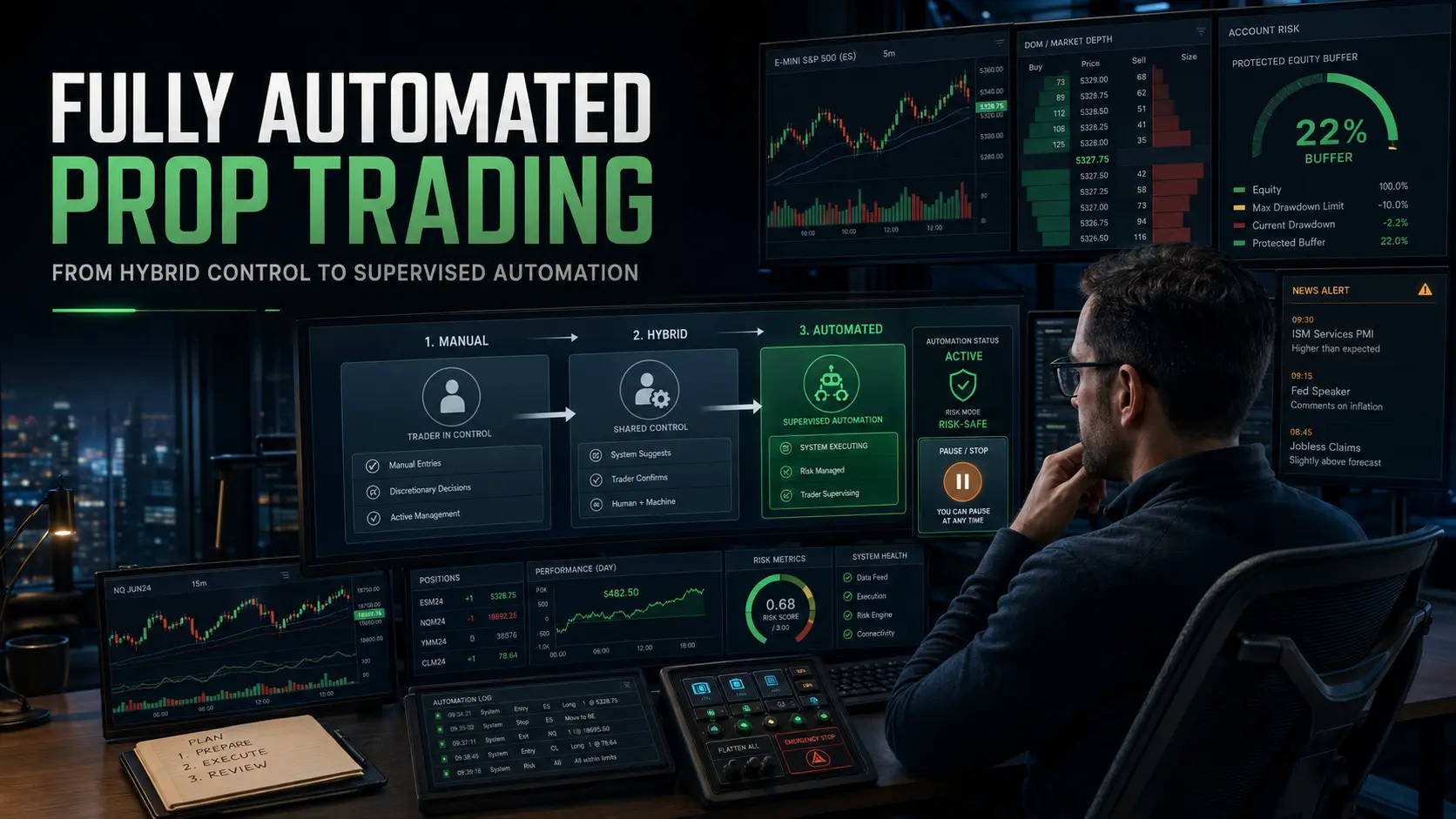
Fully automated trading for prop firm accounts is possible with Algo Futures Trader (AFT), but the professional pathway is not to activate a universal trading robot and hope it survives. The safer and more adaptable approach is to begin with Hybrid Algo Trading, validate each element of the trading process and progressively increase automation until you reach the level appropriate for your prop firm, account rules, instrument and risk tolerance.
Can ATS Be Used for Fully Automated Prop-Firm Trading?
Yes. ATS provides purpose-built automated systems and risk controls for prop-firm evaluations, simulated-funded accounts, funded accounts and live brokerage trading. However, every deployment must be configured around the selected prop firm, account type, drawdown allowance, consistency rules, permitted automation, instrument, position size and trading session.
The objective is not uncontrolled set-and-forget trading. A professionally operated AFT system may automate approximately 90% to 95% of the practical trading process while retaining the operator controls needed to pause, restrict or exit trading when market or account conditions become unsuitable.
Automation should be earned in small, measurable steps. Begin with Hybrid Algo Trading and increase automation only after each stage has been tested, understood and validated.
Why Prop-Firm Accounts Require a Different Approach
A prop account may advertise a large nominal account size, but the amount that matters is the permitted drawdown. In practical risk terms, the drawdown allowance is the real account.
A trading system can be profitable over a long period and still breach a prop-firm account during an ordinary losing sequence. Trailing drawdown, daily loss limits, consistency rules, restricted trading periods and maximum contract limits can prevent a system from remaining active long enough for its statistical edge to develop.
Successful automated prop-firm trading therefore requires more than profitable signals. It requires a complete operating framework covering:
- Prop-firm rules and permitted automation.
- Maximum daily and total account risk.
- Position sizing and contract limits.
- Expected and worst observed drawdown.
- Trading-session and instrument selection.
- News, volatility and liquidity controls.
- Contract rollover procedures.
- Platform, connection and order monitoring.
- Clear pause, exit and emergency-stop rules.
The Progressive Path from Hybrid to Fully Automated Trading
Step 1: Define the Prop-Firm Operating Rules
Begin by documenting the exact rules for the intended evaluation or funded account. Confirm whether automated trading, trade copying and unattended operation are permitted. Record the drawdown calculation, daily loss limit, consistency requirement, maximum position size, restricted news periods and any rules covering overnight or weekend positions.
Prop-firm policies can change, so these conditions should be verified directly with the firm before deployment and reviewed regularly.
Step 2: Start with an Official ATS Baseline
AFT provides turnkey systems and official baseline settings that can be assessed in Simulation, Market Replay and walk-forward operation. ATS automated Workspace 5 includes baseline models such as DSFG USAR, DSFG USAR GAP and WSFG USAR.
A baseline is a professional starting point, not a guaranteed universal configuration. It must be measured against the intended instrument, session, account rules and current market phase before it is considered for prop-firm deployment.
Step 3: Use Manual Entry with Automated Trade Management
The first practical stage is normally manual trade permission combined with automated order and exit management. The trader decides whether the setup and market conditions are suitable, while AFT controls the stop loss, profit targets, partial exits, trailing logic and other repetitive trade-management tasks.
This stage allows the trader to learn the signals and observe how the system behaves without surrendering control of trade selection.
Step 4: Progress to Hybrid Automated Entry and Exit
Once the trader understands the system, automated entry can be introduced under controlled conditions. The operator can enable long-only, short-only or two-way trading according to market direction, session structure and higher-timeframe bias.
AFT handles execution with machine speed and consistency, while the trader retains authority over when the system is permitted to trade. This removes much of the emotional and mechanical workload without removing human adaptability.
Step 5: Add Multi-Timeframe and Market-Context Controls
The next stage combines AFT automation with multi-timeframe confirmation, AlphaWebTrader market intelligence and AI Copilot support. The system can manage individual trades automatically while the operator assesses the wider trading environment.
At this stage, the trader should maintain statistics for each instrument, direction, setup, session and market phase. Automation should only be increased when the measured results remain compatible with the prop account’s limited drawdown allowance.
Step 6: Build an Account Buffer Before Increasing Automation
A profitable evaluation or funded account should not automatically trigger larger position sizes or less supervision. The first priority is to build a buffer between the current account equity and the applicable breach threshold.
This buffer gives the system more capacity to absorb normal losing trades, slippage and changing market conditions. It does not make the account safe or eliminate the possibility of failure. The required buffer must be based on the firm’s rules, the system’s observed drawdown, the position size and the operator’s risk limits—not an arbitrary percentage or fixed dollar target.
Until a suitable buffer exists, the trader may choose to maintain smaller size, restrict trade frequency and continue using hybrid approval rather than enabling wider automated operation.
Step 7: Increase Automation One Control at a Time
Automation can now be expanded progressively. The operator might first automate entries during one defined session, then automate directional selection, trade limits or additional approved setups. Only one material change should be introduced at a time so its effect can be measured.
If the equity curve, drawdown or execution begins to deviate materially from the validated baseline, automation should be reduced and the system returned to Simulation or hybrid control for review.
Step 8: Operate at 90% to 95% Automation with Human Oversight
The advanced objective is not necessarily 100% unattended trading. ATS can automate approximately 90% to 95% of the practical process while preserving a critical operator layer for market, account and technical risk.
The software can identify signals, place orders, manage positions, enforce trade limits and execute exits. The operator remains responsible for activating the correct system, confirming the market environment, supervising connectivity and intervening when conditions fall outside the validated operating plan.
When Should an Automated Prop Trading System Be Paused?
A fully automated futures trading system should not continue merely because the platform is running. The operator must be ready to pause new entries, reduce risk or exit positions when predefined conditions occur.
- Abnormal price skew: Price movement, volatility, spreads or liquidity no longer resemble the conditions used to validate the system.
- Major scheduled news: High-impact economic releases, central-bank decisions or other events can generate gaps, slippage and rapid reversals.
- Unexpected geopolitical news: Breaking geopolitical developments can change correlations, liquidity and directional behavior without warning.
- Exchange holidays: Shortened sessions and reduced participation can produce irregular volume and price action.
- Contract rollovers: Volume migration between futures contracts can affect liquidity, indicators, signals and execution.
- Technical events: Data interruptions, connection instability, platform problems, rejected orders or account synchronization errors require immediate attention.
- Risk-limit proximity: Automation should be restricted or stopped before the account reaches its daily or total loss boundary.
- Equity-curve deviation: Results that move materially outside the expected range may indicate a changed market phase, configuration problem or declining system edge.
Price-skew alerts, news intelligence and automated risk controls help identify these conditions, but the operator remains responsible for the final decision to continue, pause or exit.
Hybrid Algo Trading Is the Fastest Route to Higher Automation
It may appear faster to begin with full automation, but traders often progress more effectively by learning the system through controlled Hybrid Algo Trading. This reveals how signals, entries, exits and risk controls interact in live market conditions before the account depends on them completely.
The ATS model combines three complementary strengths:
- Trader judgment: Determines market suitability, direction, risk and permission to trade.
- AFT machine execution: Provides speed, precision, consistency and emotion-free order management.
- AI Copilot intelligence: Supports analysis of market context, alerts, news, risk conditions and operating decisions.
Automation can then be increased according to demonstrated competence and measured results. Some traders may remain at 50% to 80% automation because that provides their preferred balance of control and efficiency. Others may progress toward 90% to 95% automation with active supervision.
A Practical Automated Prop-Firm Trading Checklist
- Confirm that the prop firm permits the intended form of automation.
- Calculate the effective drawdown allowance rather than relying on the advertised account size.
- Select one instrument, one trading session and one official ATS baseline.
- Configure daily loss, position-size, trade-frequency and account-level limits.
- Test in Simulation, Market Replay and walk-forward market conditions.
- Begin with manual permission and automated trade management.
- Introduce automated entries only after understanding the signals and exits.
- Measure win rate, risk-reward, drawdown, losing sequences, slippage and equity-curve deviation.
- Use conservative size when progressing into an evaluation or funded account.
- Build an account buffer before expanding position size or automation.
- Define rules for price skew, news, geopolitical events, holidays and rollovers.
- Monitor platform, connection, orders and account synchronization.
- Pause or reduce automation whenever results move outside the validated operating range.
Frequently Asked Questions
Can AFT trade a prop-firm account automatically?
Yes. AFT supports automated entry, automated trade management and fully automated trading modes. The configuration must match the selected prop firm’s rules, instrument, account limits and permitted automation conditions.
Is fully automated prop trading completely unattended?
It should not be treated as unattended set-and-forget trading. ATS may automate approximately 90% to 95% of the practical process, but an operator should remain available to supervise risk, news, market conditions, contract rollovers and technical events.
Should I begin with fully automated trading?
The preferred ATS pathway is to begin with Hybrid Algo Trading and increase automation through small, measurable steps. This allows you to understand the system, establish your own statistics and identify problems before they threaten a prop account.
How large should the prop-account buffer be?
There is no universal figure. The required buffer depends on the prop firm’s rules, the system’s observed drawdown, position size, trade frequency and the trader’s risk limits. A buffer reduces immediate pressure but cannot guarantee that an account will survive future losses.
Can automation guarantee an evaluation pass or payout?
No. Automated and hybrid trading systems can lose money, and no software can guarantee an evaluation pass, funded account or payout. Results depend on market conditions, system configuration, risk control, execution and operator decisions.
How to Get Started with Automated Prop-Firm Trading
The most adaptable route is to start with AFT turnkey workspaces, learn the ATS Hybrid Algo Trading Methodology and progressively increase automation as your experience, statistics and account buffer develop.
Review the complete answer to Can ATS be used for fully automated prop-firm trading?, or explore the ATS trading pathways for assisted onboarding, full-featured AFT access, Zero-to-Hero orientation and the tools required to develop your own hybrid or automated prop-firm trading operation.