NinjaTrader Automated Trading by Algo Futures Trader

hybrid algorithmic automated futures trading for prop firm traders, day & swing traders

  • 🚀Get Started
  • NinjaTrader
  • Get Funded
  • Trading Servers
  • Pricing
  • blog
  • Help

Dispelling Prop Trading Myths and Misleading Funded-Account Claims

July 11, 2026 by AFT

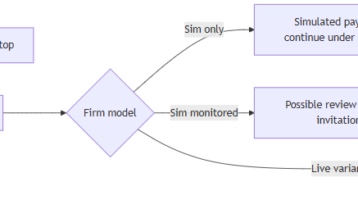
Prop Firm Trading Account Path Ways
Prop-firm trading can provide a lower-cost route into futures trading, but the opportunity is frequently misunderstood. Advertised account sizes, simulated funding, account copying, automation and payout claims can create a very different impression from the practical reality.This article examines the most common futures prop-trading myths and explains why traders must understand the firm’s real risk allowance, live-transition policy, payout rules, permitted trading practices and account restrictions before purchasing an evaluation.

Prop-firm rules vary significantly and can change without notice. The examples below are based on publicly available firm policies reviewed in July 2026. Traders must always read the latest rules for their chosen firm, account type and trading platform.

Myth 1: The Advertised Prop-Account Size Is Real Trading Capital

A headline account size such as $50,000, $100,000 or $150,000 does not normally represent the amount of capital a trader can lose. In an evaluation or simulated-funded account, the advertised figure generally represents notional buying power and the contract limits associated with the account.

The trader’s practical risk capital is much closer to the maximum permitted drawdown.

Advertised Account SizeExample Maximum Loss LimitLoss Allowance as a Percentage of Headline Size
$50,000$2,0004%
$100,000$3,0003%
$150,000$4,5003%

Topstep, for example, states that its $50K, $100K and $150K accounts carry maximum loss limits of $2,000, $3,000 and $4,500 respectively. It also explains that an Express Funded Account starts with a balance of $0 and that the headline account size refers to buying power rather than starting cash.

Therefore, a trader claiming to control twenty $100,000 accounts may describe this as $2 million in funding, but the combined nominal loss allowance could be closer to $60,000 before allowing for trailing drawdown movement, commissions, slippage, previous losses, payout withdrawals and the safety buffer required to avoid account closure.

Twenty accounts labelled $100,000 are not economically equivalent to a $2 million brokerage account containing $2 million of real, loss-bearing capital.

The Real Prop Account

The practical account should be viewed as:

Permitted drawdown minus commissions, slippage, accumulated losses, withdrawal effects and a safety buffer.

The headline account size may determine buying power and maximum contracts, but the drawdown determines how much adverse movement the trader can survive.

Myth 2: More Accounts Automatically Mean Less Risk

Multiple accounts can increase potential payouts, but they can also multiply operational risk, platform risk, copier risk and the financial cost of failed evaluations or account activations.

If one poor decision is copied across twenty accounts, the trader has not diversified the risk. The trader has multiplied the same concentrated decision twenty times.

Real diversification normally requires differences in instruments, strategies, time horizons, market phases or risk exposures. Repeating the same Nasdaq trade across many accounts is account replication, not strategy diversification.

Some firms also prohibit account stacking, coordinated trading, cross-account hedging or repeatedly taking oversized risks across a sequence of accounts. Topstep’s published prohibited-conduct policy includes account stacking, coordinated trading and cross-account hedging among the practices that can result in warnings, payout denial, resets or account closure.

Myth 3: A Fully Mechanical Trading System Can Be Switched On and Left to Survive Every Prop-Firm Rule

Some prop firms permit automated strategies, but permission to use automation is not the same as confirmation that every automated strategy is suitable for the firm’s rules.

Topstep currently permits automated strategies with conditions, but states that it will not configure or troubleshoot them and will not make exceptions for erroneous trades or system malfunctions. Its live-account policy also prohibits automated trading through certain APIs.

MyFundedFutures permits automated strategies using the trader’s own settings, but prohibits high-frequency methods and systems designed to exploit favourable simulated fills. It also requires automated trading in live accounts to comply with CME guidelines.

A mechanical system may be technically permitted and still fail because it does not account adequately for:

  • Trailing or real-time drawdown movement
  • Daily loss limits
  • Maximum position-size rules
  • Consistency requirements
  • News-trading restrictions
  • Changes in liquidity and volatility
  • Simulated fills that cannot be reproduced live
  • Slippage during fast markets
  • Connection, platform or data-feed failures
  • Contract rollover and trading-session changes
  • Payout withdrawals that reduce the remaining account buffer

A fully automated system does not understand that the trader is close to a payout, that a withdrawal has reduced the safety buffer or that the current market is unsuitable unless these conditions have been explicitly designed, coded, tested and maintained.

Automation can improve consistency, but unattended automation can also repeat the same mistake faster and across more accounts.

Myth 4: Profits Produced in Simulation Will Transfer Directly to Live Trading

Simulated trading can provide valuable practice, but simulated execution is not identical to live-market execution.

Topstep specifically prohibits strategies designed to exploit unrealistic simulator behaviour, including rapid scalping algorithms, preferential simulated queue positions, improbable fills in gapped markets, unrealistic stop execution and extremely tight brackets that depend on favourable simulated fills.

MyFundedFutures similarly warns that some strategies can perform well in simulation but produce losses when transferred to live markets because they depend on simulated fill behaviour, minimal slippage or ideal execution.

A strategy should therefore be assessed on more than its simulated net profit. Traders should examine:

  • Average trade duration
  • Average profit per trade after commissions
  • Expected live slippage
  • Maximum adverse excursion
  • Maximum consecutive losses
  • Performance during volatile and illiquid conditions
  • Dependence on limit-order queue position
  • Dependence on immediate stop or target execution

A strategy producing a very small average profit per trade may look excellent in simulation but become unviable after realistic live costs and slippage.

Myth 5: Traders Can Remain on Simulated-Funded Accounts Forever

Many traders assume they can continue collecting payouts from several simulated-funded accounts indefinitely without ever being moved to live capital.

That assumption is unsafe.

Topstep describes the simulated Express Funded Account as a proving ground for progression to a Live Funded Account. When its Risk Team determines that a trader is ready, the trader cannot decline the live invitation and remain in the Express Funded Account. All Express Funded Accounts are closed when the trader moves to one Live Funded Account.

MyFundedFutures similarly states that consistently profitable simulated-funded traders may be invited to a Live Funded Account, that the move cannot be rejected and that multiple simulated-funded accounts can be merged into one live account.

This does not mean every firm moves every trader live at the same time. It means traders should not build a business plan that depends on retaining a large collection of simulated-funded accounts permanently.

Simulated-funded payouts can be real money, but the account producing the result is still simulated until the firm specifically confirms that the trader has entered a live brokerage environment.

Myth 6: Multiple Accounts Can Always Be Mirrored After Moving to Live Trading

Trade copying may be permitted during evaluations or simulated-funded stages while being restricted or unavailable in live trading.

Topstep allows its platform trade copier across Trading Combine and Express Funded Accounts, but states that its Live Funded Account cannot use the copier. It also limits traders to one active Live Funded Account and closes their Express Funded Accounts when they move live.

MyFundedFutures states that multiple simulated-funded accounts may be merged into one Live Funded Account.

Therefore, a trader should not assume that ten or twenty mirrored simulated accounts will remain ten or twenty mirrored accounts after a live transition.

Before purchasing multiple accounts, obtain clear answers to the following questions:

  • Can the accounts be copied during the evaluation?
  • Can they be copied during the simulated-funded stage?
  • Can they still be copied after moving live?
  • Will the firm merge the accounts into one live account?
  • Does the firm permit third-party trade-copying software?
  • Are cross-firm copying and coordinated trading permitted?
  • Who is responsible when one follower account receives a different fill?

Myth 7: Trade Copiers Remove Execution Risk

A trade copier reduces repetitive manual order entry, but it does not guarantee identical executions.

Follower accounts can receive different fill prices because of liquidity, slippage, processing delays, platform disconnections or differences in each account’s contract limit and risk settings. Topstep warns that follower fills can vary and that the copier may disconnect when account scaling levels differ or when risk limits are triggered.

The lead account may enter successfully while one or more follower accounts reject the order. Stops or targets can then become mismatched, leaving accounts with different positions.

Every copied account must therefore be monitored. A copier is an execution tool, not a transfer of responsibility.

Myth 8: Prop Firms Allow Traders to Follow Any Guru or Live Trade-Calling Group

There is an important difference between receiving market education and copying another trader’s live orders.

A trader may be able to attend an educational group that discusses market structure, risk, potential setups, economic news and trading methodology. However, blindly duplicating another person’s entries and exits may conflict with rules requiring independent trading activity.

Topstep prohibits coordinated trading performed in concert with other people and prohibits trading on behalf of others.

MyFundedFutures states that every trader must maintain individual trading activity and personally enter, exit and cancel trades. Its rules prohibit traders from copying one another. It also requires each account to be traded exclusively by its owner.

Attending a group is not necessarily the violation. The potential problem is surrendering the trading decision to a third party and reproducing coordinated trades without independent analysis or control.

A Safer Educational Model

A responsible trading group should help the trader understand:

  • The current market phase and higher-timeframe context
  • Important economic events and risk periods
  • Potential long and short scenarios
  • Correlation between related markets
  • Where a setup becomes invalid
  • How much risk is appropriate
  • When standing aside may be the best decision

The trader should remain responsible for deciding whether a setup is valid for the trader’s own account, rules, risk allowance and trading plan.

Myth 9: Passing an Evaluation Proves That a Trader Is Consistently Profitable

An evaluation pass demonstrates that a profit target was reached without breaching the required rules. It does not prove that the trader has a durable edge across different market conditions.

A trader can pass because of one strong market phase, one unusually profitable day, excessive risk or favourable simulated execution. This is why many firms apply consistency objectives, payout qualification periods, scaling plans and additional risk reviews after the evaluation.

Topstep, for example, applies consistency objectives during its evaluation and offers funded payout paths requiring qualifying winning days or a defined consistency percentage.

The more important test is whether the trader can protect the funded account, qualify for payouts repeatedly and adapt when the original market conditions change.

Myth 10: A High Win Rate Is the Key to Prop-Trading Success

A high win rate can be attractive, but it means little without understanding the size of the average win, average loss and maximum losing sequence.

A strategy that wins 85% of its trades but loses five times its normal profit on each losing trade may be less suitable than a strategy that wins 45% of its trades with well-controlled losses and larger average winners.

Prop accounts are especially vulnerable to strategies that accumulate many small wins before one oversized loss reaches the daily or maximum drawdown limit.

Important measurements include:

  • Average win compared with average loss
  • Maximum consecutive losses
  • Largest historical losing day
  • Expected drawdown
  • Profit factor after costs
  • Risk per trade as a percentage of the permitted drawdown
  • Probability of reaching the firm’s loss limit

The correct objective is not the highest possible win rate. It is a repeatable positive expectancy that can survive the prop firm’s loss limits.

Myth 11: Prop Trading Is Easier Than Trading a Personal Brokerage Account

Prop trading can reduce the trader’s initial capital requirement, but the trading process is often more restrictive.

A personal brokerage account does not normally impose a profit target, consistency percentage, minimum number of winning days, payout qualification window or simulated-to-live promotion process. The brokerage account remains subject to margin, leverage and liquidation risk, but the trader usually controls withdrawals and can decide how much capital to retain as a buffer.

A prop trader must manage the market while simultaneously managing another company’s account rules.

This can make prop trading operationally harder because the trader must satisfy:

  • A narrow maximum-loss allowance
  • Daily loss restrictions
  • Trailing drawdown calculations
  • Contract limits
  • Consistency requirements
  • Minimum trading-day requirements
  • Payout caps and withdrawal conditions
  • News and holding-time restrictions
  • Automation and copier policies
  • Live-transition decisions made by the firm

Futures trading is already highly leveraged. Adding a narrow prop-firm drawdown creates an additional failure boundary that may close the account before a strategy has enough time or capital to recover from a statistically normal losing period.

Myth 12: The Statement That “95% of Prop Traders Fail” Is a Verified Universal Statistic

The frequently repeated 90% or 95% failure claim is not a single independently audited statistic covering every prop firm, account type, country and period.

Actual results depend on how failure is defined. A trader may fail an evaluation, pass but never receive a payout, receive one payout and later lose the account, or remain funded without achieving a positive return after fees.

Business Insider reported company-provided Topstep figures indicating that 12.4% of traders obtained funding in 2024 and that 28.3% of those funded traders received a payout. The figures illustrate substantial attrition, but they should not be treated as a universal audited result for the entire prop-trading industry.

Topstep also states that more than 63% of traders who lost an account did so in a single trading day, highlighting the importance of daily risk control.

Why So Many Prop Traders Struggle

  • They trade the headline account size instead of the permitted drawdown.
  • They use the maximum available contracts too early.
  • They attempt to pass as quickly as possible.
  • They overtrade after small losses.
  • They rely on one market condition or one instrument.
  • They withdraw too much and leave no account buffer.
  • They repeatedly purchase new accounts instead of correcting the underlying behaviour.
  • They follow trade calls without developing independent decision-making skills.
  • They use automation that was not designed around the firm’s exact rules.
  • They underestimate the difference between simulated and live execution.

Other Common Prop-Trading Delusions

“The Maximum Contract Limit Is the Recommended Position Size”

The maximum contract limit is an absolute ceiling, not a recommendation. Trading the maximum size can expose a narrow drawdown allowance to a very small adverse market movement.

“A Payout Means I Have Mastered Trading”

A payout is an achievement, but one payout does not prove long-term consistency. Market phases change, and a method that performed well during one month can enter a prolonged drawdown later.

“I Am Not Risking My Own Money”

The trader may not be liable for the firm’s market loss, but evaluation fees, activation fees, resets, data charges, platform costs and the trader’s time are personal economic risks.

“I Can Withdraw Every Available Dollar”

A large withdrawal can leave the account with little room for normal drawdown. MyFundedFutures advises traders to retain a reasonable buffer rather than withdrawing all available profits.

“The Rules Will Stay the Same”

Prop firms can modify account structures, payout policies, live-transition rules, platform availability and prohibited practices. A strategy built around one rulebook must be reviewed whenever the firm changes its terms.

“A Bigger Account Is Always Better”

A larger headline account may permit more contracts, but it may also have a higher profit target and encourage excessive position sizing. The best account is the one whose drawdown and contract structure match the trader’s tested risk model.

Pure Discretionary Trading, Full Automation, Guru Following and ATS Hybrid Algo Trading

ApproachPotential StrengthsPrimary Weaknesses
Pure Discretionary TradingFlexible, responsive and able to interpret unusual market conditionsVulnerable to hesitation, impulsive entries, revenge trading, inconsistent exits and emotional position sizing
Fully Automated TradingConsistent execution, repeatable rules and reduced hesitationCan continue trading in unsuitable conditions, repeat faults rapidly and breach firm rules when unattended, 99% guaranteed to have a drawdown that breaches 5% to 10%, the the worst way to trade prop firm rules.
Guru Calls or Trade FollowingCan provide education, market ideas and exposure to experienced analysisCreates dependency, delayed entries, mismatched risk and potential conflicts with independent-trading or coordinated-trading policies
ATS Hybrid Algo TradingMan and machine, best flexibility and control, doenst go out of date and is geared towards delivery of the maximum profit, minimum drawdown, and least emotion.Still requires training, active supervision, discipline, and the trader’s independent decisions
 

A Practical Prop-Trader Due-Diligence Checklist

  1. Convert the advertised account size into its actual maximum-loss allowance.
  2. Calculate risk per trade as a percentage of the drawdown, not the headline balance.
  3. Read the latest evaluation, funded, payout and live-account rules separately.
  4. Confirm whether automated strategies are allowed on the chosen platform.
  5. Confirm whether a trade copier is permitted in evaluation, simulated-funded and live stages.
  6. Ask what happens to multiple accounts when the trader is promoted to live capital.
  7. Confirm whether live trade calls, coordinated trading or third-party copying are prohibited.
  8. Understand how withdrawals affect the remaining loss buffer.
  9. Use a personal daily-loss limit below the firm’s maximum threshold.
  10. Allow for commissions, slippage and rejected orders in all testing.
  11. Keep records of trades, screenshots, statistics and rule changes.
  12. Use independent judgment and remain responsible for every order placed.

Conclusion: Prop Trading Is a Risk-Control Challenge, Not a Shortcut

Prop firms can provide a valuable route for disciplined traders to access futures buying power and pursue payouts without depositing the capital required for a comparable personal brokerage account.

However, the opportunity should not be confused with receiving the advertised account balance as personal risk capital. The trader is operating inside a narrow loss allowance, under a detailed rulebook, with the possibility of simulated-to-live transition, account consolidation, copier restrictions and payout conditions.

Pure discretionary trading can be affected by emotion and inconsistent execution. Fully unattended automation can continue trading when conditions or account rules require intervention. Guru trade following can create dependency and may conflict with independent-trading requirements.

ATS Hybrid Algo Trading offers a more practical middle path: the trader controls context, direction and risk while technology supports disciplined execution, trade management and reduced emotional interference.

The objective is not to switch on a robot or copy another trader. The objective is to become a capable, independently responsible hybrid trader who can use technology without surrendering control.

Book a Free ATS Discovery Meeting to discuss your prop-trading goals, current experience and the most suitable ATS self-assisted or Fast Track pathway.

Risk Disclosure

Futures and prop-firm trading involve a significant risk of loss and are not suitable for every trader. Evaluations, funded accounts, payouts and live-account transitions are subject to each firm’s current terms and risk policies. Past or simulated performance does not guarantee future results. ATS products, services, technology, education and market information do ot guarantee profits, evaluation passes, funded accounts or payouts.

Filed Under: prop firm trading Tagged With: Account Mirroring, algo futures trader, Algorithmic Futures Trading, ATS Hybrid Trading, automated trading, Daily Loss Limits, discretionary trading, Fully Automated Trading, Funded Account Drawdown, Funded Trading Accounts, futures prop firms, Futures Trading Automation, Guru Trading Groups, hybrid algo trading, Independent Trading, Live Funded Trading, Live Trade Calls, Prop Firm Evaluations, Prop Firm Payouts, Prop Firm Rules, prop firm trading, Prop Trader Education, prop trading, Prop Trading Myths, Prop Trading Risk Management, Simulated Funded Accounts, Trade Copier Risk, Trade Copying, Trading Consistency Rules, Trailing Drawdown


🚀 Get Started 100% FREE!

Does Trading 20 × $100K Prop Accounts Really Mean You Have $2 Million in Funding?

July 11, 2026 by AFT

Prop-firm marketing often encourages traders to add together the advertised size of multiple accounts. Twenty $100,000 accounts may therefore be described as “$2 million in funded accounts.” The arithmetic is technically correct, but the conclusion can be highly misleading.

The trader does not normally receive $2 million in cash, does not own $2 million of equity and cannot lose anything close to $2 million. The amount that actually determines whether the accounts survive is the combined maximum-loss allowance.

The Advertised Prop-Account Size Is Not the Real Risk Capital

A nominal $50,000, $100,000 or $150,000 prop account does not normally provide that amount as capital available to lose. The headline number is principally an account classification used to determine buying power, contract limits, profit targets, drawdown limits and fees.

The practical risk budget is the maximum drawdown permitted under the account rules.

For example, current official rules from several futures prop firms show maximum-loss limits of approximately $2,000 on many $50K accounts, $3,000 on many $100K accounts and between $4,000 and $4,500 on many $150K accounts. The precise amount and the way it is calculated vary by firm and account plan.

This means that a $100,000 account with a $3,000 maximum-loss allowance provides approximately 3% of its advertised account size as initial loss capacity. A $150,000 account with a $4,500 maximum-loss allowance provides approximately 3%.

The real account is not the number printed in the account name. The real account is the drawdown allowance the trader must protect and survive.

What 20 × $100K Accounts Actually Represent

Twenty accounts carrying a $100,000 label produce a combined headline value of $2,000,000:

20 × $100,000 = $2,000,000 advertised account value.

However, when each account has a $3,000 maximum-loss limit, the combined theoretical loss allowance is:

20 × $3,000 = $60,000 combined maximum drawdown.

The trader therefore controls twenty separate $3,000 risk envelopes rather than one unrestricted $2 million trading account.

Expressed as a percentage, the total initial drawdown allowance is only 3% of the $2 million headline figure:

$60,000 á $2,000,000 = 3%.

DescriptionHeadline AmountMaximum-Loss Allowance
One $100K prop account$100,000Approximately $3,000
Five $100K prop accounts$500,000Approximately $15,000
Ten $100K prop accounts$1,000,000Approximately $30,000
Twenty $100K prop accounts$2,000,000Approximately $60,000

One major futures prop firm currently permits traders to hold as many as 20 Performance Accounts, but it also states that these accounts are simulated-funded accounts. Its current $100K Performance Account carries a $3,000 maximum drawdown rather than $100,000 of trader-owned loss capital.

The Practical Risk Budget Is Usually Smaller Than $60,000

Even the combined $60,000 figure should not be treated as money that can be freely risked. A trader who repeatedly approaches the maximum drawdown is likely to lose the accounts.

A professional operating buffer must normally be deducted for:

  • Commissions and exchange fees.
  • Slippage and differences between expected and actual fills.
  • Unrealized losses included in intraday drawdown calculations.
  • Trailing drawdown movement after new equity highs.
  • Daily-loss limits that may stop trading before the maximum drawdown is reached.
  • Position-size and scaling restrictions.
  • Platform, copier, connection and order-routing risk.
  • Small differences in fills between copied accounts.

For example, maintaining a $500 safety buffer in each of twenty accounts would reduce the practical combined strategy budget from $60,000 to approximately $50,000:

20 × ($3,000 − $500) = $50,000 practical buffered risk capacity.

A more conservative trader may operate with an even larger reserve and use only a limited portion of the remaining allowance as active trading risk.

Twenty Copied Accounts Do Not Provide Twenty Independent Strategies

When the same order is copied across all twenty accounts, the accounts are highly correlated. They may be separate account numbers, but they are usually exposed to the same market, direction, entry, stop, volatility and execution risk.

A $150 loss copied across twenty accounts produces a combined loss of $3,000. A $500 loss copied across twenty accounts produces a combined loss of $10,000.

This multiplication works in both directions. Account copying can multiply profitable trades, but it also multiplies errors, slippage, oversized positions, platform failures and rule breaches.

Twenty correlated accounts should therefore not be described in the same way as a diversified $2 million institutional portfolio containing multiple independent strategies and uncorrelated asset streams.

Typical Prop-Firm Rules That Reduce Usable Capital

Prop firms use different account structures, but traders commonly need to manage several layers of rules simultaneously.

Maximum Drawdown

This is the total amount the account may lose before it fails or closes. The drawdown may be fixed, calculated at the end of the day or trailed behind the highest account balance.

Intraday Trailing Drawdown

An intraday trailing threshold can move upward when the account reaches a new equity high, including unrealized profit. It does not normally move back down when the trade retraces. Touching the threshold can result in immediate liquidation and account closure.

Daily-Loss Limit

A daily-loss limit restricts how much may be lost during one trading session. Depending on the firm, reaching it may pause the account for the remainder of the session or contribute to an account breach. Some firms use fixed daily limits, while others scale the daily limit according to account profits.

Position and Scaling Limits

The headline account size does not automatically permit maximum position size from the first day. Some plans begin with reduced contract limits and increase them only after the account reaches specified profit or safety thresholds.

Consistency and Payout Rules

A trader may be profitable but still be ineligible for a payout because of minimum trading days, safety-net requirements, consistency percentages, payout caps or minimum account-balance rules. For example, some current Apex payout plans require the trader to maintain the drawdown amount plus an additional $100 safety net before profit becomes eligible for withdrawal.

Trading-Conduct Rules

News trading, overnight positions, prohibited strategies, hedging, correlated instruments, account sharing, inactivity and copy-trading practices may also be restricted. The exact terms must be checked for the specific firm, account type, platform and payout plan.

A More Accurate Way to Describe Prop-Firm Funding

Instead of saying, “I trade $2 million,” a more accurate description would be:

“I operate twenty simulated-funded $100K prop accounts with approximately $3,000 of maximum drawdown per account, providing about $60,000 of combined theoretical loss capacity before safety buffers and additional account rules.”

This wording separates four different concepts that should never be confused:

  • Headline account value: The number used in the account name.
  • Buying power: The futures exposure permitted by the contract limit.
  • Maximum drawdown: The loss threshold that determines account survival.
  • Trader-owned capital: Cash that legally belongs to the trader.

A prop trader may control substantial futures exposure through leverage, but substantial exposure is not the same as substantial capital. Greater buying power can increase both profit potential and the speed at which a relatively small drawdown allowance is breached.

How a $100K Prop Account Compares with a $100K Live Brokerage Account

A $100,000 prop account and a $100,000 live brokerage account may carry the same headline number, but they represent completely different amounts of real capital and risk capacity.

In a live brokerage account, the $100,000 normally represents actual deposited account equity belonging to the trader, investor or fund. Futures margin determines how many contracts the account may hold, but margin is not the same as the account’s maximum permitted loss.

Futures margin is a performance bond required to open and maintain a position. Some brokers currently advertise intraday margins as low as $50 for selected Micro contracts and $500 for popular E-mini contracts, although exchange and overnight margin requirements can be substantially higher. CME currently provides estimated margins of approximately $2,504 for one Micro E-mini S&P 500 contract and $25,036 for one E-mini S&P 500 contract, with requirements subject to change.

Low intraday margin does not mean that trading the maximum possible number of contracts is responsible. It only describes the minimum collateral required by the broker. Position size should still be determined by account equity, stop distance, market volatility and the trader’s maximum acceptable drawdown.

Using a 35% Fund Drawdown Policy

For comparison, assume that a professional trader, private fund or account manager operates a real $100,000 brokerage account under an internal maximum-drawdown policy of 35%. This is an illustrative risk mandate rather than a universal brokerage or investment-fund rule.

Under this policy, the account would have:

  • $100,000 of actual account equity.
  • A maximum planned drawdown of $35,000.
  • A minimum protected-equity level of $65,000.
  • Contract capacity determined by broker margin requirements.
  • Position sizing determined by the manager’s risk controls.

The broker does not normally close the account simply because it declines by 3%, 5% or 10%, provided sufficient margin remains. The 35% drawdown limit would be imposed by the trader, fund mandate or investor agreement rather than being the advertised account structure.

Without such an internal control, a live account may lose more than 35%. The broker’s principal concern is whether the account continues to satisfy margin requirements, and positions may be liquidated if equity falls below the required level.

$100K Prop Account Versus $100K Live Account

Account Feature$100K Prop Account$100K Live Brokerage Account
Headline account size$100,000$100,000
Actual trader-owned equityNormally none of the advertised $100,000$100,000 of deposited equity
Example maximum drawdownApproximately $3,000$35,000 under an illustrative 35% fund policy
Protected equity remainingAccount fails near the drawdown thresholdApproximately $65,000 remains after a 35% drawdown
Contract capacitySet by the prop firm’s contract and scaling rulesSet by broker margin, available equity and internal risk limits
Ownership of capitalThe headline amount is not normally owned by the traderThe account equity belongs to the account owner
Control over withdrawalsSubject to payout rules, consistency requirements and account termsAvailable equity can normally be withdrawn subject to settlement and margin requirements

On this comparison, the $100,000 live account has approximately $35,000 of planned drawdown capacity. A $100,000 prop account with a $3,000 maximum-loss limit has only about one-eleventh of that amount:

$35,000 á $3,000 = approximately 11.7 times more drawdown capacity.

Comparing 20 × $100K Prop Accounts with Real Brokerage Capital

Twenty $100,000 prop accounts may be marketed or described as $2 million in funding, but with a $3,000 drawdown per account their combined theoretical loss allowance is only:

20 × $3,000 = $60,000.

A real brokerage account operating under the illustrative 35% maximum-drawdown policy would require approximately $171,429 of actual equity to provide the same $60,000 drawdown allowance:

$60,000 á 35% = approximately $171,429.

Therefore, twenty nominal $100K prop accounts with a combined headline value of $2 million may provide drawdown capacity comparable to approximately $171,429 of real brokerage equity under a 35% drawdown mandate—not $2 million of actual investment capital.

The comparison becomes even clearer when genuine $2 million live capital is considered. A real $2 million brokerage or fund account operating with a 35% maximum-drawdown policy would have:

$2,000,000 × 35% = $700,000 of planned drawdown capacity.

This is more than eleven times the $60,000 combined drawdown allowance provided by twenty prop accounts with a $3,000 loss limit each:

$700,000 á $60,000 = approximately 11.7 times greater drawdown capacity.

Margin Capacity Is Not Risk Capacity

A live futures account may technically be able to open a large number of contracts because of reduced intraday margin. However, margin capacity should never be confused with responsible risk capacity.

For example, a broker offering $500 intraday margin for an E-mini contract could theoretically provide substantial contract capacity on a $100,000 account. That does not mean the trader should use all available buying power. A relatively small adverse market movement across an oversized position could produce a severe loss long before the account’s cash balance is exhausted.

A professionally managed account normally maintains substantial excess margin and calculates position size from the amount at risk at the protective stop—not from the maximum number of contracts the broker allows.

The Correct Comparison

The appropriate comparison is not:

$100K prop account = $100K live brokerage account.

The more accurate comparison is:

Prop-account drawdown allowance versus live-account risk mandate.

A prop account’s headline value primarily describes its buying-power category and account rules. A live brokerage account’s balance represents actual equity. The futures contracts may be identical, but the capital structures are fundamentally different.

Twenty $100K prop accounts may display $2 million of nominal funding, but they do not provide the ownership, flexibility or risk capacity of a real $2 million brokerage account.

Futures margins, prop-firm rules and brokerage requirements can change without notice. A 35% maximum drawdown is used here only as an example of an internally imposed fund or account-management risk limit and should not be interpreted as a universal industry standard or recommended risk level.

The Bottom Line

Twenty $100K accounts may legitimately be described as $2 million in nominal prop-account size, but they do not provide $2 million of trader-owned or freely riskable capital.

With a $3,000 maximum loss per account, the initial combined drawdown allowance is approximately $60,000. After safety buffers, costs, trailing rules, daily-loss controls and operational risk are considered, the responsibly usable amount may be substantially lower.

The headline account value describes the package. The drawdown allowance describes the real risk account.

Prop-firm rules, account structures and payout terms change regularly. Traders should verify the current official rules for every account before trading or purchasing an evaluation. Trading futures involves a significant risk of loss, and no account size, technology or strategy guarantees profits or payouts.

Filed Under: prop firm trading Tagged With: Account Buying Power, Copy Trading, Funded Account Rules, Funded Trading Accounts, Futures Margin, futures prop firms, futures trading, Live Brokerage Accounts, Maximum Drawdown, Multi-Account Trading, Prop Account Drawdown, Prop Firm Myths, prop trading, trading capital, Trading Risk Management


🚀 Get Started 100% FREE!

Recent Posts

  • Automated Futures Trading: What Retail Traders Need to Know
  • Dispelling Prop Trading Myths and Misleading Funded-Account Claims
  • Does Trading 20 × $100K Prop Accounts Really Mean You Have $2 Million in Funding?
  • The Holy Grail Automated Trading Robot vs. How Automated Futures Trading Is Done Professionally
  • Just Give Me an Algo That Works
  • Facebook
  • RSS
  • Twitter
  • YouTube


  • NinjaTrader Automated Trading
  • automated futures trading
  • automated trading systems
  • Day Trading Futures
  • Get Started Day Trading Futures
  • VIP Trading Group Live Market Trade Along
  • Secret to Day trading futures success
  • AFT8 for NinjaTrader 8
  • Futures Algo Trading Systems
  • Market News
  • NinjaTrader Free Trading Platform
  • Legal Notices
  • AFT Legal Info
  • Terms
  • FULL RISK DISCLOSURE
  • Privacy Policy
  • Cookie Usage
  • About AlgoFuturesTrader
  • Connect to AFT
  • Blog
  • Videos
  • Support
  • Contact
  • My account
  • Sitemap
  • Affiliates

Ninja Futures Trading
Algo Futures Trader Copyright Algo Trading Systems© 2026 ¡
AlgoFuturesTrader.com is owned & operated by Algo Trading Systems LLC. By using this website or products & services, you are bound by our Terms & subject to US legal jurisdiction only. Errors & omissions excluded.
AFT made in England, powered by MicroTrends NinjaTrader development

Disclaimer: Trading & investment carry a high level of risk. AlgoFuturesTrader does not make recommendations for buying or selling any financial instruments, nor do we offer trading or investment advice. We are a software company, and we only provide educational information on ways to use our sophisticated Algo Futures trading tools. It is up to our customers & readers to make their own trading & investment decisions, or consult with a registered investment advisor.

Risk Disclosure: Futures, CFDs, & forex trading carry substantial risk and are not suitable for every investor. An investor could potentially lose all or more than the initial investment. Risk capital is money that can be lost without jeopardizing one's financial security or lifestyle. Only risk capital should be used for trading, and only those with sufficient risk capital should consider trading. Past performance is not necessarily indicative of future results. Please read the full risk disclosure here.

Hypothetical performance results have many inherent limitations, some of which are described below. No representation is made that any account will or is likely to achieve profits or losses similar to those shown. In fact, there are frequently sharp differences between hypothetical performance results and the actual results subsequently achieved by any particular trading program. One of the limitations of hypothetical performance results is that they are generally prepared with the benefit of hindsight. In addition, hypothetical trading does not involve financial risk, and no hypothetical trading record can completely account for the impact of financial risk in actual trading. For example, the ability to withstand losses or adhere to a particular trading program despite trading losses are material points that can adversely affect actual trading results. Numerous other factors related to the markets or the implementation of any specific trading program cannot be fully accounted for in the preparation of hypothetical performance results and can adversely affect trading results.

Testimonials appearing on this website may not be representative of other clients or customers and are not a guarantee of future performance or success.

NinjaTraderÂŽ is a registered trademark of NinjaTrader Group, LLC. No NinjaTrader company has any affiliation with the owner, developer, or provider of the products or services described herein, nor do they endorse, recommend, or approve any such product or service.

We use cookies on our website to give you the most relevant experience by remembering your preferences and repeat visits. By clicking “Accept All”, you consent to the use of ALL the cookies. However, you may visit "Cookie Settings" to provide a controlled consent.
Cookie SettingsAccept All
Manage consent

Privacy Overview

This website uses cookies to improve your experience while you navigate through the website. Out of these, the cookies that are categorized as necessary are stored on your browser as they are essential for the working of basic functionalities of the website. We also use third-party cookies that help us analyze and understand how you use this website. These cookies will be stored in your browser only with your consent. You also have the option to opt-out of these cookies. But opting out of some of these cookies may affect your browsing experience.
Necessary
Always Enabled
Necessary cookies are absolutely essential for the website to function properly. These cookies ensure basic functionalities and security features of the website, anonymously.
CookieDurationDescription
cookielawinfo-checkbox-analytics11 monthsThis cookie is set by GDPR Cookie Consent plugin. The cookie is used to store the user consent for the cookies in the category "Analytics".
cookielawinfo-checkbox-functional11 monthsThe cookie is set by GDPR cookie consent to record the user consent for the cookies in the category "Functional".
cookielawinfo-checkbox-necessary11 monthsThis cookie is set by GDPR Cookie Consent plugin. The cookies is used to store the user consent for the cookies in the category "Necessary".
cookielawinfo-checkbox-others11 monthsThis cookie is set by GDPR Cookie Consent plugin. The cookie is used to store the user consent for the cookies in the category "Other.
cookielawinfo-checkbox-performance11 monthsThis cookie is set by GDPR Cookie Consent plugin. The cookie is used to store the user consent for the cookies in the category "Performance".
viewed_cookie_policy11 monthsThe cookie is set by the GDPR Cookie Consent plugin and is used to store whether or not user has consented to the use of cookies. It does not store any personal data.
Functional
Functional cookies help to perform certain functionalities like sharing the content of the website on social media platforms, collect feedbacks, and other third-party features.
Performance
Performance cookies are used to understand and analyze the key performance indexes of the website which helps in delivering a better user experience for the visitors.
Analytics
Analytical cookies are used to understand how visitors interact with the website. These cookies help provide information on metrics the number of visitors, bounce rate, traffic source, etc.
Advertisement
Advertisement cookies are used to provide visitors with relevant ads and marketing campaigns. These cookies track visitors across websites and collect information to provide customized ads.
Others
Other uncategorized cookies are those that are being analyzed and have not been classified into a category as yet.
SAVE & ACCEPT