NinjaTrader Automated Trading by Algo Futures Trader

hybrid algorithmic automated futures trading for prop firm traders, day & swing traders

🚀 Get Started FREE
  • 🚀Get Started FREE
  • NinjaTrader
  • Get Funded
  • Trading Servers
  • Pricing
  • blog
  • Help

The Rise and Fall of Swing Trading and Day Trading: How Intraday Algorithms Rebuilt the Futures Market

July 20, 2026 by AFT

Traditional swing-trading desk transitioning into high-frequency algorithmic futures trading and institutional market networks
The transition from overnight swing-risk desks to high-turnover electronic and algorithmic futures markets

Futures volume accelerated as electronic day-trading desks and autonomous market-making algorithms began recycling the same capital repeatedly within the session. The market did not necessarily gain an equivalent amount of long-term or overnight risk capital: it gained turnover.

For much of the twentieth century, the visible market was also the market. A trader on an exchange floor, a bank dealer on a telephone or a proprietary desk watching a price screen could participate directly in price discovery. Day traders competed through local knowledge, order-flow awareness, judgment, and speed of response. Swing traders attempted to capture movements lasting several days or weeks.

That structure has been transformed. The modern market is a network of public exchanges, broker-dealer internalisers, alternative trading systems, interdealer platforms, bank liquidity pools, request-for-quote systems, and bilateral over-the-counter relationships. Much of the activity linking those venues is generated, routed, priced, hedged, and cancelled by software.

The pivotal change became visible around 2005–2006. Futures volume was rising much faster than the positions left open at the end of the day. Screen-based proprietary desks, electronic market makers, and early automated systems were taking over functions previously performed by floor locals and slower discretionary desks. The human day-trading desk was itself becoming an algorithm.

The result is not the literal death of day trading or swing trading. It is the transfer of the fastest part of the business from human judgment and overnight position-taking to high-turnover, tightly controlled, and increasingly machine-managed inventory.

The Apparent Paradox: Less Money, but More Futures Volume

The paradox disappears once four different measurements are separated:

MeasureWhat It RecordsWhat It Does Not Record
Trading volumeHow many contracts changed hands during a periodHow much exposure remained after the trades were closed
Open interestContracts still outstanding at the end of the trading dayHow many times positions were opened, transferred or closed intraday
Margin or performance-bond collateralAssets pledged to support the risk of open positionsThe full notional value of the contracts or total daily turnover
Notional valueThe referenced economic exposure of the contracts tradedCash invested in the way market capitalisation measures equity value

A futures contract is not a share purchased for its full value. Every long is matched by a short, and both sides post only the required collateral. Volume can therefore multiply without a comparable increase in open interest or cash committed overnight.

For example, 100 swing traders who each open one contract and retain it for ten days create 100 contracts of opening volume and 100 contracts of continuing open interest. By contrast, ten intraday traders completing 50 round-trip trades each can generate 1,000 contracts of single-counted volume while finishing the session with no open interest at all. The smaller day-trading group creates ten times the recorded volume but leaves no overnight position.

Volume is activity. Open interest is standing exposure. Margin is collateral. They are related, but they are not interchangeable measures of “money in the market.”

Why 2006 Matters

CME’s 2006 annual report provides unusually clear evidence of the transition. The exchange said its record volume was driven partly by faster technology and increased use of automated trading systems. It also began allowing customer firms to connect co-located servers over high-speed fibre, with anticipated order-entry latency below one millisecond.

CME Measure20052006Change
Total annual trading volume1.048 billion contracts1.341 billion contracts+28.0%
Electronic volume on CME Globex730 million contracts956 million contracts+31.0%
Year-end open interest30.083 million contracts35.107 million contracts+16.7%
Annual volume divided by year-end open interest34.8 times38.2 times+9.7%
Cash performance bonds$579 million$506 million−12.6%
Total cash and non-cash performance-bond collateralApproximately $46.39 billionApproximately $47.78 billion+3.0%

The volume-to-open-interest calculation is a simple comparison using year-end open interest, not an official CME turnover statistic. It is included to illustrate the direction of the change.

The numbers require a precise interpretation. CME open interest did not decline in 2006; it rose. Total performance-bond collateral also rose. The cash component fell because clearing firms could use securities and investment facilities as collateral, so the decline in cash alone should not be treated as proof that total risk capital left the market.

Nevertheless, activity rose much faster than standing exposure. Annual volume increased 28%, compared with a 16.7% increase in year-end open interest. A crude turnover proxy consequently rose by almost 10% in a single year. This is consistent with a market in which capital was being turned over faster and more positions were being opened and closed during the session.

The strongest asset-level evidence came from electronic markets. CME reported that electronically traded foreign-exchange volume rose 46% in 2006 while open-outcry FX volume fell 26%. E-mini equity volume increased 25%, and electronic interest-rate volume increased 34%. The exchange explicitly associated the broader growth with technological improvements and increased use of automated trading systems.

Annual volume and open interest cannot identify every trader’s holding period. They do not prove by themselves that all swing desks were replaced by day-trading desks. Combined with the migration to Globex, faster matching, automated-system participation, incentive programmes and co-location, however, they provide strong evidence that the market’s marginal unit of activity was becoming more electronic, faster and more intraday.

How Day-Trading Desks Took Over the Overnight Swing Function

The transition occurred in stages rather than in a single overnight event:

  1. Traditional swing and dealer desks held inventory. Their economic function involved accepting price risk between customer trades, sessions or market events.
  2. Electronic proprietary desks shortened the holding period. Screen-based traders and trading arcades could enter and exit more frequently, often flattening at the end of the day.
  3. Market-making algorithms automated the day desk. Software could quote both sides, hedge related products and recycle inventory many times before a human could complete one decision loop.
  4. Risk migrated rather than vanished. Longer-term exposure remained with hedgers, asset managers, hedge funds, banks and end users, while the transfer of that risk between participants became a high-speed intraday business.

The essential shift was from earning a return by holding a directional position to earning a smaller return many times by intermediating, hedging, or arbitrage flow. The former consumes time and overnight risk capacity. The latter consumes technology, message capacity, connectivity, and operational control.

This explains how exchange volume could grow without an equivalent increase in committed capital. The contract became a reusable vehicle for intraday risk transfer rather than simply a position held until the next major price movement.

Public Futures Markets Became the Hedge Engine for Private Institutional Networks

The growth in futures volume was not generated only by traders speculating directly on an exchange. Public futures order books increasingly became the immediate hedging layer for exposures created elsewhere.

A bank may execute a private client transaction in an OTC market and hedge it in public futures. An options market maker may trade an option, hedge the resulting delta in futures and rebalance repeatedly as price and volatility change. An ETF or cash-equity desk may use index futures while it assembles or unwinds a basket. A commodity dealer may negotiate a physical contract privately and transfer price risk through exchange-traded futures.

One underlying investment or commercial decision can therefore generate several futures transactions:

  1. a client creates the original exposure in a public or private venue;
  2. a bank or dealer hedges that exposure in futures;
  3. an electronic market maker takes the other side and hedges elsewhere;
  4. an arbitrage desk links the futures price to cash, ETF, options or OTC markets; and
  5. each intermediary adjusts or closes its hedge as market conditions change.

The volume recorded by the futures exchange can rise several times, even though the original economic exposure was created only once. Futures became the high-speed public transmission system connecting slower and more private pools of institutional risk.

Public Futures AssetPrivate or Institutional Exposure Commonly Hedged
Equity-index futuresCash-equity baskets, ETFs, listed and OTC options, structured products and portfolio flows
Interest-rate and Treasury futuresGovernment bonds, swaps, mortgage portfolios, corporate debt, repo and bank rate exposure
FX futuresSpot FX, forwards, swaps, options, corporate hedges and cross-border portfolios
Energy futuresPhysical production, storage, transport, refinery exposure, OTC swaps and commodity options
Agricultural and metals futuresProduction, inventories, forward contracts, merchant books and industrial consumption
Volatility and digital-asset futuresOptions books, structured volatility exposure, spot holdings and private OTC transactions

The Central Change: Human Traders Lost the Fastest Time Horizon

A human trader and a high-frequency market maker may both open and close positions within the same day, but they are not conducting the same business.

A conventional day trader normally assumes directional risk. The trader expects price to move and attempts to profit from that movement. A swing trader does the same over a longer period, accepting overnight and event risk in exchange for a larger potential move.

A high-frequency market maker is usually attempting to quote both sides, manage inventory, preserve queue position, capture spreads or rebates, and hedge related exposure across instruments or venues. It may trade thousands of times without expressing a meaningful view on where the market should close.

This is why high-frequency trading should not be described simply as very fast day trading. It is an industrial form of liquidity provision and short-horizon risk transfer, supported by direct data feeds, co-location, specialised infrastructure, automated controls and substantial capital.

Important distinction: “Unattended” does not usually mean unmonitored. Professional systems may make individual quoting and execution decisions without human approval, but firms supervise them through exposure limits, credit controls, kill switches, surveillance and operational staff.

From the Trading Pit and Telephone to Co-location and Code

1. The Human Market

Traditional exchanges concentrated participants physically. Floor brokers represented customers, specialists or designated market makers maintained markets, and independent “locals” traded for their own accounts. In foreign exchange, government bonds, corporate debt and derivatives, bank dealers made prices over the telephone and used their balance sheets to warehouse risk.

Access was scarce. Exchange membership, physical presence, dealer relationships and timely information created an economic advantage. The trader who stood closest to the flow could react before somebody outside the room.

2. Electronic Access Expanded the Market

Nasdaq began as an electronic stock market in 1971. CME Globex launched in 1992, and the E-mini S&P 500 later became a decisive product in the migration from the futures pit to the screen. CME described electronic access as a way to remove the physical capacity limit of the pit and allow customers to trade directly through clearing firms and trading software. The NYSE introduced its Hybrid Market in 2005, combining floor-based and electronic execution.

This was initially a democratising change. Electronic platforms reduced geographic barriers, extended trading hours, improved confirmation speed and gave more participants direct access to market data and execution.

3. Market Access Became a Technology Competition

Decimal pricing, electronic communication networks, faster matching engines and the implementation of Regulation NMS changed the economics of U.S. equity trading. Spreads narrowed, liquidity fragmented across venues and the value of being physically present was replaced by the value of connectivity, data and queue priority.

By 2010, the U.S. Securities and Exchange Commission described the equity market as having moved from primarily manual trading to primarily automated trading. It identified passive market making, arbitrage, structural and directional strategies as separate forms of high-frequency activity, alongside tools such as co-location and proprietary market-data feeds.

4. The Traditional Bank Desk Was Reorganised

After the global financial crisis, regulation and balance-sheet constraints altered the dealer model. The Volcker Rule generally prohibited proprietary trading by banking entities, while retaining exemptions for genuine market-making, underwriting and risk-mitigating hedging. This did not remove bank trading desks, but it narrowed the case for holding large positions purely for the bank’s own speculative return.

Risk did not disappear. Some of it moved from traditional bank balance sheets towards non-bank principal trading firms, hedge funds, electronic liquidity providers and asset managers. Bank dealers remained central where customer relationships, credit, financing, bespoke contracts and the capacity to warehouse less-liquid positions still mattered.

5. Automation Spread Beyond Equities and Futures

The same technology moved into foreign exchange, government bonds and then selected parts of corporate fixed income. The transition was fastest in standardised, liquid instruments and slowest where trades were large, irregular, bespoke or dependent on dealer balance sheets.

Five Different Trading Businesses Often Confused as One

ParticipantTypical HorizonPrimary Economic EdgeTypical InventoryMain Risk
Human day traderSeconds to hoursDirection, session structure, discretion and selective participationNormally closed by the end of the sessionFalse signals, execution cost, leverage and emotional error
Swing traderDays to weeksTrend, macroeconomic change, catalysts, positioning and behavioural persistenceCarried overnightGaps, news, changing correlations and financing cost
Traditional dealer deskMinutes to monthsCustomer flow, relationships, credit, spread and balance-sheet intermediationManaged or hedged according to customer demand and limitsInventory, counterparty, funding and regulatory-capital risk
Institutional execution algorithmMinutes to daysCompleting a parent order while limiting market impact and benchmark slippageDetermined by the investor’s larger orderInformation leakage, adverse selection and poor scheduling
High-frequency market maker or principal trading firmMicroseconds to secondsSpread capture, queue position, rapid repricing, cross-venue hedging and scaleFrequently neutralised or tightly limitedAdverse selection, latency, model failure and a rapid liquidity shock

There are also directional algorithms, statistical-arbitrage systems and event-driven systems. “Algorithmic trading” therefore describes a method of decision-making or execution, not one strategy and not one holding period.

Public Markets and Private Trading Networks

The public quotation visible on a retail screen is no longer a complete map of the market. It may be the reference price used by other venues, but the order can execute somewhere else.

Venue TypeHow It WorksTransparencyCommon Users and Assets
Lit exchange or central limit order bookDisplayed bids and offers compete under price-and-time or similar priority rulesHigh pre-trade transparency, subject to order types and data-access differencesEquities, ETFs, futures, listed options and some digital assets
Exchange auction or block facilityOrders cross through an auction or a privately negotiated block is reported to the exchangeLimited before execution; reported according to venue rulesEquity opening and closing auctions, options auctions, futures blocks and exchange-for-related-position trades
Alternative trading system or dark poolEligible orders interact away from a registered public exchangeLittle or no displayed pre-trade interest; securities trades remain subject to reporting requirementsInstitutional equity orders, midpoint trading, blocks and selected fixed-income instruments
Wholesaler or dealer internaliserA broker-dealer executes against its own liquidity or matches flow internallyPrivate before execution, with applicable post-trade reportingRetail equities and options; bank activity in FX, bonds and derivatives
Single-dealer platformOne bank or liquidity provider streams prices directly to approved clientsPrivate and relationship-basedForeign exchange, rates, credit and structured products
Multi-dealer or request-for-quote platformA customer requests or receives prices from several dealersParticipants see selected quotes; the wider market may see only post-trade dataGovernment and corporate bonds, FX, swaps and institutional derivatives
Interdealer broker networkDealers and principal trading firms trade with one another, often anonymouslyWholesale access with limited public pre-trade visibilityGovernment bonds, FX and interest-rate products
Bilateral OTC or voice marketTwo parties negotiate price, size, credit and contract terms directlyPrivate negotiation with asset-specific reportingLarge or bespoke FX derivatives, bonds, swaps, physical commodities and structured trades
Decentralised protocol or automated market makerSmart contracts match orders or price liquidity pools under programmed rulesPublic blockchain records, but execution conditions differ from an exchange order bookDigital assets and tokenised instruments

Private does not necessarily mean secret or unregulated. It usually means that trading interest is not displayed to the whole market before execution, access is restricted, or the transaction is negotiated bilaterally. Post-trade publication, regulatory reporting and clearing obligations depend on the asset and jurisdiction.

As of May 2026, the SEC continued to maintain a formal list of regulated alternative trading systems. In a June 2026 proposal, the Commission also noted that U.S. equity fragmentation now reflects both a proliferation of displayed venues and the division of activity between exchanges and off-exchange trading. The modern equity market is therefore public and private at the same time.

Which Asset Types Are Most Automated?

The governing rule is straightforward: automation is strongest where products are standardised, continuously traded, data-rich and easy to hedge. Human and dealer intermediation remain stronger where instruments are heterogeneous, infrequently traded, credit-sensitive or negotiated in large size.

Asset TypeMain Price-Formation VenuePrivate or Institutional LayerDegree of Short-Horizon AutomationWhere Humans Still Matter
Large-cap equities and ETFsFragmented public exchange order booksATSs, dark pools and wholesalersVery highPortfolio decisions, catalysts, block execution and longer-horizon positioning
Equity index, interest-rate and major FX futuresCentralised exchange order booksBlocks, spreads and exchange-for-related-position facilitiesVery high in the most liquid contractsDirectional risk, roll management, event interpretation and less-liquid maturities
Energy, metals and agricultural futuresExchange order booksBlocks, physical-market relationships and OTC hedgesHigh in benchmark contracts but uneven across productsPhysical supply, location, quality, seasonality and commercial hedging
Listed optionsMultiple exchange order books and auctionsDealer and wholesaler liquidity, including complex-order mechanismsVery high in quotation and hedgingVolatility views, structure selection, large orders and complex risk transfer
Spot FX and FX derivativesDecentralised OTC dealer and electronic venuesSingle-dealer platforms, multi-dealer platforms, internal pools and voice tradingHigh in liquid spot pairs; mixed in derivativesLarge trades, credit relationships and bespoke forwards, swaps and options
Benchmark government bondsElectronic interdealer and dealer-to-client platformsInterdealer networks, RFQ systems and bilateral dealer booksHigh in on-the-run securities and related futuresOff-the-run issues, balance-sheet capacity, blocks and relative-value positioning
Corporate and municipal bondsDealer-to-client RFQ and bilateral OTC marketsDealer inventories, institutional platforms and relationship networksModerate and highly unevenCredit analysis, finding liquidity, negotiation and large or unusual issues
OTC swaps and structured derivativesElectronic execution where mandated or practical, otherwise bilateralBanks, swap execution facilities, interdealer brokers and clearing networksHigh for standardised pricing; lower for bespoke structuringCredit, collateral, legal terms, structuring and balance-sheet use
Digital assetsCentralised exchange order books and on-chain protocolsOTC desks, internal market makers and private liquidity relationshipsVery high but fragmented across venuesCustody, venue selection, protocol risk and longer-horizon thesis

The differences are visible in official research. A CFTC study of CME data found extensive automation across futures, with the greatest presence in liquid FX, equity-index and interest-rate products, while physical commodity contracts retained more manual participation. In U.S. Treasury cash trading, Federal Reserve research found principal trading firms dominant on electronic interdealer venues, while primary and other dealers remained dominant across the Treasury market overall.

Foreign exchange demonstrates why electronic does not mean exchange-traded. The 2025 BIS Triennial Survey found that 59% of FX trading was electronic in April 2025, but the market remained fragmented across direct and brokered channels. Voice execution remained important for large spot trades and bespoke derivatives.

Fixed income shows the opposite edge of the spectrum. Automation is well established in futures and liquid benchmark government bonds, but high-yield and less-liquid corporate bonds still depend more heavily on dealers, RFQs and relationships. The less interchangeable the instrument, the less complete the replacement of the human desk.

What Actually Fell?

The decline was concentrated in specific functions rather than in trading as a whole:

  • The floor scalper lost the physical information advantage. Electronic access replaced the exchange seat with connectivity and software.
  • The manual trader lost the latency contest. A person cannot repeatedly reprice, cancel and hedge across several venues at machine speed.
  • The traditional proprietary bank desk became more constrained. Regulation, capital requirements and risk limits reduced some forms of balance-sheet speculation, although market-making remained.
  • Voice dealing declined in standardised and liquid products. It survived where size, discretion, credit and custom terms justify negotiation.
  • The visible exchange stopped representing the entire liquidity pool. Internalisation, ATSs, dealer platforms and bilateral networks became part of the execution landscape.

The fastest and most repetitive parts of the traditional desk were easiest to automate. Judgement-intensive, relationship-intensive and balance-sheet-intensive functions were more resistant.

Did Algorithmic Market Making Improve the Market?

The evidence is mixed but not evenly balanced. Automation has generally reduced transaction costs, accelerated price adjustment and increased quoted liquidity in normal conditions. CFTC research using account-level futures data found that greater high-frequency participation was associated with improved traded spreads and lower price impact. It also found that aggressive directional trading used by high-frequency firms to reduce inventory could damage market quality.

This is the central trade-off. Electronic liquidity is fast and competitive, but it can also be conditional. A traditional dealer may use capital and customer relationships to hold risk through a disturbance. A voluntary electronic market maker can widen its quotes, reduce size or withdraw when volatility, adverse selection or inventory risk breaches its limits.

Therefore, a narrow spread in calm conditions should not be confused with guaranteed depth during stress. Modern markets may be highly liquid on average while becoming fragile at precisely the moment everybody wants to trade.

Why Swing Trading Survived Better Than Traditional Day Trading

Automation attacks the shortest horizon first. If the expected opportunity lasts milliseconds, infrastructure determines who can capture it. If it lasts several minutes, execution still matters enormously. If it develops over days or weeks, latency becomes a much smaller part of the result.

Swing traders remain exposed to institutional algorithms, but they are not normally competing for the same spread or the same queue position. Their potential edge must come from slower information: macroeconomic change, earnings, policy, supply and demand, positioning, capital flows, sentiment or a persistent trend.

Day trading has also survived, but its viable role has narrowed. A human day trader is unlikely to beat a professional market maker at continuous two-sided quotation. The remaining advantage is selectivity: choosing an instrument, session, setup and risk level, and then choosing not to trade when conditions are unsuitable.

This has encouraged a hybrid model in which the human controls context, direction and permission while software manages scanning, order placement, exits, risk limits and repetitive execution. The human does not attempt to become the matching engine; the machine does not need to own every strategic decision.

The Modern Hierarchy of Market Power

  1. At microsecond and millisecond horizons, infrastructure dominates. Exchanges, high-frequency market makers, principal trading firms and automated dealer systems set the pace.
  2. At intraday horizons, systems and humans overlap. Execution algorithms, systematic funds, bank desks, prop firms and selective discretionary traders compete around news, liquidity and session structure.
  3. At multi-day and multi-week horizons, interpretation becomes more important. Asset managers, hedge funds, macro traders and swing traders accept more time and event risk in pursuit of larger moves.
  4. In illiquid or bespoke instruments, relationships and balance sheets still matter. Human sales traders, dealers, structurers and institutional networks remain central.

The faster the strategy, the more it has become a technology and capital business. The less standardised the asset, the more the traditional desk survives.

Conclusion: Trading Did Not Die; Its Competitive Boundary Moved

The rise of electronic and high-frequency trading did not abolish day trading or swing trading. It removed much of the easy economic space that once existed between slow information, wide spreads and limited market access.

Traditional human desks no longer control every stage of price discovery. Public exchanges now interact with private liquidity pools, bank platforms, dealer networks and automated market makers. The same instrument may be priced publicly, executed privately, hedged on another venue and cleared somewhere else.

For the modern trader, the decisive question is no longer simply whether a market will rise or fall. It is also: Who forms the price, on which venue, over what time horizon, with what information and at what execution speed?

At the shortest horizons, the answer is increasingly the machine. At longer horizons and in less-standardised markets, human judgement, relationships and controlled risk remain very much alive.

Sources and Further Reading

  • Chicago Mercantile Exchange Holdings: 2006 Annual Report
  • CME Group: Understanding Futures Open Interest
  • U.S. Securities and Exchange Commission: Concept Release on Equity Market Structure
  • U.S. Securities and Exchange Commission: Regulation NMS Final Rule
  • U.S. Securities and Exchange Commission: 2026 Proposal on the Trade-Through Rule and Market Fragmentation
  • U.S. Securities and Exchange Commission: Alternative Trading System List
  • U.S. Commodity Futures Trading Commission: Automated Trading in Futures Markets
  • U.S. Commodity Futures Trading Commission: High-Frequency Trading and Market Quality
  • Federal Reserve: Principal Trading Firm Activity in Treasury Cash Markets
  • Federal Reserve: Final Rules to Implement the Volcker Rule
  • Bank for International Settlements: The FX Trade Execution Landscape Through the 2025 Triennial Survey
  • Bank for International Settlements: Electronic Trading in Fixed-Income Markets
  • CME Group: Twenty Years of CME Globex
  • New York Stock Exchange: History of the NYSE

Filed Under: Algo Futures Trader, automated algorithmic trading, automated futures trading system, futures automated trading, ninjatrader algorithmic trading Tagged With: algorithmic trading, automated trading, CME Globex, day trading, electronic trading, futures trading, futures volume, high-frequency trading, institutional trading, market making, Market Structure, open interest, private trading venues, swing trading, trading desks

Dispelling Prop Trading Myths and Misleading Funded-Account Claims

July 11, 2026 by AFT

Prop Firm Trading Account Path Ways
Prop-firm trading can provide a lower-cost route into futures trading, but the opportunity is frequently misunderstood. Advertised account sizes, simulated funding, account copying, automation and payout claims can create a very different impression from the practical reality.This article examines the most common futures prop-trading myths and explains why traders must understand the firm’s real risk allowance, live-transition policy, payout rules, permitted trading practices and account restrictions before purchasing an evaluation.

Prop-firm rules vary significantly and can change without notice. The examples below are based on publicly available firm policies reviewed in July 2026. Traders must always read the latest rules for their chosen firm, account type and trading platform.

Myth 1: The Advertised Prop-Account Size Is Real Trading Capital

A headline account size such as $50,000, $100,000 or $150,000 does not normally represent the amount of capital a trader can lose. In an evaluation or simulated-funded account, the advertised figure generally represents notional buying power and the contract limits associated with the account.

The trader’s practical risk capital is much closer to the maximum permitted drawdown.

Advertised Account SizeExample Maximum Loss LimitLoss Allowance as a Percentage of Headline Size
$50,000$2,0004%
$100,000$3,0003%
$150,000$4,5003%

Topstep, for example, states that its $50K, $100K and $150K accounts carry maximum loss limits of $2,000, $3,000 and $4,500 respectively. It also explains that an Express Funded Account starts with a balance of $0 and that the headline account size refers to buying power rather than starting cash.

Therefore, a trader claiming to control twenty $100,000 accounts may describe this as $2 million in funding, but the combined nominal loss allowance could be closer to $60,000 before allowing for trailing drawdown movement, commissions, slippage, previous losses, payout withdrawals and the safety buffer required to avoid account closure.

Twenty accounts labelled $100,000 are not economically equivalent to a $2 million brokerage account containing $2 million of real, loss-bearing capital.

The Real Prop Account

The practical account should be viewed as:

Permitted drawdown minus commissions, slippage, accumulated losses, withdrawal effects and a safety buffer.

The headline account size may determine buying power and maximum contracts, but the drawdown determines how much adverse movement the trader can survive.

Myth 2: More Accounts Automatically Mean Less Risk

Multiple accounts can increase potential payouts, but they can also multiply operational risk, platform risk, copier risk and the financial cost of failed evaluations or account activations.

If one poor decision is copied across twenty accounts, the trader has not diversified the risk. The trader has multiplied the same concentrated decision twenty times.

Real diversification normally requires differences in instruments, strategies, time horizons, market phases or risk exposures. Repeating the same Nasdaq trade across many accounts is account replication, not strategy diversification.

Some firms also prohibit account stacking, coordinated trading, cross-account hedging or repeatedly taking oversized risks across a sequence of accounts. Topstep’s published prohibited-conduct policy includes account stacking, coordinated trading and cross-account hedging among the practices that can result in warnings, payout denial, resets or account closure.

Myth 3: A Fully Mechanical Trading System Can Be Switched On and Left to Survive Every Prop-Firm Rule

Some prop firms permit automated strategies, but permission to use automation is not the same as confirmation that every automated strategy is suitable for the firm’s rules.

Topstep currently permits automated strategies with conditions, but states that it will not configure or troubleshoot them and will not make exceptions for erroneous trades or system malfunctions. Its live-account policy also prohibits automated trading through certain APIs.

MyFundedFutures permits automated strategies using the trader’s own settings, but prohibits high-frequency methods and systems designed to exploit favourable simulated fills. It also requires automated trading in live accounts to comply with CME guidelines.

A mechanical system may be technically permitted and still fail because it does not account adequately for:

  • Trailing or real-time drawdown movement
  • Daily loss limits
  • Maximum position-size rules
  • Consistency requirements
  • News-trading restrictions
  • Changes in liquidity and volatility
  • Simulated fills that cannot be reproduced live
  • Slippage during fast markets
  • Connection, platform or data-feed failures
  • Contract rollover and trading-session changes
  • Payout withdrawals that reduce the remaining account buffer

A fully automated system does not understand that the trader is close to a payout, that a withdrawal has reduced the safety buffer or that the current market is unsuitable unless these conditions have been explicitly designed, coded, tested and maintained.

Automation can improve consistency, but unattended automation can also repeat the same mistake faster and across more accounts.

Myth 4: Profits Produced in Simulation Will Transfer Directly to Live Trading

Simulated trading can provide valuable practice, but simulated execution is not identical to live-market execution.

Topstep specifically prohibits strategies designed to exploit unrealistic simulator behaviour, including rapid scalping algorithms, preferential simulated queue positions, improbable fills in gapped markets, unrealistic stop execution and extremely tight brackets that depend on favourable simulated fills.

MyFundedFutures similarly warns that some strategies can perform well in simulation but produce losses when transferred to live markets because they depend on simulated fill behaviour, minimal slippage or ideal execution.

A strategy should therefore be assessed on more than its simulated net profit. Traders should examine:

  • Average trade duration
  • Average profit per trade after commissions
  • Expected live slippage
  • Maximum adverse excursion
  • Maximum consecutive losses
  • Performance during volatile and illiquid conditions
  • Dependence on limit-order queue position
  • Dependence on immediate stop or target execution

A strategy producing a very small average profit per trade may look excellent in simulation but become unviable after realistic live costs and slippage.

Myth 5: Traders Can Remain on Simulated-Funded Accounts Forever

Many traders assume they can continue collecting payouts from several simulated-funded accounts indefinitely without ever being moved to live capital.

That assumption is unsafe.

Topstep describes the simulated Express Funded Account as a proving ground for progression to a Live Funded Account. When its Risk Team determines that a trader is ready, the trader cannot decline the live invitation and remain in the Express Funded Account. All Express Funded Accounts are closed when the trader moves to one Live Funded Account.

MyFundedFutures similarly states that consistently profitable simulated-funded traders may be invited to a Live Funded Account, that the move cannot be rejected and that multiple simulated-funded accounts can be merged into one live account.

This does not mean every firm moves every trader live at the same time. It means traders should not build a business plan that depends on retaining a large collection of simulated-funded accounts permanently.

Simulated-funded payouts can be real money, but the account producing the result is still simulated until the firm specifically confirms that the trader has entered a live brokerage environment.

Myth 6: Multiple Accounts Can Always Be Mirrored After Moving to Live Trading

Trade copying may be permitted during evaluations or simulated-funded stages while being restricted or unavailable in live trading.

Topstep allows its platform trade copier across Trading Combine and Express Funded Accounts, but states that its Live Funded Account cannot use the copier. It also limits traders to one active Live Funded Account and closes their Express Funded Accounts when they move live.

MyFundedFutures states that multiple simulated-funded accounts may be merged into one Live Funded Account.

Therefore, a trader should not assume that ten or twenty mirrored simulated accounts will remain ten or twenty mirrored accounts after a live transition.

Before purchasing multiple accounts, obtain clear answers to the following questions:

  • Can the accounts be copied during the evaluation?
  • Can they be copied during the simulated-funded stage?
  • Can they still be copied after moving live?
  • Will the firm merge the accounts into one live account?
  • Does the firm permit third-party trade-copying software?
  • Are cross-firm copying and coordinated trading permitted?
  • Who is responsible when one follower account receives a different fill?

Myth 7: Trade Copiers Remove Execution Risk

A trade copier reduces repetitive manual order entry, but it does not guarantee identical executions.

Follower accounts can receive different fill prices because of liquidity, slippage, processing delays, platform disconnections or differences in each account’s contract limit and risk settings. Topstep warns that follower fills can vary and that the copier may disconnect when account scaling levels differ or when risk limits are triggered.

The lead account may enter successfully while one or more follower accounts reject the order. Stops or targets can then become mismatched, leaving accounts with different positions.

Every copied account must therefore be monitored. A copier is an execution tool, not a transfer of responsibility.

Myth 8: Prop Firms Allow Traders to Follow Any Guru or Live Trade-Calling Group

There is an important difference between receiving market education and copying another trader’s live orders.

A trader may be able to attend an educational group that discusses market structure, risk, potential setups, economic news and trading methodology. However, blindly duplicating another person’s entries and exits may conflict with rules requiring independent trading activity.

Topstep prohibits coordinated trading performed in concert with other people and prohibits trading on behalf of others.

MyFundedFutures states that every trader must maintain individual trading activity and personally enter, exit and cancel trades. Its rules prohibit traders from copying one another. It also requires each account to be traded exclusively by its owner.

Attending a group is not necessarily the violation. The potential problem is surrendering the trading decision to a third party and reproducing coordinated trades without independent analysis or control.

A Safer Educational Model

A responsible trading group should help the trader understand:

  • The current market phase and higher-timeframe context
  • Important economic events and risk periods
  • Potential long and short scenarios
  • Correlation between related markets
  • Where a setup becomes invalid
  • How much risk is appropriate
  • When standing aside may be the best decision

The trader should remain responsible for deciding whether a setup is valid for the trader’s own account, rules, risk allowance and trading plan.

Myth 9: Passing an Evaluation Proves That a Trader Is Consistently Profitable

An evaluation pass demonstrates that a profit target was reached without breaching the required rules. It does not prove that the trader has a durable edge across different market conditions.

A trader can pass because of one strong market phase, one unusually profitable day, excessive risk or favourable simulated execution. This is why many firms apply consistency objectives, payout qualification periods, scaling plans and additional risk reviews after the evaluation.

Topstep, for example, applies consistency objectives during its evaluation and offers funded payout paths requiring qualifying winning days or a defined consistency percentage.

The more important test is whether the trader can protect the funded account, qualify for payouts repeatedly and adapt when the original market conditions change.

Myth 10: A High Win Rate Is the Key to Prop-Trading Success

A high win rate can be attractive, but it means little without understanding the size of the average win, average loss and maximum losing sequence.

A strategy that wins 85% of its trades but loses five times its normal profit on each losing trade may be less suitable than a strategy that wins 45% of its trades with well-controlled losses and larger average winners.

Prop accounts are especially vulnerable to strategies that accumulate many small wins before one oversized loss reaches the daily or maximum drawdown limit.

Important measurements include:

  • Average win compared with average loss
  • Maximum consecutive losses
  • Largest historical losing day
  • Expected drawdown
  • Profit factor after costs
  • Risk per trade as a percentage of the permitted drawdown
  • Probability of reaching the firm’s loss limit

The correct objective is not the highest possible win rate. It is a repeatable positive expectancy that can survive the prop firm’s loss limits.

Myth 11: Prop Trading Is Easier Than Trading a Personal Brokerage Account

Prop trading can reduce the trader’s initial capital requirement, but the trading process is often more restrictive.

A personal brokerage account does not normally impose a profit target, consistency percentage, minimum number of winning days, payout qualification window or simulated-to-live promotion process. The brokerage account remains subject to margin, leverage and liquidation risk, but the trader usually controls withdrawals and can decide how much capital to retain as a buffer.

A prop trader must manage the market while simultaneously managing another company’s account rules.

This can make prop trading operationally harder because the trader must satisfy:

  • A narrow maximum-loss allowance
  • Daily loss restrictions
  • Trailing drawdown calculations
  • Contract limits
  • Consistency requirements
  • Minimum trading-day requirements
  • Payout caps and withdrawal conditions
  • News and holding-time restrictions
  • Automation and copier policies
  • Live-transition decisions made by the firm

Futures trading is already highly leveraged. Adding a narrow prop-firm drawdown creates an additional failure boundary that may close the account before a strategy has enough time or capital to recover from a statistically normal losing period.

Myth 12: The Statement That “95% of Prop Traders Fail” Is a Verified Universal Statistic

The frequently repeated 90% or 95% failure claim is not a single independently audited statistic covering every prop firm, account type, country and period.

Actual results depend on how failure is defined. A trader may fail an evaluation, pass but never receive a payout, receive one payout and later lose the account, or remain funded without achieving a positive return after fees.

Business Insider reported company-provided Topstep figures indicating that 12.4% of traders obtained funding in 2024 and that 28.3% of those funded traders received a payout. The figures illustrate substantial attrition, but they should not be treated as a universal audited result for the entire prop-trading industry.

Topstep also states that more than 63% of traders who lost an account did so in a single trading day, highlighting the importance of daily risk control.

Why So Many Prop Traders Struggle

  • They trade the headline account size instead of the permitted drawdown.
  • They use the maximum available contracts too early.
  • They attempt to pass as quickly as possible.
  • They overtrade after small losses.
  • They rely on one market condition or one instrument.
  • They withdraw too much and leave no account buffer.
  • They repeatedly purchase new accounts instead of correcting the underlying behaviour.
  • They follow trade calls without developing independent decision-making skills.
  • They use automation that was not designed around the firm’s exact rules.
  • They underestimate the difference between simulated and live execution.

Other Common Prop-Trading Delusions

“The Maximum Contract Limit Is the Recommended Position Size”

The maximum contract limit is an absolute ceiling, not a recommendation. Trading the maximum size can expose a narrow drawdown allowance to a very small adverse market movement.

“A Payout Means I Have Mastered Trading”

A payout is an achievement, but one payout does not prove long-term consistency. Market phases change, and a method that performed well during one month can enter a prolonged drawdown later.

“I Am Not Risking My Own Money”

The trader may not be liable for the firm’s market loss, but evaluation fees, activation fees, resets, data charges, platform costs and the trader’s time are personal economic risks.

“I Can Withdraw Every Available Dollar”

A large withdrawal can leave the account with little room for normal drawdown. MyFundedFutures advises traders to retain a reasonable buffer rather than withdrawing all available profits.

“The Rules Will Stay the Same”

Prop firms can modify account structures, payout policies, live-transition rules, platform availability and prohibited practices. A strategy built around one rulebook must be reviewed whenever the firm changes its terms.

“A Bigger Account Is Always Better”

A larger headline account may permit more contracts, but it may also have a higher profit target and encourage excessive position sizing. The best account is the one whose drawdown and contract structure match the trader’s tested risk model.

Pure Discretionary Trading, Full Automation, Guru Following and ATS Hybrid Algo Trading

ApproachPotential StrengthsPrimary Weaknesses
Pure Discretionary TradingFlexible, responsive and able to interpret unusual market conditionsVulnerable to hesitation, impulsive entries, revenge trading, inconsistent exits and emotional position sizing
Fully Automated TradingConsistent execution, repeatable rules and reduced hesitationCan continue trading in unsuitable conditions, repeat faults rapidly and breach firm rules when unattended, 99% guaranteed to have a drawdown that breaches 5% to 10%, the the worst way to trade prop firm rules.
Guru Calls or Trade FollowingCan provide education, market ideas and exposure to experienced analysisCreates dependency, delayed entries, mismatched risk and potential conflicts with independent-trading or coordinated-trading policies
ATS Hybrid Algo TradingMan and machine, best flexibility and control, doenst go out of date and is geared towards delivery of the maximum profit, minimum drawdown, and least emotion.Still requires training, active supervision, discipline, and the trader’s independent decisions
 

A Practical Prop-Trader Due-Diligence Checklist

  1. Convert the advertised account size into its actual maximum-loss allowance.
  2. Calculate risk per trade as a percentage of the drawdown, not the headline balance.
  3. Read the latest evaluation, funded, payout and live-account rules separately.
  4. Confirm whether automated strategies are allowed on the chosen platform.
  5. Confirm whether a trade copier is permitted in evaluation, simulated-funded and live stages.
  6. Ask what happens to multiple accounts when the trader is promoted to live capital.
  7. Confirm whether live trade calls, coordinated trading or third-party copying are prohibited.
  8. Understand how withdrawals affect the remaining loss buffer.
  9. Use a personal daily-loss limit below the firm’s maximum threshold.
  10. Allow for commissions, slippage and rejected orders in all testing.
  11. Keep records of trades, screenshots, statistics and rule changes.
  12. Use independent judgment and remain responsible for every order placed.

Conclusion: Prop Trading Is a Risk-Control Challenge, Not a Shortcut

Prop firms can provide a valuable route for disciplined traders to access futures buying power and pursue payouts without depositing the capital required for a comparable personal brokerage account.

However, the opportunity should not be confused with receiving the advertised account balance as personal risk capital. The trader is operating inside a narrow loss allowance, under a detailed rulebook, with the possibility of simulated-to-live transition, account consolidation, copier restrictions and payout conditions.

Pure discretionary trading can be affected by emotion and inconsistent execution. Fully unattended automation can continue trading when conditions or account rules require intervention. Guru trade following can create dependency and may conflict with independent-trading requirements.

ATS Hybrid Algo Trading offers a more practical middle path: the trader controls context, direction and risk while technology supports disciplined execution, trade management and reduced emotional interference.

The objective is not to switch on a robot or copy another trader. The objective is to become a capable, independently responsible hybrid trader who can use technology without surrendering control.

Book a Free ATS Discovery Meeting to discuss your prop-trading goals, current experience and the most suitable ATS self-assisted or Fast Track pathway.

Risk Disclosure

Futures and prop-firm trading involve a significant risk of loss and are not suitable for every trader. Evaluations, funded accounts, payouts and live-account transitions are subject to each firm’s current terms and risk policies. Past or simulated performance does not guarantee future results. ATS products, services, technology, education and market information do ot guarantee profits, evaluation passes, funded accounts or payouts.

Filed Under: prop firm trading Tagged With: Account Mirroring, algo futures trader, Algorithmic Futures Trading, ATS Hybrid Trading, automated trading, Daily Loss Limits, discretionary trading, Fully Automated Trading, Funded Account Drawdown, Funded Trading Accounts, futures prop firms, Futures Trading Automation, Guru Trading Groups, hybrid algo trading, Independent Trading, Live Funded Trading, Live Trade Calls, Prop Firm Evaluations, Prop Firm Payouts, Prop Firm Rules, prop firm trading, Prop Trader Education, prop trading, Prop Trading Myths, Prop Trading Risk Management, Simulated Funded Accounts, Trade Copier Risk, Trade Copying, Trading Consistency Rules, Trailing Drawdown

The Holy Grail Automated Trading Robot vs. How Automated Futures Trading Is Done Professionally

July 11, 2026 by AFT

The retail trading dream is one automated robot that trades every market, survives every condition, produces consistent profits and requires no further involvement. Switch it on, go and play golf and retire forever. Professional automated trading looks very different.

The Automated Trading Dream

Many traders search for a single automated trading robot with an impressive win rate, an attractive risk-to-reward ratio and a smooth historical equity curve. They want one set of settings that can trade long and short, operate on any futures instrument, work throughout every market phase and continue indefinitely without intervention.

The assumption is that once this robot has been discovered, the difficult work is finished. The trader can switch it on, leave it unattended and watch the profits accumulate.

This is the retail trading version of the “holy grail.” It is also one of the most persistent myths surrounding fully automated trading.

Why One Robot Cannot Excel in Every Market Condition

Futures markets continually move between different conditions, including trends, ranges, high volatility, low volatility, expanding volume, contracting volume, news-driven movement and irregular price behaviour. A strategy designed to exploit one condition can perform poorly when the market changes into another.

A trend-following robot can struggle in a sideways market. A mean-reversion robot can be damaged by a powerful breakout. A long-biased strategy may perform well during a sustained bullish phase but become unsuitable when the wider structure turns bearish. A strategy calibrated for quiet overnight trading may behave very differently during the volatile New York open.

The more conditions one robot attempts to cover, the more compromises are usually introduced. It can become a blunt instrument that is average at many tasks but excellent at none.

How Automated Trading Is Done Professionally

Professional automation is normally approached as a portfolio of specialised systems rather than one universal robot. Each system is designed for a defined task, market, direction, session or market condition in which it has demonstrated an identifiable advantage.

  • Specialised strategies: A robot is created to perform a specific task that it can execute consistently rather than being expected to trade everything.
  • Defined instruments: A system may be developed specifically for an equity index, energy, metal, currency, agricultural or interest-rate futures market.
  • Defined directions: Some systems may trade long only, short only or both directions according to the market phase.
  • Defined sessions: A strategy may operate only during selected periods, such as the European session, New York open, regular trading hours or overnight market.
  • Controlled activation: Systems may be switched on, reduced, paused or parked when conditions become unsuitable or predefined drawdown limits are reached.
  • Portfolio construction: Capital is distributed across different systems and preferably less-correlated instruments, behaviours and return streams.
  • Continuous supervision: Performance, execution quality, slippage, risk limits, infrastructure and market behaviour remain under observation.
  • Ongoing research: Systems are repeatedly tested, reviewed and adjusted as markets, volatility, liquidity and participant behaviour change.

The Holy Grail Robot vs. Professional Automated Trading

The Holy Grail MythProfessional Reality
One robot trades everything.Multiple specialised systems perform clearly defined tasks.
One set of parameters works forever.Parameters and system suitability must be monitored as market behaviour changes.
The robot trades continuously.Systems can be activated, restricted, reduced, paused or parked.
The robot always trades long and short.Some strategies operate long only, short only or only during selected market phases.
Automation removes the need for risk management.Professional automation depends on strict position, order, account and portfolio-level controls.
A strong backtest is sufficient.Development normally includes backtesting, replay, simulation, forward testing, pre-production and carefully controlled live deployment.
Automation means less work.Reliable full automation requires substantial development, infrastructure, monitoring and ongoing research.
A small account can run many systems.Each system requires sufficient risk allocation, margin capacity and drawdown tolerance.

The Real Holy Grail Is Diversification, Not One Robot

Ray Dalio describes his investment “holy grail” as striving to hold “15 good uncorrelated investments that are risk balanced.” His principle is not to find one perfect investment or prediction, but to combine multiple quality return streams so that the portfolio is not dependent on one concentrated bet.

The same principle can be applied conceptually to automated trading. Instead of searching for one robot that must always be correct, the professional objective is to build a collection of specialised systems whose risks, market dependencies and periods of strength are not identical.

Owning five robots does not automatically create diversification. Five strategies trading similar logic on ES, NQ and other closely related equity-index futures may all lose together. Genuine diversification requires attention to instrument correlation, strategy logic, timeframe, market regime, trade direction and the underlying source of each system’s returns.

Professional Automation Requires Controls and Infrastructure

Professional automation is not simply a trading strategy connected to a brokerage account. It is an operating environment containing development controls, risk controls, monitoring, records, recovery procedures and human responsibility.

National Futures Association guidance for automated order-routing systems addresses security, capacity, stress testing, pre-execution limits, post-execution monitoring, alerts, contingency planning and redundant systems. This illustrates how seriously automated execution must be treated when real orders and financial exposure are involved.

A more complete automated trading operation may require historical tick data, backtesting and replay environments, simulation accounts, forward-testing servers, pre-production systems, live-production systems, monitoring, alerts, logs, backup connectivity and procedures for immediately disabling a malfunctioning strategy.

The robot may place the trade, but people remain responsible for the system, its behaviour and the financial consequences.

Be Prepared for Significant Capital Requirements

There is no universal account size that makes fully automated trading safe or viable. Capital requirements depend on the futures contracts being traded, volatility, contract size, margin, strategy frequency, expected drawdown, number of systems and the amount of correlation between them.

CME Group explains that futures risk should be managed through the contract selected, the number of contracts traded and stops aligned with the trader’s risk tolerance. It also warns traders to size positions according to realistic risk scenarios rather than simply trading the maximum quantity allowed by broker margin.

A professional automated portfolio needs sufficient capital to allocate risk across several strategies while allowing each strategy to survive normal losing periods. Attempting to place numerous automated systems inside one small account with a tight maximum-loss or trailing-drawdown rule can create a structural mismatch between the portfolio design and the available risk budget.

Micro futures can improve position-sizing flexibility, but they do not remove market risk, strategy risk, correlation risk, slippage, technical failures or drawdown.

Be Prepared for Months or Years of Work

Fully automated trading is frequently marketed as a way to save time. Building it properly can require considerably more time than learning to trade one structured hybrid methodology.

At ATS, we regard six to twelve months as a strong start for serious automated system development. A professional multi-system operation can take one to three years to research, develop, test, forward test and prepare for carefully controlled live deployment.

The work does not finish when a system reaches the market. Strategies must continue to be reviewed because liquidity, volatility, correlations, contract behaviour and market participants change. A successful strategy may later need to be reduced, modified, transferred to another instrument or parked until its preferred conditions return.

Professional automation is an ongoing research and risk-management operation, not a one-time software installation.

The Hybrid Algo Trading Alternative

Most individual futures and prop-firm traders do not have the capital, infrastructure, technical resources or development timeline required to build a professionally diversified fully automated operation.

Hybrid algo trading provides a more practical route by combining human market awareness with algorithmic execution, structured risk management and real-time decision-support technology.

The trader remains responsible for deciding whether the market conditions, direction, timing and risk are suitable. The technology assists with identifying opportunities, executing repeatable processes, managing orders and reducing emotional interference.

This man-and-machine approach allows the algorithm to perform the tasks at which software excels while the trader retains control over the areas where changing context, judgement and adaptability remain important.

The ATS Hybrid Algo Futures Trading Solution

ATS is designed to provide a faster and more accessible route to market for serious futures and prop-firm traders, including traders working with smaller accounts and micro futures on suitable $25K prop-account programmes.

  • Algo Futures Trader: Provides semi-automated and automated trading tools, structured entries, trade management, exits and real-time control.
  • Alpha Web Trader: Provides market context, confirmation, correlations, trend information and decision-support intelligence.
  • AI Trading Copilot: Assists with market preparation, risk, news, context, setups and live-session awareness.
  • Turnkey workspaces: Give traders structured starting points for learning, testing and developing their own repeatable process.
  • ATS Trader Fast Track: Provides assisted onboarding, platform setup, hybrid methodology, workspace guidance, trade planning and a structured pathway towards prop or live-trading readiness.
  • VIP Trading Group: Provides live-market education, instruction, context and continuing development within the ATS trading framework.

ATS baseline algorithms are reference starting points for understanding market phases, testing ideas and learning how systems win and lose. They are not presented as universal set-and-forget robots or guaranteed live-trading solutions.

The objective is to help traders pursue maximum profit, minimum drawdown and least emotion through a controlled hybrid process. These are trading goals, not promises or guarantees.

Which Path Is Right for You?

Fully automated trading may suit experienced, technically capable and well-capitalised traders who are prepared to commit to extensive research, infrastructure, portfolio construction and ongoing system management.

Hybrid algo trading may provide a more realistic route for traders who want to reach the futures or prop-firm market sooner, retain direct control and use automation without depending on an imaginary robot that must work in every market condition forever.

The most important decision is not which robot has the most attractive historical statistics. It is whether your chosen approach is compatible with your capital, available time, technical ability, risk tolerance and long-term commitment.

Discuss Your ATS Trading Pathway

Book a free, obligation-free ATS Discovery Meeting to discuss your current experience, trading goals, available time, account plans and whether the self-assisted, Fast Track or longer-term automated development route is the most suitable fit.

🎧 Book Your Free ATS Discovery Meeting

Sources and Further Reading

  1. Ray Dalio: Investment Principles — What Should You Do Under Existing Conditions?
  2. National Futures Association: Supervision of the Use of Automated Order-Routing Systems
  3. CME Group: Position and Risk Management for Futures Traders

Risk Disclosure: Futures and prop-firm trading involve a significant risk of loss and are not suitable for every trader. Automated, algorithmic and hybrid trading systems can lose money and may experience slippage, technical failures, changing market behaviour and extended drawdowns. Historical, hypothetical, simulated or baseline results do not guarantee future performance. Prop-firm rules, account conditions and permitted automation vary by provider and can change. Traders must review and comply with all applicable rules before using any automated or semi-automated technology.

Filed Under: AFT8, automated futures trading, fully automated trading system, NinjaTrader 8, ninjatrader trading bot Tagged With: algo futures trader, algorithmic trading, ATS Trader Fast Track, automated futures trading, automated trading, Fully Automated Trading, futures trading, hybrid algo trading, Micro Futures, professional trading systems, prop firm trading, Trading Risk Management, Trading Robots, trading system diversification, uncorrelated strategies

Why We Love Hybrid Algo Trading for Prop-Firm and Live Brokerage Account Trading

July 11, 2026 by AFT

Hybrid Algo Trading Versus Fully Automated Trading

When man and machine work in unison, hybrid trading powered by the ATS methodology and systems can combine advantages that purely manual discretionary trading and standalone automated systems may not achieve alone.

For many traders, the ultimate dream is a fully automated trading robot: switch it on, walk away and watch the profits accumulate.

It is an attractive idea, but it is also one of the most misunderstood propositions in retail trading.

Fully automated systems can be effective when they are properly researched, diversified, capitalized, monitored and maintained. However, that is very different from purchasing a single robot, applying it to one market and expecting it to generate reliable prop-firm payouts or live-account profits indefinitely.

For active futures traders, particularly those operating under strict prop-firm drawdown rules or trading their own personal capital, we believe there is a more practical, flexible and potentially more rewarding approach:

Hybrid algo trading: the machine supplies speed, structure and discipline, while the trader supplies context, judgment and control.

This is the foundation of the ATS objective:

Maximum Profit. Minimum Drawdown. Least Emotion.

These are operating objectives, not guarantees. Every trader, market and trading period is different, and all trading involves a significant risk of loss.

The Power of Man and Machine Trading in Unison

Hybrid algo trading combines algorithmic speed, consistency, and automated trade management with human context, judgment and real-time risk control.

The technology handles the calculations, monitoring, and execution tasks that machines perform exceptionally well. The trader remains responsible for understanding the wider environment, assessing risk, and deciding whether the current conditions justify participation.

We also believe trading should support a balanced life rather than consume it. We prefer to use technology, preparation and a structured process to do less unnecessary work while achieving more from a focused trading session.

ATS traders can begin with a turnkey workspace and setup designed as a strong all-round foundation—similar to a dependable all-weather tyre. The trader can then use AFT automation, AWT market intelligence, AI Copilot support, Trade Zone education and hybrid control sets to optimize each opportunity as it develops.

Sometimes a trade may be fully automated from entry to exit. At other times, the trader may authorize, adjust, reduce, pause or exit the position. The practical level of automation varies by trader, strategy and market conditions, but an illustrative ATS hybrid range is approximately 50% to 80%.

This division of responsibility is particularly valuable in two trading environments:

Prop-Firm Trading

Prop accounts normally provide only a small usable drawdown relative to their advertised account size. The trader must operate with precision, remain within changing rules and protect the account before a loss threshold is breached.

Live Brokerage Trading

A live brokerage account provides greater freedom, but every loss directly affects the trader’s own capital. The priority becomes controlled risk, account preservation, gradual scaling and sustainable compounding.

Both environments benefit from the same central advantage: automation provides speed and consistency, while the trader retains the authority to adapt, reduce risk, pause, switch direction or disengage.

The Difference Between Fully Automated and Hybrid Trading

A fully automated system normally decides:

  • When to enter.
  • Which direction to trade.
  • How much to trade.
  • Where to place the stop and target.
  • When to exit.
  • Whether to continue trading as conditions change.

Once activated, the robot follows its programmed rules until those rules tell it to stop or a human operator intervenes.

A hybrid trading system divides those responsibilities between the trader and the technology.

The algorithms can identify opportunities, calculate dynamic levels, place and manage orders, control stops and targets, monitor market conditions and reduce execution errors. The trader remains responsible for deciding whether the current market environment, account risk and opportunity justify taking the trade.

The Machine Handles

  • Rapid calculations.
  • Consistent execution.
  • Repetitive monitoring.
  • Order placement and management.
  • Dynamic stops, targets and trading rules.
  • Mechanical tasks without hesitation.

The Trader Handles

  • Understanding the wider market context.
  • Recognizing unusual or changing conditions.
  • Assessing news and event risk.
  • Deciding when not to trade.
  • Selecting the best opportunities.
  • Reducing risk during uncertain periods.
  • Disengaging the system when required.

This is not an argument against technology. It is an argument for placing technology in the role where it provides the greatest advantage.

Why Hybrid Algo Trading Works for Prop-Firm Accounts

Prop-firm trading adds a layer of difficulty that does not normally exist in the same form within a personal brokerage account.

The trader must not only identify profitable opportunities but also operate within strict account rules that may include:

  • Daily-loss limits.
  • End-of-day or intraday trailing drawdown.
  • Contract limits.
  • Consistency requirements.
  • Minimum trading days.
  • Payout buffers.
  • News-trading restrictions.
  • Position-scaling rules.

These rules are designed to control the firm’s risk. They also mean that only a relatively small percentage of traders are likely to progress from evaluation to repeated payouts.

A profitable strategy may therefore be unsuitable if it cannot remain within the firm’s drawdown rules while its statistical advantage develops.

Hybrid trading allows the trader to:

  • Reduce size as remaining drawdown decreases.
  • Reject technically valid signals when the account cannot justify the risk.
  • Stop after reaching the daily objective.
  • Avoid major economic events and abnormal volatility.
  • Pause when correlations and market structure become unclear.
  • Remain within the firm’s position, consistency and payout rules.
  • Protect the account before its loss threshold is threatened.

In prop trading, being profitable eventually is not enough. The strategy must survive every stage between the first trade and the eventual payout.

Why Hybrid Algo Trading Works for Live Brokerage Accounts

Live brokerage trading removes many prop-firm restrictions, but it introduces a different responsibility: every trading loss directly affects the trader’s personal capital.

There may be no external trailing-drawdown rule, consistency requirement or payout approval process. However, the trader must still protect the account from excessive drawdowns, emotional decisions, overtrading and unfavorable market phases.

Hybrid trading can help a live-account trader:

  • Apply personal daily, weekly and account-level loss limits.
  • Adjust position size as account equity and volatility change.
  • Stand aside during unsuitable market phases.
  • Avoid unnecessary automated drawdown cycles.
  • Retain manual authority over entries, exits and exposure.
  • Use automation for rapid and consistent trade management.
  • Scale gradually according to verified personal statistics.
  • Protect profits and pursue controlled compounding.
  • Switch instruments, filters or strategies as conditions evolve.
  • Operate without surrendering the account to a fixed robot.

A live brokerage account gives the trader more freedom than a prop account, but that freedom must be accompanied by discipline and active risk control.

Hybrid trading allows the trader to use automation without allowing the automation to become the final authority over personal capital.

What Published Automated-Trading Results Really Show

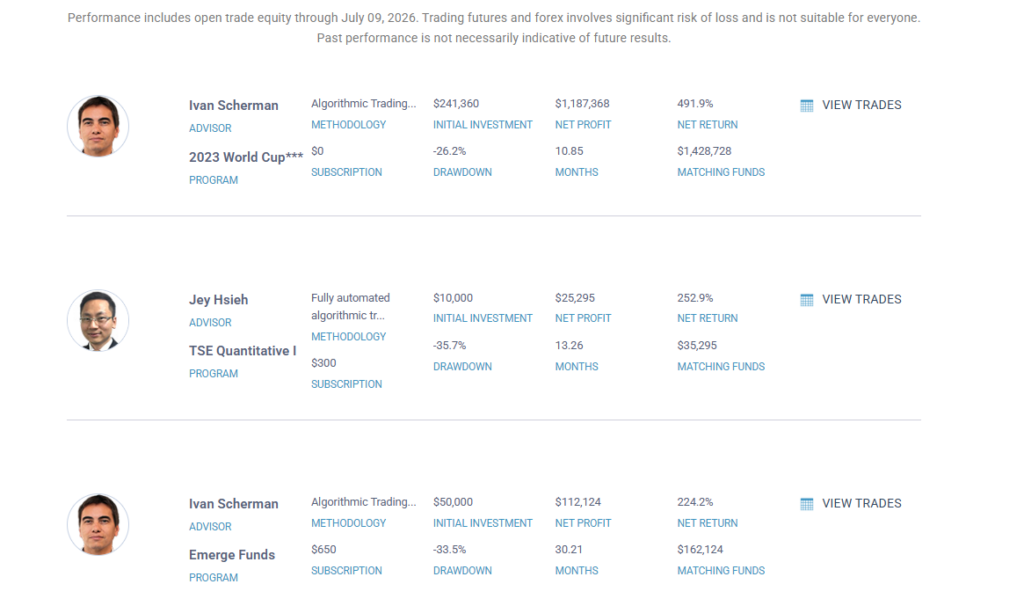
World Cup Advisor publishes live-account summaries from featured professional traders and allows subscribers to follow selected lead accounts automatically.

As of the market close on July 9, 2026, its featured accounts included the following published results:

World Cup Advisor fully automated trading statistics showing returns and published drawdowns

Examples of published automated and systematic trading results.
Featured ProgramMethodologyNet ReturnPublished DrawdownPeriod
Ivan Scherman — 2023 World CupAlgorithmic trading491.9%26.2%10.85 months
Jey Hsieh — TSE Quantitative IFully automated algorithmic trading252.9%35.7%13.26 months
Ivan Scherman — Emerge FundsAlgorithmic trading224.2%33.5%30.21 months
Daniele Sambataro — Momentum SelectionSystematic trend-following and mean reversion202.2%36.17%40.8 months

These are substantial returns and should not be dismissed as poor trading. The published figures do not demonstrate that the advisors are unskilled; quite the opposite.

The World Cup Trading Championships states that it has been attracting some of the world’s leading traders since 1983. Traders operating at this level are generally highly experienced, well-capitalized and prepared to spend years researching, testing, refining and operating their systems.

However, even at this advanced level, the published drawdowns reveal something extremely important:

A profitable automated strategy can still be completely unsuitable for a tightly constrained prop account.

Source: World Cup Advisor. Published figures may change over time and should be independently verified.

Automated Drawdown Versus Prop-Account Drawdown

The listed automated-system drawdowns range from approximately 26% to 36%.

By comparison, a nominal $50,000 futures prop evaluation may provide only around $2,000 of maximum loss capacity, which is approximately 4% of the headline account size.

Published DrawdownCompared With a 4% Loss Limit
26.2%Approximately 6.6 times the limit
35.7%Approximately 8.9 times the limit
33.5%Approximately 8.4 times the limit
36.17%Approximately 9 times the limit

That does not mean these strategies are bad.

It means they were not necessarily designed for an environment in which a relatively small peak-to-trough movement can terminate the account.

To attempt to use such a system within a 4% drawdown allowance, its position size would have to be reduced substantially. That would also reduce its expected returns, while trailing-drawdown mechanics could still create additional path-dependent risk.

Return Without Drawdown Is Only Half the Story

Retail marketing frequently concentrates attention on:

  • Percentage return.
  • Profit screenshots.
  • Winning months.
  • Backtested equity curves.
  • High win rates.
  • Short evaluation passes.

However, a percentage return has little meaning without understanding the risk required to produce it.

A strategy producing a 100% return with a 35% drawdown may be appropriate for one investor and completely unusable for another. A prop trader with only a 4% effective loss allowance does not have the freedom to sit through that same drawdown.

The most important question is not:

“How much did the robot make?”

Better questions include:

  • What maximum drawdown did it experience?
  • How long did recovery take?
  • Was the drawdown calculated from closed trades or real-time equity?
  • What happened during unfavorable market phases?
  • How much capital was required?
  • Could the trader psychologically and financially continue operating?
  • Would the strategy survive the intended prop-firm rules?
  • How frequently must the system be reviewed or reoptimized?

A strategy can eventually recover and still destroy a prop account long before that recovery occurs.

Why Prop-Account Limitations Change Everything

A nominal $50,000 prop account may sound like the trader has $50,000 available to lose. In practice, the usable risk allowance may be only $2,000.

That usable drawdown is the real account.

An intraday trailing drawdown may follow unrealized equity highs. A trade can move strongly into profit, pull back and breach the account threshold even though it might later have closed profitably.

A robot designed around normal live-account volatility may therefore be unsuitable for a prop account unless it was built and tested specifically around that firm’s current rules.

Prop-firm rules may also restrict practices commonly used in professional systematic trading, including hedging, holding opposing positions, running long-only and short-only models on separate allocations, using different parameter sets or time-series variations across accounts, and replicating trades through account copiers.

These restrictions can prevent the automated trader from using the directional, parameter, strategy and account diversification normally required to reduce portfolio risk. The trader may instead be forced to operate one concentrated system inside a very small drawdown allowance.

Rules differ between firms and may change, so traders must verify the current policy before using automation, hedging, opposing positions, multiple accounts or trade-copying technology.

The problem is not simply whether the system is profitable eventually.

The problem is whether it survives the route between today and that eventual profit.

Why Fully Automated Trading Is Not Set and Forget

Fully automated trading can be highly demanding and may require:

  • Multiple non-correlated markets and independent strategies.
  • System, directional, parameter and time-series diversification.
  • Separate research, testing, simulation and production environments.
  • Reliable historical and real-time data.
  • Backtesting, replay and forward-testing infrastructure.
  • Dedicated computers, servers, monitoring and backup systems.
  • Live execution monitoring, alerts, fail-safe controls and kill switches.
  • Continuous research and reoptimization as market behavior changes.
  • Ongoing human supervision, portfolio management and technical support.

Even a system that is 90% to 95% automated during live operation still normally requires a human operator. The operator may need to activate, reduce, pause, restart or completely disengage systems in response to news, market shocks, abnormal drawdown, changing conditions or technical faults.

The professional model is rarely:

Switch it on and forget about it.

It is closer to:

Research it, test it, supervise it, control it, diversify it, maintain it and know when to switch it off.

Full automation does not remove the work. It transfers much of the work from live decision-making into research, engineering, validation, monitoring, infrastructure and portfolio management.

The setup and development phase can take months or years, involve very long working weeks and require substantial capital before the trader sees any return on investment. Even then, published professional results show that strong returns may still be accompanied by drawdowns of approximately 26% to 36%.

For many traders, this means sacrificing work-life balance during the development phase with no guarantee that the final system will remain effective as markets change.

Can the Average Retail Trader Compete With Professional System Developers?

The traders featured by services such as World Cup Advisor and Striker operate near the visible upper end of retail systematic trading.

Before assuming that a newly purchased robot can produce better results with less risk, a trader should ask an honest question:

Am I currently more experienced, better capitalized and better equipped than the traders who have spent years developing these systems?

Most retail traders are not currently equipped with the experience, capital, data, infrastructure and research capability used by leading professional system developers.

These professionals are generally not running a vendor trial for one month and hoping that the system continues producing indefinitely. They may have spent years developing rules, acquiring data, backtesting, optimizing, forward-testing, monitoring live execution and adjusting their systems as market behavior changed.

A new or currently unsuccessful trader should therefore consider:

  • Do I have the technical knowledge required to design and validate a system?
  • Do I have reliable market data and suitable testing infrastructure?
  • Do I understand overfitting, slippage, liquidity and execution risk?
  • Do I have sufficient personal risk capital?
  • Am I prepared to invest several years in research and development?
  • Can the system survive my intended prop-firm or brokerage rules?
  • Can I continue operating through an extended drawdown?

Retail trading failure rates are widely reported as high, but exact percentages vary according to the market, time period, methodology and definition of failure. The central point remains the same: neither discretionary nor automated trading becomes easy simply because software is involved.

Automation does not remove the difficulty of trading. It moves much of that difficulty into system design, data quality, validation, infrastructure, risk allocation and ongoing maintenance.

The Capital and Infrastructure Required for Serious Automated Trading

A fully automated system can become a relatively blunt instrument when it must operate without real-time human judgment. It therefore needs a larger margin for error, greater drawdown capacity, substantial risk capital and enough diversification to survive unfavorable market phases.

A properly structured automated operation may require significantly more than a single robot and a small trading account.

  • Substantial personal risk capital.
  • Several years of research, testing and system refinement.
  • Dedicated computers, servers, data feeds and backup infrastructure.
  • A portfolio of genuinely non-correlated strategies and asset streams.
  • Multiple accounts or brokerage relationships where appropriate.
  • Strict portfolio-level and system-level risk controls.
  • Continuous monitoring, review and development.

As an illustrative ATS planning model, a highly diversified automated operation might consider capital levels of approximately $250,000 for micro-contract portfolios or $1.5 million for E-mini portfolios when using conservative portfolio-risk limits.

These are planning examples rather than universal minimum requirements. Actual capital requirements depend on the systems, instruments, drawdowns, leverage, diversification and risk model involved.

For many retail traders, swing trading may be more compatible with full automation than short-term prop trading because it can reduce execution frequency, intraday noise and sensitivity to tight trailing-drawdown rules.

It still requires sufficient capital, robust research and careful risk management.

Why Automated Portfolio Diversification Matters

Diversification is one reason professional operators may run many systems simultaneously. One strategy may perform well while another is experiencing an unfavorable market phase.

However, genuine diversification requires capital, infrastructure, and expertise. Adding several highly correlated robots to the same instrument is not necessarily diversification. They may all fail for the same reason at approximately the same time.

Ray Dalio has repeatedly emphasized the importance of combining good, risk-balanced, and genuinely uncorrelated investments rather than concentrating all risk in one market or strategy.

“Strive to have 15 good uncorrelated investments that are risk-balanced.”

The principle is that a well-diversified portfolio of good opportunities can produce a better return relative to risk than a concentrated portfolio whose outcomes depend on one market, one system or one economic environment.

For automated trading, diversification should not simply involve running several slightly different settings on the same instrument.

Genuine diversification may require:

  • Different instruments.
  • Different asset classes.
  • Different holding periods.
  • Different strategy families.
  • Different market regimes.
  • Independent return drivers.

Further reading: Ray Dalio — Investment Principles.

Why Hybrid Algo Trading Is More Maneuverable

A fixed automated system can be compared with a heavily loaded vehicle following a predetermined route. It may operate with a very high level of automation, but human oversight is often limited to monitoring the system and deciding when to switch it on or off.

It can perform extremely well while market conditions resemble those for which it was designed. However, when the environment changes through unexpected news, abnormal volatility, reduced liquidity or a sudden shift in market structure, the system may continue following its existing rules unless those conditions were anticipated and programmed in advance.

Hybrid algo trading gives the operator steering, brakes, navigation, and the authority to change route in real time.

Trader Control Sets

  • Use purpose-built controls that provide exceptional flexibility and trading capability within the live, real-time trading environment.
  • Adjust the level of automation from full automation for selected periods to manual authorization of long, short, entry, exit, scale-in and scale-out actions.
  • Respond to moving targets while retaining control and benefiting from the combined speed of automation and the judgment of an experienced human operator.
  • Use graphical interfaces and one-click macro controls to execute complex entry, exit, and order-management sequences that could take a manual trader 30 seconds or longer to perform on a basic platform.
  • Operate more like the pilot of an advanced aircraft or the driver of an intelligent vehicle than a passenger watching a fixed robot follow a predetermined route.

Risk-Avoidance Market Radar

  • Avoid major economic releases and scheduled event risk.
  • Stop trading after reaching the daily objective.
  • Reduce position size when market relationships become mixed or unclear.
  • Reject signals during low-quality conditions.
  • Select only the clearest and highest-quality opportunities.
  • Pause after abnormal volatility or unexpected market behavior.
  • Switch instruments, data series, and filters in real time.
  • Change direction as market structure and conditions evolve.

External Confirmation and Intelligence Systems

  • Use additional confirmation systems, market-intelligence tools, and human guidance that may not be available to a standalone algorithm or conventional trading platform.
  • Combine execution technology with broader information about news, volatility, correlations, higher-time-frame structure and current market state.
  • Use independent confirmation to help determine whether a technically valid signal is appropriate for the current trading environment.

Prop-Account Protection

  • Protect a prop account before its maximum-loss or trailing-drawdown threshold is threatened.
  • Trade with greater precision while remaining within the firm’s current risk, position, and payout rules.
  • Reduce size, pause trading or reject an otherwise valid signal when the account’s remaining drawdown does not justify the risk.
  • Avoid relying on a fixed automated system that may continue trading through conditions or account limits for which it was not specifically designed.
  • Recognize that even a profitable automated system can breach a tightly constrained prop account before its longer-term statistical advantage has time to recover.

Live Brokerage Account Protection

  • Apply personal risk limits before account losses become emotionally or financially damaging.
  • Reduce exposure when volatility, correlations or account equity no longer justify the current position size.
  • Protect accumulated profits rather than allowing a robot to continue through an unfavorable market phase.
  • Retain the authority to stop, switch or modify the trading approach as personal capital and market conditions change.

This maneuverability is why we describe hybrid trading as man and machine operating in unison.

The trader is not fighting the technology. The trader is piloting it.

The ATS Hybrid Trading Environment

AFT: Execution and Trade Management

AFT is designed to provide rapid control over entries, exits, position management, dynamic stops, targets and trading-system rules.

Its purpose is not merely to place trades automatically. Its purpose is to reduce execution effort while preserving trader control.

AWT: Market Intelligence

AWT provides market context and confirmation at a glance, helping the trader assess:

  • Market direction.
  • Trend strength.
  • Volatility.
  • Structure.
  • Correlations.
  • Session conditions.
  • Higher-time-frame context.
  • Risk and opportunity.

AI and VIP Group Copilot

The AI and group environment adds further planning, education and live-market support, including:

  • Economic events.
  • Earnings and scheduled news.
  • Holidays and liquidity conditions.
  • Market correlations.
  • Higher-time-frame analysis.
  • Current trend state.
  • Risk planning.
  • Setup quality.
  • Live instructor observations.

Together, these components are designed to create a trader who is neither purely discretionary nor blindly automated.

The result is a more capable hybrid operator.

Practical Hybrid-Trading Goal States

Trading statistics should be treated as development goals, not promises.

A trader should never pursue a high win rate at the expense of excessive risk, oversized losses or poor-quality decisions. The real objective is positive expectancy combined with controlled drawdown and repeatable execution.

A practical overall ATS hybrid goal range may include:

  • Win ratio: approximately 55% to 85%.
  • Average winner relative to average loss: approximately 0.75 to 1.20.
  • Level of automation: approximately 50% to 80%.
  • Trader responsibility: context, authorization, risk and continued supervision.
  • Machine responsibility: calculation, detection, execution and management.
Where the average winner is only 0.75 times the average loss, the mathematical break-even win rate is approximately 57.1% before commissions and slippage. A 55% win rate at that reward-to-risk relationship would not be profitable.
Development StateIllustrative Win-Rate GoalAverage Winner á Average LossAutomationPrimary Objective
FoundationDo not prioritize win rate initially1.00–1.2050%–60%Correct setup, execution and journaling
Developing Consistency55%–65%1.00–1.2055%–70%Establish positive expectancy
Consistent Hybrid Trader60%–75%0.85–1.1060%–75%Reduce mistakes and drawdown
Selective Advanced Trader70%–85%0.75–1.0070%–80%Trade fewer, higher-quality opportunities

The upper win-rate range should generally be associated with highly selective trading, specific market conditions and a meaningful sample size. It should not be presented as an everyday certainty.

Simplified expectancy examples before commissions and slippage include:

  • A 55% win rate with an average winner of 1.2R produces approximately +0.21R per trade.
  • A 65% win rate with an average winner of 0.9R produces approximately +0.235R per trade.
  • A 75% win rate with an average winner of 0.75R produces approximately +0.313R per trade.

This demonstrates why win rate alone does not define a successful trader.

Smaller Repeatable Objectives Can Be More Valuable

A hybrid prop trader does not necessarily need to chase spectacular daily returns.

An illustrative objective might be:

  • $100 average daily net progress.
  • Approximately $500 over five trading days.
  • Approximately $2,000 over a four-week period.

Where a firm permits multiple accounts and compliant trade copying, the same carefully controlled process may potentially be applied across several accounts.

Five accounts averaging $2,000 each would equal $10,000, but this is arithmetic rather than a performance promise.

Actual outcomes will depend on:

  • Trader performance.
  • Prop-firm rules.
  • Account survival.
  • Market conditions.
  • Trading costs and slippage.
  • Payout requirements.
  • The number of trading days.
  • Whether copying and multiple-account operation are permitted.

The purpose of the example is not to promise $10,000.

It is to show why a small, controlled and repeatable trading process can be more useful than chasing a large headline return accompanied by an unsustainable drawdown.

The Potential Capital Efficiency of Hybrid Trading

A skilled hybrid trader may be able to target a higher return relative to usable drawdown than a fully automated strategy operating on a single account.

Where prop-firm rules permit multiple accounts and compliant trade replication, a controlled hybrid process may potentially be distributed across several accounts without exposing one large personal brokerage account to the full capital requirement of a diversified automated portfolio.

Within a live brokerage account, the trader may instead scale gradually as verified statistics, account equity and personal risk tolerance permit.

This does not mean that scaling from one account to five, ten or twenty accounts is effortless or unlimited. The trader must still manage:

  • Execution accuracy.
  • Account and copier reliability.
  • Position limits.
  • Liquidity and slippage.
  • Prop-firm rules.
  • Daily and trailing drawdown.
  • Consistency across every account.
  • The psychological pressure created by larger aggregate exposure.

The trader is effectively attempting to hit a moving target while maintaining a high level of consistency and a low level of drawdown.

In our view, this combination of precision, adaptability and active risk control is where hybrid algo trading provides its greatest advantage for both retail prop traders and live-account traders.

It remains an objective rather than a guarantee, and increasing account size or the number of accounts also increases operational and financial risk.

Hybrid Trading Still Requires a Trader

Hybrid technology does not remove personal responsibility.

ATS cannot promise:

  • That every trader will succeed.
  • That every evaluation will be passed.
  • That every funded account will produce a payout.
  • That a trader will recover the cost of the system.
  • That historical or simulated results will continue.
  • That tools can compensate for undisciplined execution.

ATS can provide the framework, technology, education, workspace, support and development pathway.

The trader must still:

  • Attend and practise.
  • Follow the process.
  • Control risk.
  • Journal trades.
  • Review mistakes.
  • Build a repeatable routine.
  • Remain calm after wins and losses.
  • Avoid revenge trading.
  • Trade only suitable conditions.
  • Continue developing over time.

Technology can make a committed trader more capable. It cannot make an uncommitted trader successful.

From Zero to Hero Is a Process, Not a Promise

ATS Fast Track and Mastery are designed to help traders progress through a structured development pathway.

A practical initial horizon may be approximately three months, although individual development can take less or considerably more time.

The goal is to help the trader move through stages such as:

  1. Correct technical setup.
  2. Understanding the ATS workspace.
  3. Learning the hybrid methodology.
  4. Practising in simulation.
  5. Building a trade plan.
  6. Establishing risk controls.
  7. Producing personal statistics.
  8. Attempting an evaluation or live-account transition when ready.
  9. Working toward funded-account survival or controlled live-account growth.
  10. Working toward a first payout or sustainable live-account return.

ATS aims to shorten the route to a usable system, method and routine by providing a turnkey workspace, technology, guidance and an established process rather than requiring the trader to build everything from scratch.

Some traders may set an objective of recovering the cost of their system and education within an early payout cycle or the first month of successful trading. Others may take considerably longer or may never achieve that objective.

By comparison, developing a serious fully automated trading operation can require one to three years of research, testing, infrastructure and live validation before a return on investment becomes possible.

In both cases, return on investment remains an objective rather than a guaranteed outcome.

Success depends on the trader applying the process correctly and consistently.

Learn From Traders Who Have Completed the Journey

One of the major advantages of the ATS environment is that new traders can learn from people who have already followed the pathway.

ATS invites selected traders who have progressed from beginner or struggling stages, learned the tools, used the turnkey workspace and achieved documented payout success to help newer traders.

These traders understand:

  • What it feels like to begin.
  • How evaluations are lost.
  • How discipline breaks down.
  • How a trader recovers from mistakes.
  • How to develop a repeatable routine.
  • How to move from random trading to structured execution.
  • How to protect a funded or live brokerage account.
  • How to progress toward payouts or controlled account growth.

Behind them are the system inventors, developers and experienced ATS leaders who support the coaches and continually develop the wider framework.

This creates a practical meritocracy:

Knowledge and experience move downward through the organization, while capable traders are given a pathway to move upward.

The objective is to help new traders reach levels of capability that they may not previously have believed possible.

Why We Love Hybrid Algo Trading

We do not want trading to consume every hour of the day. Life needs balance, and we prefer to use technology, preparation and a structured process to do less unnecessary work while achieving more from the time we commit.

We also love trading futures indices and remaining at the wheel in man-and-machine mode. Algorithmic automation, AI technology and hybrid control sets give the trader an exceptional ability to evaluate, authorize and manage each opportunity as it develops.

ATS provides a turnkey workspace and setup designed as a strong all-round, all-weather foundation. Within the trade, the trader can combine AFT execution and management, AWT market intelligence, AI Copilot support, Trade Zone education and hybrid controls.

Sometimes the process may be fully automated from entry to exit. At other times, the trader may interact by authorizing the direction, adjusting risk, taking partial profit, reducing exposure, pausing the system or exiting the trade.

The level of automation varies by trader, strategy and market conditions, but an illustrative ATS hybrid range is approximately 50% to 80%. The trader remains at the wheel without having to perform every calculation and execution task manually.

The objective is a focused and sustainable trading routine—often a defined two-to-three-hour session rather than around-the-clock monitoring, extensive work outside trading hours or years spent building infrastructure before reaching the market.

For a suitable and disciplined trader, ATS aims to provide a faster pathway to a working system, method and process, with the objective of progressing toward payouts, live-account returns and an eventual return on the cost of the technology and education.

Hybrid algo trading is not a single robot. It is a complete operating framework made up of algorithms, automated execution, AI-supported intelligence, market context, risk controls, education and a responsible human operator.

This combination provides the precision and flexibility of a surgical instrument. Fully automated trading can require the larger margin for error of a blunt instrument: substantial capital, broad diversification, large drawdown capacity, expensive infrastructure and months or years of research and development.

Hybrid trading retains the benefits of automation without surrendering context, judgment, adaptability, selectivity, accountability or proactive account protection.

The objective is not to become a passenger watching a robot trade.

The objective is to become a better pilot, capable of hitting a relatively small moving target from a considerable distance.

Maximum Profit. Minimum Drawdown. Least Emotion.

  • Not guaranteed.
  • Not effortless.
  • But structured, controlled, and built around the development of a capable trader.

Important Risk Disclosure

Futures trading, leveraged trading, and prop-firm trading involve a significant risk of loss and are not suitable for every trader. Past, hypothetical, simulated or published performance does not guarantee future results.

Statistics, account examples, objectives, development ranges, and capital illustrations shown in this article are for educational and illustrative purposes only. They are not earnings claims, promises, guarantees or assurances that any trader will achieve the same or similar results.

References to multiple accounts, trade copying, prop-firm accounts, and potential account scaling are illustrative only. Availability, eligibility and permitted trading practices depend on the current rules of each firm, brokerage, and jurisdiction.

Prop-firm rules, drawdown calculations, account conditions, fees, and payout requirements vary and may change. Traders should verify all current rules directly with the relevant firm before trading.

Filed Under: AFT8, Hybrid Algo Trading, NinjaTrader 8, ninjatrader automated trading, prop firm trading Tagged With: AFT trading platform, AI trading copilot, algorithmic trading, ATS trading systems, automated trading, automated trading systems, AWT market intelligence, discretionary trading, futures prop firms, futures trading, hybrid algo trading, man and machine trading, prop firm trading, prop trading, risk management, systematic trading, trader development, trading automation, trading drawdown, trading psychology

  • NinjaTrader Automated Trading
  • automated futures trading
  • automated trading systems
  • Day Trading Futures
  • Get Started Day Trading Futures
  • VIP Trading Group Live Market Trade Along
  • Secret to Day trading futures success
  • AFT8 for NinjaTrader 8
  • Futures Algo Trading Systems
  • Market News
  • NinjaTrader Free Trading Platform
  • Legal Notices
  • AFT Legal Info
  • Terms
  • FULL RISK DISCLOSURE
  • Privacy Policy
  • Cookie Usage
  • About AlgoFuturesTrader
  • Connect to AFT
  • Blog
  • Videos
  • Support
  • Contact
  • My account
  • Sitemap
  • Affiliates

Ninja Futures Trading
Algo Futures Trader Copyright Algo Trading Systems© 2026 ¡
AlgoFuturesTrader.com is owned & operated by Algo Trading Systems LLC. By using this website or products & services, you are bound by our Terms & subject to US legal jurisdiction only. Errors & omissions excluded.
AFT made in England, powered by MicroTrends NinjaTrader development

Disclaimer: Trading & investment carry a high level of risk. AlgoFuturesTrader does not make recommendations for buying or selling any financial instruments, nor do we offer trading or investment advice. We are a software company, and we only provide educational information on ways to use our sophisticated Algo Futures trading tools. It is up to our customers & readers to make their own trading & investment decisions, or consult with a registered investment advisor.

Risk Disclosure: Futures, CFDs, & forex trading carry substantial risk and are not suitable for every investor. An investor could potentially lose all or more than the initial investment. Risk capital is money that can be lost without jeopardizing one's financial security or lifestyle. Only risk capital should be used for trading, and only those with sufficient risk capital should consider trading. Past performance is not necessarily indicative of future results. Please read the full risk disclosure here.

Hypothetical performance results have many inherent limitations, some of which are described below. No representation is made that any account will or is likely to achieve profits or losses similar to those shown. In fact, there are frequently sharp differences between hypothetical performance results and the actual results subsequently achieved by any particular trading program. One of the limitations of hypothetical performance results is that they are generally prepared with the benefit of hindsight. In addition, hypothetical trading does not involve financial risk, and no hypothetical trading record can completely account for the impact of financial risk in actual trading. For example, the ability to withstand losses or adhere to a particular trading program despite trading losses are material points that can adversely affect actual trading results. Numerous other factors related to the markets or the implementation of any specific trading program cannot be fully accounted for in the preparation of hypothetical performance results and can adversely affect trading results.

Testimonials appearing on this website may not be representative of other clients or customers and are not a guarantee of future performance or success.

NinjaTraderÂŽ is a registered trademark of NinjaTrader Group, LLC. No NinjaTrader company has any affiliation with the owner, developer, or provider of the products or services described herein, nor do they endorse, recommend, or approve any such product or service.

We use cookies on our website to give you the most relevant experience by remembering your preferences and repeat visits. By clicking “Accept All”, you consent to the use of ALL the cookies. However, you may visit "Cookie Settings" to provide a controlled consent.
Cookie SettingsAccept All
Manage consent

Privacy Overview

This website uses cookies to improve your experience while you navigate through the website. Out of these, the cookies that are categorized as necessary are stored on your browser as they are essential for the working of basic functionalities of the website. We also use third-party cookies that help us analyze and understand how you use this website. These cookies will be stored in your browser only with your consent. You also have the option to opt-out of these cookies. But opting out of some of these cookies may affect your browsing experience.
Necessary
Always Enabled
Necessary cookies are absolutely essential for the website to function properly. These cookies ensure basic functionalities and security features of the website, anonymously.
CookieDurationDescription
cookielawinfo-checkbox-analytics11 monthsThis cookie is set by GDPR Cookie Consent plugin. The cookie is used to store the user consent for the cookies in the category "Analytics".
cookielawinfo-checkbox-functional11 monthsThe cookie is set by GDPR cookie consent to record the user consent for the cookies in the category "Functional".
cookielawinfo-checkbox-necessary11 monthsThis cookie is set by GDPR Cookie Consent plugin. The cookies is used to store the user consent for the cookies in the category "Necessary".
cookielawinfo-checkbox-others11 monthsThis cookie is set by GDPR Cookie Consent plugin. The cookie is used to store the user consent for the cookies in the category "Other.
cookielawinfo-checkbox-performance11 monthsThis cookie is set by GDPR Cookie Consent plugin. The cookie is used to store the user consent for the cookies in the category "Performance".
viewed_cookie_policy11 monthsThe cookie is set by the GDPR Cookie Consent plugin and is used to store whether or not user has consented to the use of cookies. It does not store any personal data.
Functional
Functional cookies help to perform certain functionalities like sharing the content of the website on social media platforms, collect feedbacks, and other third-party features.
Performance
Performance cookies are used to understand and analyze the key performance indexes of the website which helps in delivering a better user experience for the visitors.
Analytics
Analytical cookies are used to understand how visitors interact with the website. These cookies help provide information on metrics the number of visitors, bounce rate, traffic source, etc.
Advertisement
Advertisement cookies are used to provide visitors with relevant ads and marketing campaigns. These cookies track visitors across websites and collect information to provide customized ads.
Others
Other uncategorized cookies are those that are being analyzed and have not been classified into a category as yet.
SAVE & ACCEPT