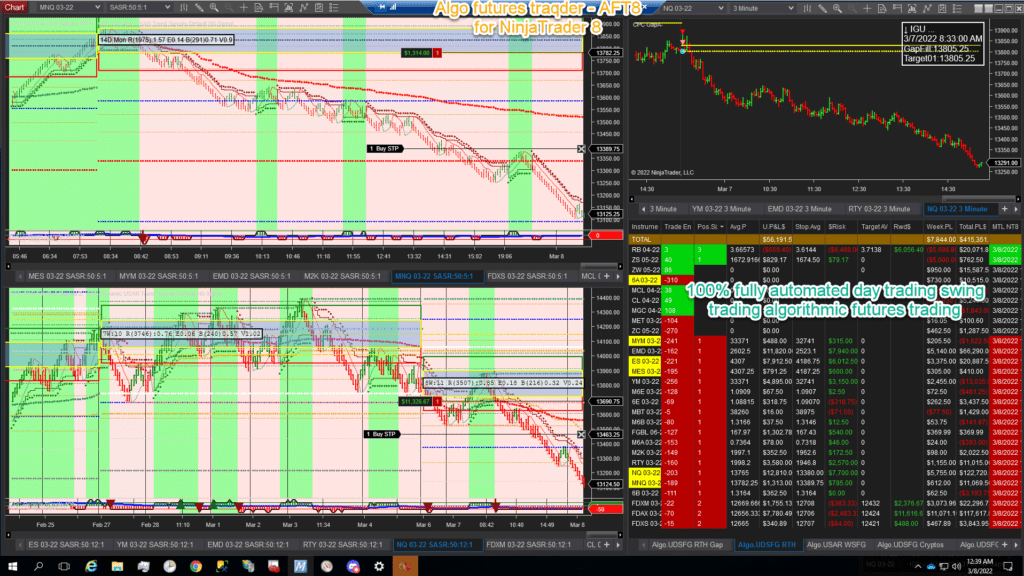
Automated Trading Systems for NinjaTrader 8: AFT8 Hybrid Versus Fully Automated Trading
Algo Futures Trader 8 combines algorithmic trade signals, interactive decision support, semi-automatic entries, fully automatic trade management, and optional fully automated execution within the NinjaTrader 8 platform.
An automated trading system can calculate signals, place orders, manage positions, control risk, and close trades according to predefined rules. However, the amount of automation a trader should use is not determined only by what the software can do. It must also reflect the trader’s experience, capital, account rules, available time, risk tolerance, trading session, and ability to supervise the system.
AFT8 is technically capable of manual, hybrid, semi-automatic, and fully automatic trading. For most retail futures traders and prop-firm traders, ATS recommends beginning with the hybrid route: the trader provides market context and authorizes suitable opportunities while AFT8 handles the precision, speed, order management, risk controls, and repetitive execution work.
What Is Algo Futures Trader 8?
Algo Futures Trader 8, commonly called AFT8, is a specialist algorithmic futures trading system developed for NinjaTrader 8. It combines multiple algorithmic models, multiple timeframes, professional order handling, interactive controls, and automated trade management in one integrated trading environment.
AFT8 can be used with Micro and E-mini futures and includes trading models designed for market conditions such as trend continuation, trend pullbacks, momentum, session breakouts, opening-range behaviour, volatility expansion, OCO breakouts, and news-related price movement.
- Manual trading: The trader chooses the setup and enters the position while AFT8 manages the order, stop, targets, scaling, and risk.
- Semi-automatic trading: The trader selects a long or short bias and authorizes AFT8 to execute the next qualifying algorithmic setup.
- Interactive hybrid trading: The trader and system work together throughout the session using live signals, filters, controls, and automated management.
- Fully automatic trading: AFT8 can take qualifying trades without individual confirmation when the configured rules, permissions, and safety conditions are satisfied.
- Fully automatic trade management: Once a position is entered, AFT8 can manage stops, targets, break-even logic, trailing logic, scale-outs, time controls, session limits, and position exits.
The key distinction is that AFT8 supports full automation without forcing every trader to use it. The trader can choose the appropriate level of automation for each market, session, account, and stage of development.
What Is Hybrid Algorithmic Trading?
Hybrid algorithmic trading combines human situational awareness with machine-based calculation and execution. The trader remains responsible for the trading plan, market selection, directional bias, operating schedule, risk limits, and final trade authorization. The software handles the repetitive and time-sensitive parts of execution.
A hybrid trader might determine that the market has a long bias based on higher-timeframe structure, overnight movement, economic news, volatility, session levels, and current price action. The trader can then instruct AFT8 to take the next valid long setup while automatically rejecting short entries.
Once the trade is opened, AFT8 can apply the predefined risk and trade-management plan without hesitation. This reduces manual order-entry errors and helps prevent emotional changes to stops, targets, or position size after the trade has begun.
Typical AFT8 Hybrid Workflow
- Prepare: Review the economic calendar, overnight market structure, important levels, session conditions, and current volatility.
- Select: Choose the instrument, workspace, trading model, permitted direction, and maximum session risk.
- Confirm: Use AFT8 signals, charts, ATS Web Trader information, and trading-group context to identify suitable conditions.
- Authorize: Permit the next qualifying long or short setup rather than allowing every theoretical signal to trade.
- Automate: Allow AFT8 to place and manage the orders using predefined stops, targets, scale-outs, and risk controls.
- Supervise: Remain present to pause trading when conditions change, scheduled news approaches, platform issues occur, or session objectives are reached.
- Review: Journal the session, examine execution quality, and improve the trading plan using actual evidence rather than emotion.
Hybrid Trading Versus Fully Automated Trading
| Consideration | Hybrid AFT8 Trading | Fully Automated Trading |
|---|---|---|
| Trade selection | The trader filters market conditions and authorizes suitable opportunities. | The system takes every signal permitted by its programmed rules. |
| Market context | Human judgement can account for unusual news, volatility, liquidity, and changing conditions. | All relevant context must be represented by data, filters, code, or external controls. |
| Execution | AFT8 provides fast, consistent order placement and automatic trade management. | The system controls both entry and management without individual confirmation. |
| Supervision | Normally attended during the selected trading session. | May operate unattended but still requires technical monitoring, review, and intervention procedures. |
| Development burden | Lower because the trader can adapt to context and specialize in a defined setup or session. | Higher because market regimes, exceptions, failures, and risk events must be anticipated programmatically. |
| Diversification requirement | A trader can concentrate on a smaller number of high-quality methods and use discretion to avoid unsuitable conditions. | Professional deployment normally requires several non-correlated systems, instruments, sessions, or trading models. |
| Emotional control | Reduces emotion while keeping the trader accountable for decisions. | Removes manual trade decisions but can create pressure when the system enters a normal losing cycle. |
| Best suited to | Retail traders, day traders, prop-firm traders, developing traders, and specialists. | Experienced systematic traders with sufficient capital, infrastructure, diversification, and research capability. |
Why the Hybrid Route Is Practical for Most Traders
The hybrid route allows a trader to benefit from automation without first building an institutional-scale automated trading operation. This is particularly important for traders using accounts with strict drawdown limits, daily loss rules, consistency rules, automation restrictions, or trailing thresholds.
In a prop-firm account, the advertised account size is not the amount that can be lost. The practical trading account is the permitted drawdown allowance. A system can be profitable over a long sample while still failing an evaluation or funded account during an ordinary sequence of losses. Hybrid filtering can reduce unnecessary exposure by allowing the trader to pause during unsuitable conditions rather than forcing the system to trade every statistically valid setup.
Advantages of the Hybrid AFT8 Approach
- Specialization: The trader can focus on one instrument, one session, one workspace, or one repeatable market behaviour.
- Context awareness: The trader can respond to central-bank announcements, employment reports, unexpected news, abnormal volatility, poor liquidity, and changing market structure.
- Precision execution: AFT8 can handle order placement and management faster and more consistently than manual clicking.
- Reduced emotional interference: Stops, targets, scaling, and risk controls can be managed according to the plan rather than fear or greed.
- Controlled frequency: The trader can authorize only the next suitable trade instead of allowing unlimited entries.
- Flexible operation: Manual, semi-automatic, and fully automatic modes can be selected according to the situation.
- Faster learning: The trader sees how the algorithm responds while remaining involved in the decision-making process.
- Lower research burden: The trader does not need to develop and maintain a large portfolio of independent algorithms before beginning.
Limitations of Hybrid Trading
- The trader must be present, prepared, and capable of making consistent decisions.
- Poor discretionary filtering can reduce the performance of an otherwise sound trading model.
- The trader may still overtrade, chase losses, change direction impulsively, or override safety controls.
- Success requires a written plan, session discipline, risk limits, and regular review.
- Hybrid trading is not a shortcut around learning market structure, platform operation, or risk management.
What Fully Automated Trading Really Requires
Fully automated trading is often presented as a system that can be switched on and left to generate passive income. Professional automation is considerably more demanding. The entry algorithm is only one part of the complete operation.
A production-grade automated trading process must account for market data, strategy state, order state, broker responses, partial fills, rejected orders, disconnected sessions, platform restarts, contract rollover, position reconciliation, abnormal spreads, slippage, news volatility, daily limits, and emergency shutdown procedures.
Core Components of a Professional Automated Trading Operation
- Clearly defined trading logic: Every entry, exit, filter, exception, and risk decision must be represented by objective rules.
- Reliable historical data: Testing requires suitable tick, minute, volume, session, and contract data with realistic costs.
- Backtesting: The strategy must be tested across different market conditions rather than only its best period.
- Out-of-sample validation: Parameters should be tested on data that was not used to create or optimize the model.
- Walk-forward testing: The development process should evaluate how the model adapts as market conditions change.
- Replay and simulation: The system must be observed in realistic execution conditions before live capital is exposed.
- Forward testing: Live market data should be used for an extended period to compare expected and actual behaviour.
- Execution monitoring: Orders, fills, slippage, platform connections, and account positions must be checked continuously.
- Risk controls: Position size, daily loss, strategy loss, account loss, maximum exposure, and shutdown limits must be enforced.
- Version control: Strategy changes, parameter changes, software versions, and deployment records must be documented.
- Operational redundancy: Professional operations may require backup internet, servers, data feeds, platforms, alerts, and recovery procedures.
- Portfolio management: Systems must be allocated, reduced, paused, retired, and redeployed according to objective evidence.
A fully automated strategy can still experience long losing periods, performance decay, increased slippage, and changes in market behaviour. Automation removes manual execution decisions; it does not remove financial risk, model risk, technology risk, or the need for oversight.
Pros and Cons of Fully Automated Trading
Potential Advantages
- Consistency: The system executes the programmed rules without hesitation or selective memory.
- Speed: Signals and orders can be processed faster than manual execution.
- Scalability: Multiple systems, instruments, and sessions can be monitored simultaneously when the infrastructure supports them.
- Repeatability: The same logic can be tested, measured, and compared over time.
- Reduced manual workload: The trader does not need to click every entry, stop, target, or exit.
- Broader operating hours: Properly designed systems can trade sessions that would be impractical for one person to supervise manually.
Important Disadvantages
- Development time: Creating a reliable system usually takes far longer than creating an attractive backtest.
- Overfitting risk: A strategy can be optimized to historical noise and then fail in live trading.
- Regime dependency: A model developed during one type of market may struggle when volatility, liquidity, or correlations change.
- Technology risk: Data failures, connectivity problems, rejected orders, platform errors, and synchronization issues can create unexpected positions.
- Capital requirements: A diversified automated portfolio normally requires more capital than a single specialist hybrid approach.
- Psychological pressure: Traders frequently stop systems during normal drawdowns and restart them after favourable periods, damaging the intended statistical process.
- Ongoing maintenance: Performance, execution, code, dependencies, contracts, platform versions, and market behaviour require continuing review.
- No guaranteed pass through prop rules: A profitable long-term strategy may still breach a tight trailing drawdown during an ordinary losing sequence.
How Long Does Automated Trading System Development Take?
The time required depends on whether the trader is learning to operate an established hybrid system or attempting to research and deploy a proprietary fully automated portfolio.
Learning an Established AFT8 Hybrid Workflow
A trader can install and configure AFT8 relatively quickly, but learning to use it safely and consistently takes practice. The initial objective should not be immediate live profits. The trader should learn the workspace, signals, order controls, trade-management behaviour, session routine, and emergency procedures in simulation.
A structured 30-day assisted Fast Track can establish the operating foundation, but many traders need one to three months of disciplined simulation before deciding whether they are ready for a prop evaluation or live account. Some traders require longer. Progress should be based on documented consistency, not a deadline.
Developing a New Fully Automated Trading System
A new automated strategy may take six to twelve months to research, code, test, validate, forward-test, and prepare for controlled deployment. Developing a robust portfolio of strategies often takes one to three years, particularly when the trader must also build the required data, testing, monitoring, and operational infrastructure.
Even after deployment, automated trading remains an ongoing research and maintenance process. Markets change, contracts change, software changes, execution costs change, and previously successful models can weaken or stop working.
| Stage | Typical Work Involved |
|---|---|
| Concept development | Define the market behaviour, hypothesis, session, entries, exits, filters, and risk model. |
| Initial research | Gather data, create prototypes, reject weak ideas, and identify realistic assumptions. |
| Backtesting | Test across instruments, years, volatility regimes, costs, and adverse periods. |
| Validation | Perform out-of-sample, walk-forward, sensitivity, robustness, and Monte Carlo analysis. |
| Simulation | Observe order behaviour, platform operation, timing, slippage, and real-time state handling. |
| Controlled live deployment | Begin with the smallest practical size and compare live performance with validated expectations. |
| Portfolio operation | Monitor, allocate, reduce, pause, retire, update, and replace systems as evidence changes. |
Specialization Versus Diversification
Specialization and diversification solve different problems. A hybrid trader can specialize because human supervision provides an additional layer of context. A fully automated operation normally requires greater diversification because every decision must be generated by the programmed models.
Hybrid Specialization
A hybrid trader might specialize in one instrument such as MNQ, one active session, one opening-range breakout workspace, and one repeatable trade-management plan. The trader becomes familiar with the instrument’s pace, volatility, liquidity, typical false breaks, and session behaviour.
This focused route reduces complexity and can accelerate skill development. AFT8 supplies the algorithmic signals and execution framework while the trader decides when conditions are suitable. The trader can stand aside when the market does not match the plan.
Fully Automated Diversification
A single fully automated strategy creates concentration risk. If its market behaviour disappears or enters an extended losing regime, the entire operation may suffer. Professional systematic trading therefore tends to combine several non-correlated return streams.
A more resilient automated portfolio may require four to eight independently validated systems across different instruments, timeframes, sessions, and trading concepts. Examples can include trend following, mean reversion, momentum, breakout, intraday, swing, volatility, and event-driven models.
True diversification does not mean running the same strategy on several highly correlated index futures. Systems that appear different can still lose simultaneously if they depend on the same underlying market condition. Correlation, shared risk factors, execution overlap, and combined drawdown must all be measured.
Why Hybrid Trading Needs Less System Diversification
Hybrid trading allows the trader to diversify decisions through context rather than only through additional algorithms. The trader can change from long-only to short-only, reduce size, avoid a news window, change the selected model, pause during poor conditions, or stop after the session objective is met.
This does not eliminate the value of diversification, but it allows a developing trader to begin with a specialist process rather than immediately funding and maintaining a multi-system automated portfolio.
AFT8 Technology for NinjaTrader 8
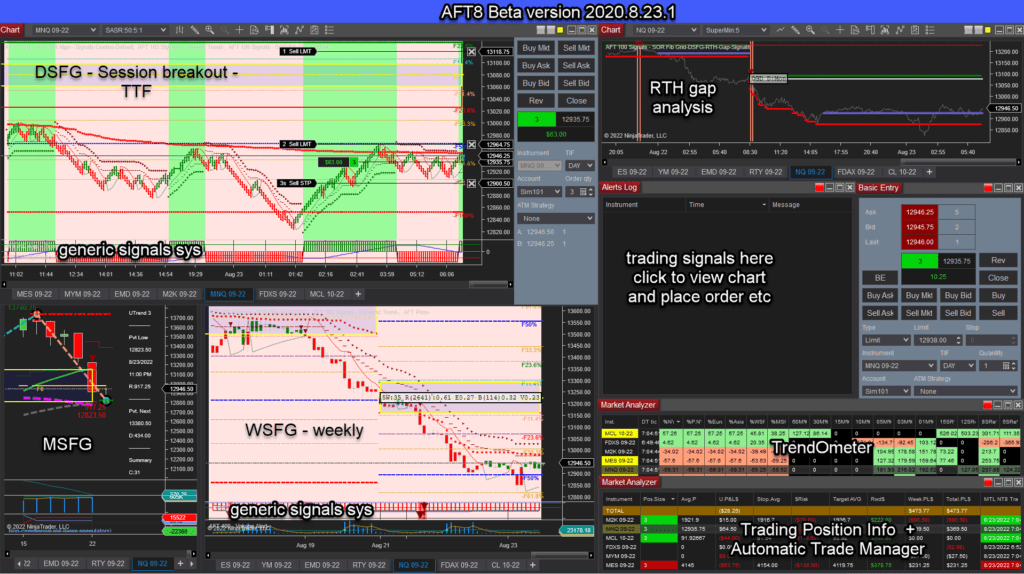
AFT8 is actively developed for NinjaTrader 8 and combines algorithmic signals, strategy technology, interactive controls, and live order-management components. It is designed to support both systematic testing and practical real-time trading workflows.
Key AFT8 Capabilities
- Flexible trading modes: Manual, semi-automatic, interactive hybrid, and fully automated trade entry.
- Multiple algorithmic models: Run multiple strategies, trade-management models, and timeframe confirmations for different market conditions.
- Directional controls: Operate in long-only, short-only, or two-direction trading modes.
- Advanced order entry: Support for market, stop-market, stop-limit, and limit entries where compatible with the selected strategy and broker connection.
- Algorithmic exit control: Exit positions using strategy signals, protective orders, operator commands, or configured trade-management rules.
- Automated platform continuity: Start automatically with NinjaTrader and continue managing configured trading operations during an active platform session.
- Fault-tolerant recovery: Automatic position and order rebinding, synchronization, and safety controls following supported disconnections, restarts, or strategy reloads.
- Low-latency trade copying: Multi-account and multi-instance trade-copying capabilities for supported configurations.
- Adaptive bars and optimization: Adaptive and self-optimizing bar structures, targets, stops, trend filters, and strategy parameters where enabled by the selected system.
- Chart Trader integration: Algorithmic controls for entries, exits, trade context, and real-time operator decisions directly from the chart-trading workspace.
- Portfolio trading: Support for diversified portfolio, swing, intermediate-term, and position-sizing workflows across multiple instruments and strategy streams.
- Precision day-trading controls: Dedicated control sets and user-interface layouts designed for fast, accurate, real-time futures and prop-style day trading.
- Session supervision: Start, pause, stop, restart, and continue controls for active trading sessions.
- Automated trade management: Configurable stops, profit targets, OCO handling, break-even logic, trailing logic, signal exits, and emergency position exits.
- Position building and scaling: Multiple entries, scaling in, scaling out, position building, and multiple-target management where supported by the selected workspace and strategy plan.
- Risk-management controls: Session limits, daily trade limits, position limits, directional restrictions, loss controls, and configurable risk settings.
- Day, swing, and position trading: Support for professional intraday trading together with selected swing and longer-duration strategy workflows.
- Research and testing: Strategy optimization, historical analysis, Market Replay, simulation, walk-forward development, and forward-testing workflows.
- Interactive NinjaBuddy Realtime trade control: Real-time controls for monitoring, filtering, approving, modifying, pausing, and managing algorithmic trading activity.
- and more…
Advanced Position-Sizing and Capital-Allocation Controls
- Static or real-time adjustable sizing: Set fixed position sizes or adjust trade size dynamically during hybrid trading operations.
- Portfolio capital allocation: Allocate defined amounts of capital, buying power, or risk to each instrument, asset, system, or strategy stream.
- Commercial fund-style allocation: Configure portfolio-level allocation models for multiple independent trading streams and managed strategy groups.
- Classic retail allocation: Apply a percentage of the total account capital or risk budget across selected strategies and instruments.
- Compounding controls: Use fixed sizing, controlled compounding, stepped increases and reductions, or operator-managed unlimited compounding in hybrid mode.
- Operator-adjustable sizing: Increase, reduce, disable, or override position sizing in real time according to account conditions and market context.
Professional Algorithm and Trade-Management Architecture
- Symmetrical and asymmetrical trade series: Configure different entry and exit sequences, including symmetrical or independently controlled time-series logic.
- Parallel algorithm operation: Run multiple algorithms and trade-management models simultaneously for different conditions.
- Selective activation: Enable all compatible models together or allow the operator to select the algorithms appropriate for the current market environment.
- Specialist and diversified workflows: Use focused single-market strategies or diversified multi-market portfolios according to the trader’s objectives, capital, and risk plan.
- Hybrid operator control: Combine algorithmic consistency with human supervision, directional filtering, market-context decisions, and real-time risk adjustment.
ATS Ecosystem Integration
- ATS Web Trader intelligence: Use AWT market information, index relationships, correlations, and advanced instrument analytics to support trading decisions.
- Dynamic market structure: Apply cloud-assisted context to help identify potential structure, targets, risk levels, stops, and trailing-management zones.
- Trading Group workflows: Integrate AFT8 with ATS VIP Group market commentary, educational resources, technical analysis, and AI-assisted trading context.
- Unified trading ecosystem: Combine NinjaTrader execution, AFT8 algorithmic controls, ATS Web Trader information, supported trading resources, and professional operator workflows.
The highest level of automation is not automatically the safest or most profitable mode. AFT8 gives the trader control over how much decision-making is delegated to the software.
How to Use AFT8 Automation Responsibly
Do
- Begin in simulation: Learn the platform, workspace, controls, signals, order behaviour, and emergency procedures without risking capital.
- Use the smallest practical position size: Prove the process before increasing exposure.
- Define a maximum session loss: Know when trading must stop before the session begins.
- Trade a defined session: Avoid leaving a day-trading system active without a planned operating window.
- Understand every control: Know what will happen after an entry, partial fill, stop movement, target fill, disconnection, or restart.
- Use directional and market filters: Permit only the trades that match the prepared plan.
- Monitor scheduled news: Know when volatility and liquidity can change suddenly.
- Keep records: Journal signals, decisions, overrides, results, mistakes, and market conditions.
- Review a meaningful sample: Judge performance over enough trades to include both winning and losing cycles.
- Separate testing from production: Do not make untested settings changes directly in a live environment.
- Verify broker and prop-firm rules: The trader remains responsible for complying with account, automation, platform, and trading restrictions.
Do Not
- Do not assume automation guarantees profit: A system follows rules; it does not remove uncertainty or loss.
- Do not rush from installation to live trading: Platform familiarity is not the same as demonstrated trading consistency.
- Do not optimize only for maximum historical profit: Fragile settings frequently collapse outside the optimized period.
- Do not ignore drawdown: The sequence and depth of losses can matter more than the final historical net profit.
- Do not increase size to recover losses: Position size must follow the plan rather than emotion.
- Do not repeatedly switch settings after a few trades: Constant changes make performance impossible to evaluate.
- Do not run unattended without safeguards: Fully automatic operation still requires monitoring, alerts, shutdown controls, and recovery procedures.
- Do not run several correlated systems and call it diversification: Measure how the strategies behave together during stress.
- Do not expect a single strategy to perform in every market regime: Understand when the model should be active, reduced, or paused.
- Do not override stops or daily loss controls impulsively: Removing safety limits can turn a manageable loss into an account-ending event.
Automated Trading and Prop-Firm Accounts
Prop-firm evaluations and funded accounts commonly operate with strict maximum-loss, trailing-drawdown, daily-loss, consistency, platform, and automation rules. These constraints can make unattended automation unsuitable even when the underlying system has positive long-term expectations.
A fully automated system may encounter a statistically normal sequence of losses before its next profitable cycle. In a conventional brokerage account with adequate capitalization, the strategy may have room to recover. In a prop account with a small effective drawdown allowance, the same sequence can breach the account rules first.
The ATS hybrid approach is designed to help the trader control participation, frequency, direction, session risk, and exposure while retaining automated execution and management. This does not guarantee a prop-firm pass or payout, but it provides greater control than blindly allowing every signal to trade.
Each trader must verify the current rules of the selected firm and remain responsible for every order placed in the account, whether the order is manual, semi-automatic, copied, or fully automated.
Which AFT8 Trading Mode Should You Choose?
Manual With Automated Management
This mode can suit traders who already understand their entries but want AFT8 to manage stops, targets, scaling, and exits consistently.
Semi-Automatic Entry
This mode can suit traders who want to establish a long or short bias and allow AFT8 to execute the next qualifying setup without manually timing every order.
Interactive Hybrid Trading
This is the recommended starting route for many retail and prop-firm traders. It combines trader judgement, algorithmic confirmation, controlled authorization, automatic execution, and automatic management.
Attended Fully Automatic Trading
This mode can suit experienced traders who have validated the selected system and settings but still remain present to supervise market conditions, platform operation, and account risk.
Unattended Fully Automatic Trading
This should be considered an advanced operational model. It requires proven strategies, sufficient capital, realistic diversification, resilient infrastructure, extensive testing, technical monitoring, and clearly documented intervention procedures.
The Recommended ATS Development Path
- Choose a pathway: Review your trading experience, goals, available time, account type and preferred automation level using ATS self-assisted resources or optional paid ATS Ecosystem assistance.
- Installation and orientation: Configure NinjaTrader 8, AFT8, the selected workspace, account connections, and the associated ATS resources.
- Structured simulation: Learn the signals, controls, trade management, risk process, session routine, and platform behaviour.
- Hybrid specialization: Focus on a defined instrument, session, setup, and repeatable trade plan.
- Performance review: Use statistics and a journal to identify whether results are consistent enough to progress.
- Controlled progression: Consider a prop evaluation or the smallest appropriate live position only after demonstrating operational and trading discipline.
- Advanced automation: Explore attended or unattended full automation only after building the necessary knowledge, evidence, capital, diversification, and infrastructure.
Explore ATS Ecosystem services for optional paid one-to-one help with setup, training and choosing a suitable pathway.
Explore the ATS Fast Track and Trade Mastery Pathways for assisted installation, onboarding, AFT8 training, hybrid trading guidance, and access to the ATS trading ecosystem.
🚀 Get Started Trading the Easy Way
Get started 100% FREE with NinjaTrader Desktop, an ATS Universal Account and access to eligible ATS Freemium applications and trader resources without a time limit. Follow the self-assisted ATS Launchpad to create and configure your account, access AFT Freemium and request an available full-feature trial. No payment card is required to get started. If you prefer personal assistance, explore optional independently supplied setup and onboarding services through the ATS Ecosystem.1) 📊 Download and Set Up NinjaTrader Desktop
Download NinjaTrader Desktop for futures charting and simulated trading. Real-time market data requires an appropriate connection and may involve separate fees. Use NinjaTrader with AFT for manual discretionary, Hybrid Algo or fully automated trading across supported demo, simulation, prop-firm evaluation, funded and live-trading accounts, subject to your AFT plan and account-provider rules.2) 🚀 Get Started 100% FREE
Create your free ATS Universal Account and follow the self-assisted Trader Launchpad to unlock eligible ATS Freemium access, Market IQ, trading-group resources, trader benefits and available full-feature trials.- Freemium Access Without a Time Limit: Use eligible ATS Freemium applications within their included feature limits.
- AFT Freemium: Higher-timeframe charting indicator usage free forever for swing/intermediate position trading
- Self-Assisted Launchpad: Follow the guided steps to set up your account, applications and available services.
- White Glove Services: Setup, onboarding and trader-mastery services through the ATS Ecosystem.
- Full-Feature Trial: Eligible traders can request an available trial directly from their ATS Account Trader Launchpad.
- No Payment Card Required: Create your account and begin with Freemium access at no cost.