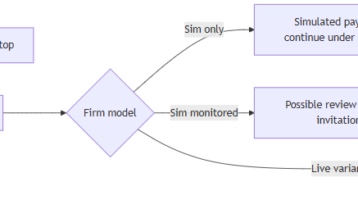
Prop-firm rules vary significantly and can change without notice. The examples below are based on publicly available firm policies reviewed in July 2026. Traders must always read the latest rules for their chosen firm, account type and trading platform.
Myth 1: The Advertised Prop-Account Size Is Real Trading Capital
A headline account size such as $50,000, $100,000 or $150,000 does not normally represent the amount of capital a trader can lose. In an evaluation or simulated-funded account, the advertised figure generally represents notional buying power and the contract limits associated with the account.
The trader’s practical risk capital is much closer to the maximum permitted drawdown.
| Advertised Account Size | Example Maximum Loss Limit | Loss Allowance as a Percentage of Headline Size |
|---|---|---|
| $50,000 | $2,000 | 4% |
| $100,000 | $3,000 | 3% |
| $150,000 | $4,500 | 3% |
Topstep, for example, states that its $50K, $100K and $150K accounts carry maximum loss limits of $2,000, $3,000 and $4,500 respectively. It also explains that an Express Funded Account starts with a balance of $0 and that the headline account size refers to buying power rather than starting cash.
Therefore, a trader claiming to control twenty $100,000 accounts may describe this as $2 million in funding, but the combined nominal loss allowance could be closer to $60,000 before allowing for trailing drawdown movement, commissions, slippage, previous losses, payout withdrawals and the safety buffer required to avoid account closure.
Twenty accounts labelled $100,000 are not economically equivalent to a $2 million brokerage account containing $2 million of real, loss-bearing capital.
The Real Prop Account
The practical account should be viewed as:
Permitted drawdown minus commissions, slippage, accumulated losses, withdrawal effects and a safety buffer.
The headline account size may determine buying power and maximum contracts, but the drawdown determines how much adverse movement the trader can survive.
Myth 2: More Accounts Automatically Mean Less Risk
Multiple accounts can increase potential payouts, but they can also multiply operational risk, platform risk, copier risk and the financial cost of failed evaluations or account activations.
If one poor decision is copied across twenty accounts, the trader has not diversified the risk. The trader has multiplied the same concentrated decision twenty times.
Real diversification normally requires differences in instruments, strategies, time horizons, market phases or risk exposures. Repeating the same Nasdaq trade across many accounts is account replication, not strategy diversification.
Some firms also prohibit account stacking, coordinated trading, cross-account hedging or repeatedly taking oversized risks across a sequence of accounts. Topstep’s published prohibited-conduct policy includes account stacking, coordinated trading and cross-account hedging among the practices that can result in warnings, payout denial, resets or account closure.
Myth 3: A Fully Mechanical Trading System Can Be Switched On and Left to Survive Every Prop-Firm Rule
Some prop firms permit automated strategies, but permission to use automation is not the same as confirmation that every automated strategy is suitable for the firm’s rules.
Topstep currently permits automated strategies with conditions, but states that it will not configure or troubleshoot them and will not make exceptions for erroneous trades or system malfunctions. Its live-account policy also prohibits automated trading through certain APIs.
MyFundedFutures permits automated strategies using the trader’s own settings, but prohibits high-frequency methods and systems designed to exploit favourable simulated fills. It also requires automated trading in live accounts to comply with CME guidelines.
A mechanical system may be technically permitted and still fail because it does not account adequately for:
- Trailing or real-time drawdown movement
- Daily loss limits
- Maximum position-size rules
- Consistency requirements
- News-trading restrictions
- Changes in liquidity and volatility
- Simulated fills that cannot be reproduced live
- Slippage during fast markets
- Connection, platform or data-feed failures
- Contract rollover and trading-session changes
- Payout withdrawals that reduce the remaining account buffer
A fully automated system does not understand that the trader is close to a payout, that a withdrawal has reduced the safety buffer or that the current market is unsuitable unless these conditions have been explicitly designed, coded, tested and maintained.
Automation can improve consistency, but unattended automation can also repeat the same mistake faster and across more accounts.
Myth 4: Profits Produced in Simulation Will Transfer Directly to Live Trading
Simulated trading can provide valuable practice, but simulated execution is not identical to live-market execution.
Topstep specifically prohibits strategies designed to exploit unrealistic simulator behaviour, including rapid scalping algorithms, preferential simulated queue positions, improbable fills in gapped markets, unrealistic stop execution and extremely tight brackets that depend on favourable simulated fills.
MyFundedFutures similarly warns that some strategies can perform well in simulation but produce losses when transferred to live markets because they depend on simulated fill behaviour, minimal slippage or ideal execution.
A strategy should therefore be assessed on more than its simulated net profit. Traders should examine:
- Average trade duration
- Average profit per trade after commissions
- Expected live slippage
- Maximum adverse excursion
- Maximum consecutive losses
- Performance during volatile and illiquid conditions
- Dependence on limit-order queue position
- Dependence on immediate stop or target execution
A strategy producing a very small average profit per trade may look excellent in simulation but become unviable after realistic live costs and slippage.
Myth 5: Traders Can Remain on Simulated-Funded Accounts Forever
Many traders assume they can continue collecting payouts from several simulated-funded accounts indefinitely without ever being moved to live capital.
That assumption is unsafe.
Topstep describes the simulated Express Funded Account as a proving ground for progression to a Live Funded Account. When its Risk Team determines that a trader is ready, the trader cannot decline the live invitation and remain in the Express Funded Account. All Express Funded Accounts are closed when the trader moves to one Live Funded Account.
MyFundedFutures similarly states that consistently profitable simulated-funded traders may be invited to a Live Funded Account, that the move cannot be rejected and that multiple simulated-funded accounts can be merged into one live account.
This does not mean every firm moves every trader live at the same time. It means traders should not build a business plan that depends on retaining a large collection of simulated-funded accounts permanently.
Simulated-funded payouts can be real money, but the account producing the result is still simulated until the firm specifically confirms that the trader has entered a live brokerage environment.
Myth 6: Multiple Accounts Can Always Be Mirrored After Moving to Live Trading
Trade copying may be permitted during evaluations or simulated-funded stages while being restricted or unavailable in live trading.
Topstep allows its platform trade copier across Trading Combine and Express Funded Accounts, but states that its Live Funded Account cannot use the copier. It also limits traders to one active Live Funded Account and closes their Express Funded Accounts when they move live.
MyFundedFutures states that multiple simulated-funded accounts may be merged into one Live Funded Account.
Therefore, a trader should not assume that ten or twenty mirrored simulated accounts will remain ten or twenty mirrored accounts after a live transition.
Before purchasing multiple accounts, obtain clear answers to the following questions:
- Can the accounts be copied during the evaluation?
- Can they be copied during the simulated-funded stage?
- Can they still be copied after moving live?
- Will the firm merge the accounts into one live account?
- Does the firm permit third-party trade-copying software?
- Are cross-firm copying and coordinated trading permitted?
- Who is responsible when one follower account receives a different fill?
Myth 7: Trade Copiers Remove Execution Risk
A trade copier reduces repetitive manual order entry, but it does not guarantee identical executions.
Follower accounts can receive different fill prices because of liquidity, slippage, processing delays, platform disconnections or differences in each account’s contract limit and risk settings. Topstep warns that follower fills can vary and that the copier may disconnect when account scaling levels differ or when risk limits are triggered.
The lead account may enter successfully while one or more follower accounts reject the order. Stops or targets can then become mismatched, leaving accounts with different positions.
Every copied account must therefore be monitored. A copier is an execution tool, not a transfer of responsibility.
Myth 8: Prop Firms Allow Traders to Follow Any Guru or Live Trade-Calling Group
There is an important difference between receiving market education and copying another trader’s live orders.
A trader may be able to attend an educational group that discusses market structure, risk, potential setups, economic news and trading methodology. However, blindly duplicating another person’s entries and exits may conflict with rules requiring independent trading activity.
Topstep prohibits coordinated trading performed in concert with other people and prohibits trading on behalf of others.
MyFundedFutures states that every trader must maintain individual trading activity and personally enter, exit and cancel trades. Its rules prohibit traders from copying one another. It also requires each account to be traded exclusively by its owner.
Attending a group is not necessarily the violation. The potential problem is surrendering the trading decision to a third party and reproducing coordinated trades without independent analysis or control.
A Safer Educational Model
A responsible trading group should help the trader understand:
- The current market phase and higher-timeframe context
- Important economic events and risk periods
- Potential long and short scenarios
- Correlation between related markets
- Where a setup becomes invalid
- How much risk is appropriate
- When standing aside may be the best decision
The trader should remain responsible for deciding whether a setup is valid for the trader’s own account, rules, risk allowance and trading plan.
Myth 9: Passing an Evaluation Proves That a Trader Is Consistently Profitable
An evaluation pass demonstrates that a profit target was reached without breaching the required rules. It does not prove that the trader has a durable edge across different market conditions.
A trader can pass because of one strong market phase, one unusually profitable day, excessive risk or favourable simulated execution. This is why many firms apply consistency objectives, payout qualification periods, scaling plans and additional risk reviews after the evaluation.
Topstep, for example, applies consistency objectives during its evaluation and offers funded payout paths requiring qualifying winning days or a defined consistency percentage.
The more important test is whether the trader can protect the funded account, qualify for payouts repeatedly and adapt when the original market conditions change.
Myth 10: A High Win Rate Is the Key to Prop-Trading Success
A high win rate can be attractive, but it means little without understanding the size of the average win, average loss and maximum losing sequence.
A strategy that wins 85% of its trades but loses five times its normal profit on each losing trade may be less suitable than a strategy that wins 45% of its trades with well-controlled losses and larger average winners.
Prop accounts are especially vulnerable to strategies that accumulate many small wins before one oversized loss reaches the daily or maximum drawdown limit.
Important measurements include:
- Average win compared with average loss
- Maximum consecutive losses
- Largest historical losing day
- Expected drawdown
- Profit factor after costs
- Risk per trade as a percentage of the permitted drawdown
- Probability of reaching the firm’s loss limit
The correct objective is not the highest possible win rate. It is a repeatable positive expectancy that can survive the prop firm’s loss limits.
Myth 11: Prop Trading Is Easier Than Trading a Personal Brokerage Account
Prop trading can reduce the trader’s initial capital requirement, but the trading process is often more restrictive.
A personal brokerage account does not normally impose a profit target, consistency percentage, minimum number of winning days, payout qualification window or simulated-to-live promotion process. The brokerage account remains subject to margin, leverage and liquidation risk, but the trader usually controls withdrawals and can decide how much capital to retain as a buffer.
A prop trader must manage the market while simultaneously managing another company’s account rules.
This can make prop trading operationally harder because the trader must satisfy:
- A narrow maximum-loss allowance
- Daily loss restrictions
- Trailing drawdown calculations
- Contract limits
- Consistency requirements
- Minimum trading-day requirements
- Payout caps and withdrawal conditions
- News and holding-time restrictions
- Automation and copier policies
- Live-transition decisions made by the firm
Futures trading is already highly leveraged. Adding a narrow prop-firm drawdown creates an additional failure boundary that may close the account before a strategy has enough time or capital to recover from a statistically normal losing period.
Myth 12: The Statement That “95% of Prop Traders Fail” Is a Verified Universal Statistic
The frequently repeated 90% or 95% failure claim is not a single independently audited statistic covering every prop firm, account type, country and period.
Actual results depend on how failure is defined. A trader may fail an evaluation, pass but never receive a payout, receive one payout and later lose the account, or remain funded without achieving a positive return after fees.
Business Insider reported company-provided Topstep figures indicating that 12.4% of traders obtained funding in 2024 and that 28.3% of those funded traders received a payout. The figures illustrate substantial attrition, but they should not be treated as a universal audited result for the entire prop-trading industry.
Topstep also states that more than 63% of traders who lost an account did so in a single trading day, highlighting the importance of daily risk control.
Why So Many Prop Traders Struggle
- They trade the headline account size instead of the permitted drawdown.
- They use the maximum available contracts too early.
- They attempt to pass as quickly as possible.
- They overtrade after small losses.
- They rely on one market condition or one instrument.
- They withdraw too much and leave no account buffer.
- They repeatedly purchase new accounts instead of correcting the underlying behaviour.
- They follow trade calls without developing independent decision-making skills.
- They use automation that was not designed around the firm’s exact rules.
- They underestimate the difference between simulated and live execution.
Other Common Prop-Trading Delusions
“The Maximum Contract Limit Is the Recommended Position Size”
The maximum contract limit is an absolute ceiling, not a recommendation. Trading the maximum size can expose a narrow drawdown allowance to a very small adverse market movement.
“A Payout Means I Have Mastered Trading”
A payout is an achievement, but one payout does not prove long-term consistency. Market phases change, and a method that performed well during one month can enter a prolonged drawdown later.
“I Am Not Risking My Own Money”
The trader may not be liable for the firm’s market loss, but evaluation fees, activation fees, resets, data charges, platform costs and the trader’s time are personal economic risks.
“I Can Withdraw Every Available Dollar”
A large withdrawal can leave the account with little room for normal drawdown. MyFundedFutures advises traders to retain a reasonable buffer rather than withdrawing all available profits.
“The Rules Will Stay the Same”
Prop firms can modify account structures, payout policies, live-transition rules, platform availability and prohibited practices. A strategy built around one rulebook must be reviewed whenever the firm changes its terms.
“A Bigger Account Is Always Better”
A larger headline account may permit more contracts, but it may also have a higher profit target and encourage excessive position sizing. The best account is the one whose drawdown and contract structure match the trader’s tested risk model.
Pure Discretionary Trading, Full Automation, Guru Following and ATS Hybrid Algo Trading
| Approach | Potential Strengths | Primary Weaknesses |
|---|---|---|
| Pure Discretionary Trading | Flexible, responsive and able to interpret unusual market conditions | Vulnerable to hesitation, impulsive entries, revenge trading, inconsistent exits and emotional position sizing |
| Fully Automated Trading | Consistent execution, repeatable rules and reduced hesitation | Can continue trading in unsuitable conditions, repeat faults rapidly and breach firm rules when unattended, 99% guaranteed to have a drawdown that breaches 5% to 10%, the the worst way to trade prop firm rules. |
| Guru Calls or Trade Following | Can provide education, market ideas and exposure to experienced analysis | Creates dependency, delayed entries, mismatched risk and potential conflicts with independent-trading or coordinated-trading policies |
| ATS Hybrid Algo Trading | Man and machine, best flexibility and control, doenst go out of date and is geared towards delivery of the maximum profit, minimum drawdown, and least emotion. | Still requires training, active supervision, discipline, and the trader’s independent decisions |
A Practical Prop-Trader Due-Diligence Checklist
- Convert the advertised account size into its actual maximum-loss allowance.
- Calculate risk per trade as a percentage of the drawdown, not the headline balance.
- Read the latest evaluation, funded, payout and live-account rules separately.
- Confirm whether automated strategies are allowed on the chosen platform.
- Confirm whether a trade copier is permitted in evaluation, simulated-funded and live stages.
- Ask what happens to multiple accounts when the trader is promoted to live capital.
- Confirm whether live trade calls, coordinated trading or third-party copying are prohibited.
- Understand how withdrawals affect the remaining loss buffer.
- Use a personal daily-loss limit below the firm’s maximum threshold.
- Allow for commissions, slippage and rejected orders in all testing.
- Keep records of trades, screenshots, statistics and rule changes.
- Use independent judgment and remain responsible for every order placed.
Conclusion: Prop Trading Is a Risk-Control Challenge, Not a Shortcut
Prop firms can provide a valuable route for disciplined traders to access futures buying power and pursue payouts without depositing the capital required for a comparable personal brokerage account.
However, the opportunity should not be confused with receiving the advertised account balance as personal risk capital. The trader is operating inside a narrow loss allowance, under a detailed rulebook, with the possibility of simulated-to-live transition, account consolidation, copier restrictions and payout conditions.
Pure discretionary trading can be affected by emotion and inconsistent execution. Fully unattended automation can continue trading when conditions or account rules require intervention. Guru trade following can create dependency and may conflict with independent-trading requirements.
ATS Hybrid Algo Trading offers a more practical middle path: the trader controls context, direction and risk while technology supports disciplined execution, trade management and reduced emotional interference.
The objective is not to switch on a robot or copy another trader. The objective is to become a capable, independently responsible hybrid trader who can use technology without surrendering control.
Book a Free ATS Discovery Meeting to discuss your prop-trading goals, current experience and the most suitable ATS self-assisted or Fast Track pathway.