NinjaTrader Automated Trading by Algo Futures Trader

hybrid algorithmic automated futures trading for prop firm traders, day & swing traders

🚀 Get Started 🔴LIVE
  • 🚀Get Started
  • NinjaTrader
  • Get Funded
  • Trading Servers
  • Pricing
  • blog
  • Help

A Guide to Trading a $50K Futures Prop-Firm Account

June 17, 2026 by AFT

🛡️ Position Size and Risk Management

Capital protection comes first.

The objective is to survive, trade steadily, and collect small, consistent gains over time. Focus on executing the trading plan correctly rather than forcing a daily profit target. When risk and execution are controlled, the financial results can take care of themselves.

💰 $50K Prop Account Example

A “$50K account” does not normally mean that the trader has $50,000 available to lose. The account’s practical risk capital is its permitted drawdown.

Example account parameters:

  • Nominal account size: $50,000
  • Trailing drawdown: $2,000
  • Suggested daily target: $100–$250 per account
  • Suggested risk per trade: $150–$250
  • Maximum trades: normally 1–3 quality trades per session

A $150 risk represents approximately 0.3% of the nominal account size, while $250 represents 0.5%.

More importantly, this equals approximately 7.5%–12.5% of the account’s $2,000 drawdown allowance.

In simple mathematical terms:

  • $2,000 ÷ $150 = approximately 13 losses
  • $2,000 ÷ $250 = 8 losses

However, traders should never plan to use the entire drawdown. The actual margin for error may be smaller because of trailing-drawdown movement, commissions, fees, slippage, and previous trading losses.

Risk per trade must therefore remain well below the available drawdown to reduce the chance of early account failure.

📏 Position-Size Guide

The following examples use a session-breakout trade with an approximate 20% Fib Grid stop loss:

  • 1–2 MNQ: approximately $250–$500 risk per trade
  • 3–6 M2K: approximately $150–$450 risk per trade

These figures are estimates. Actual risk depends on the entry price, stop-loss distance, contract value, market conditions, commissions, and slippage.

Adjust the stop-loss price to fit the trade structure. A limit order may also provide a better entry and reduce the total risk.

A 10% Fib Grid stop loss may be used for tighter risk control, but a tighter stop can result in more frequent stop-outs during choppy markets, normal retracements, or volatile opening conditions.

Never reduce the stop distance simply to justify trading a larger position.

⚖️ Instrument Comparison

Approximate position-size relationships:

  • 1 MNQ ≈ 4 M2K
  • 1 RTY ≈ 3 MNQ
  • 1 RTY ≈ 10 M2K

These are practical risk comparisons rather than exact fixed equivalents. Volatility and stop-loss distance can change the real risk significantly.

M2K

M2K generally provides greater position-sizing flexibility.

A trader may enter with several micro contracts and then scale out, partially exit, or reduce the position as required. This can make risk easier to control.

For many developing traders, 1–3 M2K contracts may provide a calm and manageable starting point. Larger positions, such as 3–6 contracts, should only be used when the calculated dollar risk remains within the trade plan.

MNQ

MNQ is generally faster, more volatile, and more sensitive to price movement.

Even one contract may create more risk than a developing trader is comfortable accepting. Because one contract is the minimum position, its risk cannot be reduced through smaller contract sizing.

This makes MNQ less forgiving when the stop-loss distance is wide or market conditions are unstable.

🚦Practical Risk Rules

Before entering a trade:

  1. Identify the correct technical stop location.
  2. Calculate the dollar risk for one contract.
  3. Select a position size that remains within the permitted risk.
  4. Include commissions and possible slippage.
  5. Skip the trade when the minimum contract size creates too much risk.

A trade is not valid simply because a setup appears. It must also fit the account’s risk limits.

Consider stopping for the session after:

  • Reaching the planned daily target
  • Taking two consecutive losses
  • Reaching the personal daily loss limit
  • Breaking a trading rule
  • Encountering unstable or unusually volatile market conditions

The prop firm’s maximum daily-loss rule is an emergency boundary—not a daily risk allowance.

📝 Final Note

Trading done correctly is often boring and may not feel like trading at all.

There should be no need to chase the market, force trades, recover losses, or create excitement. Consistent execution is more important than frequent action.

For many traders, trading 1–3 M2K contracts and taking only one to three high-quality trades fits this approach better than trading MNQ.

Less is more. Trade less, select quality setups, and keep risk under control.

Filed Under: Get Funded, get funded trading, Micro EMini Equity Futures, prop firm trading Tagged With: positoin sizing, risk managment


🚀 Get Started 100% FREE!

The Best Path to Getting Funded Trading Futures

June 17, 2026 by AFT

get funded trading futures

From a Fair Evaluation to Sim Funded, Pre-Live, and Real Live Trading

The best futures prop firm should offer more than a cheap evaluation or an impressive-looking account size.

A proper funding program should provide a clear progression:

Fair simulated evaluation → simulated funded/PA account with real payouts → Pre-Live transition → fully live brokerage trading with a workable risk allocation and position size.

This progression allows traders to develop their skills, demonstrate consistency, receive payouts, and eventually trade real firm capital under realistic brokerage conditions.

However, not every futures prop firm follows this complete pathway. Some firms remain entirely simulated. Others place strict limits on simulated payouts before forcing traders into live accounts. Some advertise large account sizes but provide only a very small live loss allowance or position limit.

Traders should therefore examine the entire funding route—not just the evaluation price.

Stage 1: A Fair Simulated Evaluation

The evaluation or challenge is the first stage of the process.

Its purpose should be to determine whether a trader can:

  • Follow a trading plan
  • Control risk
  • Trade consistently
  • Respect the maximum drawdown
  • Avoid excessive position sizing
  • Reach a realistic profit target

A fair evaluation should provide clear rules and enough time for the trader to demonstrate skill.

Important features include:

  • A reasonable profit target
  • End-of-day drawdown where possible
  • Workable contract limits
  • Clear news-trading and holding rules
  • No hidden restrictions
  • No unnecessary pressure to overtrade
  • A transparent path to the funded stage

An evaluation should test trading ability—not encourage traders to gamble in an attempt to pass quickly.

Stage 2: Simulated Funded or Performance Accounts

After passing the evaluation, the trader normally moves into a simulated funded account. Depending on the firm, this may be called a:

  • Funded Account
  • Performance Account
  • PA Account
  • PRO Account
  • Qualified Account
  • Master Account
  • Sim Funded Account

These accounts may carry labels such as $25K, $50K, $100K or $150K, but the account size is normally a program tier rather than actual cash deposited into a brokerage account.

The more important figures are:

  • Maximum loss or drawdown allowance
  • Starting contract quantity
  • Scaling rules
  • Payout requirements
  • Payout caps
  • Profit split
  • Consistency rules
  • Minimum trading days
  • Live-transition policy

For example, a nominal $150K simulated funded account may provide a $4,500 drawdown and permission to trade several mini or micro contracts. The $150K label does not mean that the trader controls $150,000 of real cash.

Receiving Real Payouts From Simulated Trading

Although trading in a funded or PA account may be simulated, approved payouts are real payments made by the prop firm.

This is one of the most important stages of the funding process. It allows the prop firm to assess whether the trader can remain disciplined after becoming eligible to withdraw money.

Traders should compare:

  • How quickly the first payout becomes available
  • Whether a safety buffer must be built
  • The minimum and maximum payout
  • The trader’s profit share
  • The number of qualifying trading days
  • Any consistency requirement
  • Whether payouts reduce the remaining drawdown
  • Whether there is a lifetime payout limit
  • Whether repeated payouts trigger a live transition

Some firms allow frequent payouts but place strict caps on each request. Others allow larger payouts after five or ten qualifying days. Some firms review traders for live trading after a fixed number of successful withdrawals.

A profitable trader should understand what happens after the third, fifth or tenth payout—not only how to qualify for the first payout.

Stage 3: Pre-Live Trading

A Pre-Live account can provide a useful bridge between simulated funded trading and fully live brokerage execution.

Pre-Live may involve:

  • A controlled or monitored trading environment
  • Smaller contract limits
  • Live-style risk controls
  • A protected starting balance
  • More frequent payout access
  • A performance target before real capital is deployed

The purpose is to confirm that the trader can continue following the same methodology under conditions that resemble live trading.

A good Pre-Live program should clearly disclose:

  1. Whether orders are simulated, mirrored or exchange-routed
  2. How much profit must be generated
  3. How long the Pre-Live stage can continue
  4. Whether withdrawals are permitted
  5. What conditions trigger the fully live account
  6. What happens if the trader declines the transition

Pre-Live should be a genuine stepping stone—not another evaluation with unclear rules.

Stage 4: Fully Live Brokerage Trading

The final stage is a real brokerage account in which orders are routed to the futures exchange.

This is where the advertised account size can become especially misleading.

A live account may be described as starting at $0 while still allowing the trader to hold one or more futures contracts. This does not necessarily mean the underlying brokerage arrangement has no capital.

Instead, the structure may look like this:

Live-account measureExample
Trader-facing P&L balance$0
Maximum loss guard−$2,000
Starting position size2 minis or 20 micros
Scaled position size4 minis or 40 micros
Trader profit share80%–90%
ExecutionLive exchange-routed orders

The prop firm supplies or controls the brokerage margin needed to support the permitted positions. The trader’s account is then managed through a risk limit or drawdown guard.

The true live account should therefore be measured using:

  • Live maximum loss allocation
  • Number of minis permitted
  • Number of micros permitted
  • Scaling thresholds
  • Daily loss controls
  • Profit split
  • Withdrawal conditions
  • Brokerage and clearing arrangements

A nominal $150K live tier with a $4,500 loss guard and six-mini position limit is not the same as a personally owned brokerage account containing $150,000.

Nevertheless, it can still provide a workable live trading facility when the risk allocation and contract limits are sufficient for the trader’s strategy.

What Is a Workable Live Position Size?

The answer depends on the market and trading methodology, but a practical live starting facility may provide at least:

  • 1–3 mini contracts, or
  • 10–30 micro contracts

A larger live program may allow:

  • 4–8 minis
  • 40–80 micros
  • Additional scaling as profits accumulate

Position capacity should always be considered alongside the loss allowance.

A live account allowing six minis but only a very small loss limit may encourage excessive risk. Conversely, a modest contract limit combined with a reasonable fixed drawdown can provide a more sustainable route.

The objective is not to trade the maximum number of contracts. It is to have enough capacity to use a proven trading method while keeping risk controlled.

The Weak Prop-Firm Model

Traders should be cautious of the following structure:

Cheap evaluation → large simulated account → several capped payouts → forced live transition → tiny live loss allowance → all simulated accounts closed.

A trader may progress from several nominal $100K or $150K simulated accounts into one much smaller live risk facility.

Although the final account may technically be live, it may not provide enough drawdown or position capacity to continue trading the same strategy effectively.

Before choosing a firm, ask:

  • Can I remain in simulated funding?
  • Is the live transition mandatory?
  • How many payouts trigger a review?
  • What happens to unpaid simulated profits?
  • How many accounts move into live?
  • What is the actual live loss allocation?
  • How many mini and micro contracts are permitted?
  • Does the account start with a protected balance?
  • Can the live position size scale?
  • What happens if the live account is closed?

The Strong Prop-Firm Model

The strongest overall structure is:

Pass a fair evaluation, earn genuine payouts in a simulated funded account, demonstrate consistency through Pre-Live and then receive a properly supported live brokerage account.

This provides benefits for both parties.

The trader receives:

  • A structured route into professional trading
  • Reduced personal capital exposure
  • Real payout opportunities
  • Time to prove consistency
  • A pathway toward live execution
  • Scalable position capacity

The prop firm receives:

  • Verified performance data
  • Evidence of risk control
  • A record of successful payout cycles
  • A trader who has demonstrated consistency before real capital is allocated

This is how a futures funding program can become a genuine trader-development pathway rather than simply an evaluation-sales business.

Choosing the Right Futures Prop Firm

There is no single firm that is best for every trader.

Some traders prefer to remain in simulated funded accounts and collect regular payouts. Others want to progress into live brokerage trading. Some value daily payouts, while others prioritize a larger drawdown and higher position capacity.

Compare firms using the complete funding journey:

StageWhat to compare
EvaluationTarget, drawdown, cost and rules
Sim fundedPayouts, profit split and account limits
TransitionNumber of payouts and whether live is mandatory
Pre-LivePerformance requirements and withdrawal access
LiveLoss allocation, margin support and contract limits
ScalingHow buying power increases
Exit rulesWhat happens if the account closes

Do not select a prop firm based only on the advertised account size or evaluation discount.

Get Funded Trading Futures With ATS

Algo Trading Systems provides hybrid futures trading technology, structured workspaces, education and support for traders progressing through evaluation, simulated funded and live trading environments.

The objective is to help traders combine human decision-making with systematic market analysis and adaptive trade management while remaining responsible for every trading decision.

Explore the available prop-trading resources, supported solutions and current funding opportunities on the ATS Get Funded page:

Get Funded Trading Futures

Final Thoughts

The most valuable prop-firm pathway is not simply:

“Pass a challenge and receive a large account.”

It is:

Develop consistency in simulation, earn real payouts, prove the ability to manage risk and progress into live brokerage trading with sufficient loss allocation and position capacity.

The advertised account label is only one part of the offer.

The real value lies in:

Fair rules + reliable payouts + a sensible transition + workable live risk and buying power.


Trading futures involves substantial risk and is not suitable for every trader. Simulated results do not guarantee future live performance. Prop-firm rules, payout policies, and account conditions may change. Traders should review the current terms of each provider before purchasing an evaluation or trading account.

Filed Under: Get Funded, get funded trading, prop firm trading Tagged With: prop firm trading, top one futures


🚀 Get Started 100% FREE!

Important Update: Get Funded Subscriptions Discontinued GFA Program REBOOTED

January 27, 2025 by AFT

🚀 Get Funded Accelerator (v2) — Zero to Hero Fast Track

Start with a full-feature 7-Day ATS Free Trial and unlock access to the Get Funded Accelerator pathway, including up to 90% discounts on prop firm evaluations.

This is a structured, no-guesswork route designed to take you from first trade → evaluation ready using proven turnkey workspaces and hybrid trading workflows.


🎯 Zero to Hero — 5 Stages in 5 Days

Progress through 5 structured stages in 1 week — 1 stage per day — building real trading skill step by step.

Each stage includes:

  • Live NYSE session insights
  • AI Copilot guidance
  • ATS Help Bot support
  • Trading group interaction

By Stage 5, you are positioned for simulation, evaluation, or live hybrid trading.


🧠 Trading Progression Path

✨ VIP Group — NYSE Session Live Market Copilot

✅ Stage 1: AFT trade signals + automated exits
→ Learn execution, timing, and structure

✅ Stage 2: AFT hybrid auto trades + auto exits
→ Introduce controlled automation

✅ Stage 3: AFT multi-timeframe + hybrid trading
→ Build trend alignment and confidence

✅ Stage 4: AlphaWebTrader + AFT MTF hybrid trading
→ Full confirmation suite + precision execution

🏆 Stage 5: VIP trading — evaluation, prop, or live
→ Apply your edge in real conditions


🏁 End of Trial Path

At the end of your 7-day progression:

  • Advance to VIP → Continue with full tools, support, and prop pathways
  • Or downgrade to Freemium → Maintain limited access and continue learning

💡 Key Objective

The goal is simple:

Build competence first → then performance → then funding.

All traders should progress Stage 1 → Stage 5 in order to properly understand the system across both breadth and depth, before moving into evaluation or live trading environments.


🔥 Outcome

  • Structured learning (no random trading)
  • Hybrid trading mastery (man + machine)
  • Clear path to prop firm evaluation
  • Access to high-discount evaluation opportunities (up to 90%)

Filed Under: AFT8, Get Funded Tagged With: Get Funded Accelerator


🚀 Get Started 100% FREE!

Trading System Win Rates: Ranges, Realities, and Refinements

January 5, 2025 by AFT

I was recently asked, “What win ratio percentage do your algos achieve?” This is a broad and open-ended question. It is a good question, but not a great one. It is not the kind of question a professional trader or fund manager would usually ask. They would be more likely to ask about NAV, percentage return, drawdown, or, better still, expectancy—and then discuss win ratio, risk-reward, and system preference from there.

Let’s put the question into proper perspective.

AFT (Algo Trading Framework) is a comprehensive trading framework with preconfigured turnkey systems that give traders a ready-made starting point. At the same time, it also allows traders to configure, combine, and even code their own system rules. With such a broad range of features and flexibility, there is no single answer to what a system can achieve. The permutations are extensive, and traders can spend years refining, optimizing, and evolving their own approach if they choose.

For many traders, the journey begins with the turnkey systems, which provide a solid baseline. From there, traders can learn the process, optimize their execution, experiment carefully, and build a more personalized approach. Some traders keep things simple and stay close to the turnkey setups, while others evolve into a highly refined hybrid trading style. Either way, AFT adapts to the trader’s skill level and objectives.

Win Rates Vary Widely

Trading system win rates can vary widely depending on the trader’s goals, the style of system, the market traded, and the system rules in play. In general, trading systems can range anywhere from 35% to 95% win rates. However, win percentage alone tells very little unless you also understand the risk-reward profile and the expectancy of the system.

Baselines, Win Rates, and System Profiles

At Algo Trading Systems, baseline systems are intended to be starting points. They are not fixed promises, guarantees, or magic settings. They are framework baselines that reflect a certain trading style and system profile, and the actual results always depend on the trader, the rules being used, market conditions, and execution quality.

Typical Baseline Ranges

  • Session Breakout System: 50% to 66% is a typical range.
  • Trend Scalper System: 66% to 85% is a typical range.

These are not hard promises. They are typical baseline profile ranges and depend entirely on the system rules in play, which ultimately comes down to the trader.

Baseline Profile by System Type

Baseline Session Breakout is generally a looser system profile. It is broader in structure and typically targets around 50% average win rate with a positive risk-reward goal of approximately 1:1.25.

Baseline Trend Scalper is generally a tighter system profile. It is designed to seek more frequent accuracy and typically targets around 65% average win rate with a 1:1 risk-reward goal.

This is why win percentage on its own can be misleading. A lower win rate with better risk-reward can outperform a higher win rate with poor expectancy. The real question is always how win ratio and risk-reward work together over a meaningful sample of trades.

In the real world, traders using hybrid methods, better trade selection, timing, and execution may improve on the baseline profile substantially. That improvement comes from skill, discretion, and experience—not from simply chasing settings.

Why Win Percentage Alone Is Misleading

Win percentage is an important metric, but it cannot determine profitability on its own. For example, a system with a 95% win rate could still lose money after commissions, slippage, and costs if the losses are too large relative to the wins.

A more useful measure combines win ratio and risk-reward into expectancy. For example:

  • A 65% win rate with a 1:1 risk-reward ratio is excellent.
  • A 50% win rate with a 1:2 risk-reward ratio would be exceptional.
  • A 50% win rate with a 1:1.25 risk-reward ratio is more typical and sustainable.

Example: High Win Ratio Scalper System (ES Futures)

Consider a scalping system with the following parameters:

  • Stop: 24 ticks
  • Target: 8 ticks

If we assume random price movement without any real edge or strategy, the probability of price hitting the target or stop is broadly related to their relative distances from entry. The nearer price objective is more likely to be reached first.

Probabilities

  • Target Being Hit: 75%
  • Stop Being Hit: 25%

That means the system could achieve a 75% win rate largely on distance bias alone, even without any genuine trading edge.

Adjusted Example: Smaller Target

  • Stop: 28 ticks
  • Target: 6 ticks
  • Total Distance: 34 ticks

Probabilities

  • Target Being Hit: 82.35%
  • Stop Being Hit: 17.65%

In this case, the target is 82.35% likely to be hit because it is much closer to the entry point than the stop.

Caveats of High Win Ratios

While this kind of system heavily favors hitting the target, it also creates a poor risk-reward profile. In this example, the system would need a very high win rate just to overcome the imbalance.

Improving the System

The way to improve a system is not simply by pushing targets closer to inflate the win rate. A better approach is to align trading with high-probability times and better conditions.

  • Stop: 20 ticks
  • Targets: 20, 40, and 100

With trading skill and discipline, it is realistic to move a system from around 50% to 65% or higher.

Introduction to Expectancy

Expectancy combines win percentage and risk-reward ratio to estimate the average outcome per trade.

Expectancy Example 1: Negative

  • Loss: 24 ticks
  • Reward: 12 ticks
  • Win %: 66%

Expectancy = (0.66 × 12) − (0.34 × 24) = -0.24

This system loses over time despite a strong win rate.

Expectancy Example 2: Positive

  • Loss: 24 ticks
  • Reward: 20 ticks
  • Win %: 66%

Expectancy = (0.66 × 20) − (0.34 × 24) = +5.04

This system is profitable over time.

Combining Systems for Success

Using AWT with AFT improves trade selection and confirmation, increasing win rate and expectancy without changing stops or targets.

Traders may achieve 85%+ in strong conditions, but a consistent ~66% with 1:1 risk-reward is already high-level performance.

Conclusion

Hybrid trading allows you to increase win rate without destroying system profile. The goal is not chasing settings but improving execution, timing, and discipline.

It is about refining one robust method until performance becomes consistent and repeatable.

A Simple Analogy

Think of it like a Tesla on autopilot vs. a skilled driver. The system performs—but the human enhances performance through adaptation and control.

Trading is dynamic. The edge comes from human + machine, not automation alone.

Filed Under: AFT Trading Videos, AFT8, Algo Futures Trader, automated futures trading system, automated trade entry, automated trade management, Automated Trading Videos, Get Funded Tagged With: automated futures trading, automated futures trading software, automated futures trading strategies, automated futures trading system, automated futures trading systems, Automated Trading NinjaTrader, automated trading with ninjatrader, best automated futures trading software, fully automated trading system, futures algo trading, futures algorithmic trading, futures automated trading, futures trading algorithms, ninjatrader algorithmic trading, ninjatrader automated trading, ninjatrader automated trading systems, ninjatrader trading bot, ninjatrader trading systems


🚀 Get Started 100% FREE!

Get funded Accelerator for NinjaTrader hybrid automated trading save 80% forever on evaluation trading

May 31, 2024 by AFT

As of June 2024, AlgoFuturesTrader is free for simulation, replay, backtesting, and NinjaTrader demo account trading. A license will be required for trading non-approved prop firm evaluation accounts. For more details, view: Notice From June 2024 AFT is free for sim, replay and NinjaTrader demo account trading only paid for live and prop firm trading

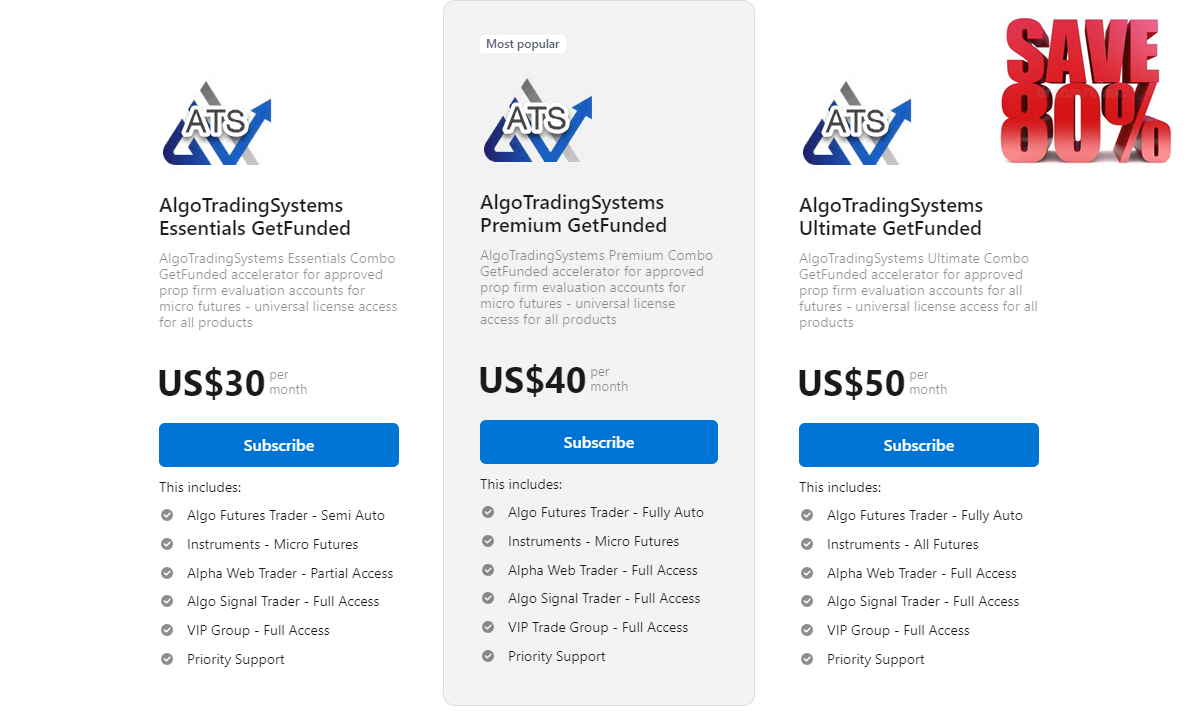
Get Funded Accelerator Save 80%

PLUS get an extra 25% off! with promo coupon GetFunded25 or use the coupon given to you by any of our trusted affiliates.


ATS Pricing 2024 Reduced


Get Funded Accelerator Subscriptions

The great news is that evaluation trading for Apex and Bulenox Rithmic trading accounts will be possible with an 80% saving off the list prices!

  • Get Funded Here with Apex or Bulenox
  • Get Funded Accelerator View Here
  • Further discount promos can be applied!

Over time, we aim to add more providers to this list and to add Tradovate accounts. This will depend on the ability to detect evaluation accounts and differentiate from live and performance accounts, so keep in contact for news on this.
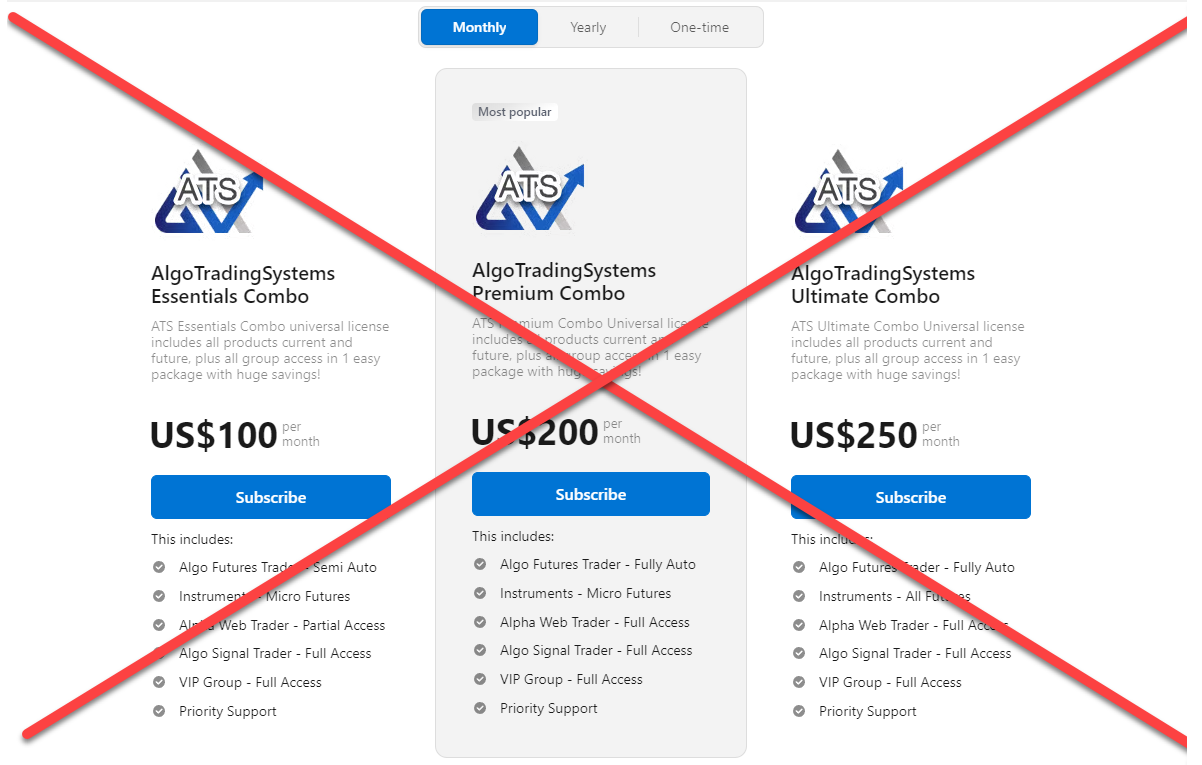
Get Funded Accelerator Save 80% off the ATS Combo Universal subscription for use with Apex or Bulenox Rithmic prop firm evaluation trading accounts, all in one ATS Combo Universal license for all products, VIP Trading Group via monthly subscriptions.

Filed Under: AFT8, Get Funded Tagged With: automated futures trading, automated futures trading systems, best automated futures trading software, futures algo trading, futures automated trading, ninjatrader algorithmic trading, ninjatrader automated trading, ninjatrader automated trading systems


🚀 Get Started 100% FREE!

Notice From June 2024 AFT is free for sim, replay and NinjaTrader demo account trading only paid for live and prop firm trading

May 29, 2024 by AFT

AFT is free for simulation, replay, and NinjaTrader demo account trading only, plus a 7-day live full-feature trading trial.

Notice: From June 2024, AFT is free for simulation, replay, and NinjaTrader demo account trading only. It will be paid for live and prop firm trading. Free evaluation trading is no longer available for the following reasons:

  1. It is mostly impossible to distinguish a prop firm evaluation trading account from a live trading performance account with many prop firms using Rithmic and Tradovate.
  2. Most prop firms did not pay; they took all the traffic but didn’t want to pay out, except for Apex, which was 100% trustworthy. Trading Legends is brand new and 100% trusted.
  3. It was also impossible to see who had used our coupon and who had not, so we could not reconcile who was contributing and who was using it for free.
  4. The prop firm payout sum of fees collected was too small, not even covering the cost of one monthly user subscription. Imagine over time hundreds of traders trying, not paying, and wanting support; this was not viable.
  5. Quality affiliate partners are being invited, and the question over referrals on prop firms can be isolated.

Transition for Those Affected

    • Please check your promotions in your pricing and subscriptions.
    • Get Funded Accelerator for Apex and Bulenox Evaluation

Win-Win Scenario

  1. AFT is free for simulation, replay, and NinjaTrader demo trading.
  2. 100% free for practice and to hone skills risk-free!
  3. Then, when ready to do an evaluation trading or go live, a license is required.
  4. A 7-day full-feature live account of any type will be available.
  5. Get Funded Accelerator for Apex and Bulenox Evaluation launching!

Filed Under: AFT8, Get Funded Tagged With: automated futures trading systems, best automated futures trading software, futures algo trading, futures automated trading, ninjatrader automated trading systems


🚀 Get Started 100% FREE!

  • 1
  • 2
  • Next Page »

Help & Information

  • ninjatrader automated trading
  • Automated Trading Systems
  • Support Center
  • Help Desk Articles
  • Trading Group & Forum
  • Videos

Recent Posts

  • A Guide to Trading a $50K Futures Prop-Firm Account
  • The Best Path to Getting Funded Trading Futures
  • AFT8 Performance Tweaks for NinjaTrader 8.1.7
  • AFT Lifetime (One-Time Purchase) License Terms Updated
  • ATS Futures Trading Group Rebooted!
  • Facebook
  • RSS
  • Twitter
  • YouTube


  • NinjaTrader Automated Trading
  • automated futures trading
  • automated trading systems
  • Day Trading Futures
  • Get Started Day Trading Futures
  • VIP Trading Group Live Market Trade Along
  • Secret to Day trading futures success
  • AFT8 for NinjaTrader 8
  • Futures Algo Trading Systems
  • Market News
  • NinjaTrader Free Trading Platform
  • Legal Notices
  • AFT Legal Info
  • Terms
  • FULL RISK DISCLOSURE
  • Privacy Policy
  • Cookie Usage
  • About AlgoFuturesTrader
  • Connect to AFT
  • Blog
  • Videos
  • Support
  • Contact
  • My account
  • Sitemap
  • Affiliates

Ninja Futures Trading
Algo Futures Trader Copyright Algo Trading Systems© 2026 ·
AlgoFuturesTrader.com is owned & operated by Algo Trading Systems LLC. By using this website or products & services, you are bound by our Terms & subject to US legal jurisdiction only. Errors & omissions excluded.
AFT made in England, powered by MicroTrends NinjaTrader development

Disclaimer: Trading & investment carry a high level of risk. AlgoFuturesTrader does not make recommendations for buying or selling any financial instruments, nor do we offer trading or investment advice. We are a software company, and we only provide educational information on ways to use our sophisticated Algo Futures trading tools. It is up to our customers & readers to make their own trading & investment decisions, or consult with a registered investment advisor.

Risk Disclosure: Futures, CFDs, & forex trading carry substantial risk and are not suitable for every investor. An investor could potentially lose all or more than the initial investment. Risk capital is money that can be lost without jeopardizing one's financial security or lifestyle. Only risk capital should be used for trading, and only those with sufficient risk capital should consider trading. Past performance is not necessarily indicative of future results. Please read the full risk disclosure here.

Hypothetical performance results have many inherent limitations, some of which are described below. No representation is made that any account will or is likely to achieve profits or losses similar to those shown. In fact, there are frequently sharp differences between hypothetical performance results and the actual results subsequently achieved by any particular trading program. One of the limitations of hypothetical performance results is that they are generally prepared with the benefit of hindsight. In addition, hypothetical trading does not involve financial risk, and no hypothetical trading record can completely account for the impact of financial risk in actual trading. For example, the ability to withstand losses or adhere to a particular trading program despite trading losses are material points that can adversely affect actual trading results. Numerous other factors related to the markets or the implementation of any specific trading program cannot be fully accounted for in the preparation of hypothetical performance results and can adversely affect trading results.

Testimonials appearing on this website may not be representative of other clients or customers and are not a guarantee of future performance or success.

NinjaTrader® is a registered trademark of NinjaTrader Group, LLC. No NinjaTrader company has any affiliation with the owner, developer, or provider of the products or services described herein, nor do they endorse, recommend, or approve any such product or service.

We use cookies on our website to give you the most relevant experience by remembering your preferences and repeat visits. By clicking “Accept All”, you consent to the use of ALL the cookies. However, you may visit "Cookie Settings" to provide a controlled consent.
Cookie SettingsAccept All
Manage consent

Privacy Overview

This website uses cookies to improve your experience while you navigate through the website. Out of these, the cookies that are categorized as necessary are stored on your browser as they are essential for the working of basic functionalities of the website. We also use third-party cookies that help us analyze and understand how you use this website. These cookies will be stored in your browser only with your consent. You also have the option to opt-out of these cookies. But opting out of some of these cookies may affect your browsing experience.
Necessary
Always Enabled
Necessary cookies are absolutely essential for the website to function properly. These cookies ensure basic functionalities and security features of the website, anonymously.
CookieDurationDescription
cookielawinfo-checkbox-analytics11 monthsThis cookie is set by GDPR Cookie Consent plugin. The cookie is used to store the user consent for the cookies in the category "Analytics".
cookielawinfo-checkbox-functional11 monthsThe cookie is set by GDPR cookie consent to record the user consent for the cookies in the category "Functional".
cookielawinfo-checkbox-necessary11 monthsThis cookie is set by GDPR Cookie Consent plugin. The cookies is used to store the user consent for the cookies in the category "Necessary".
cookielawinfo-checkbox-others11 monthsThis cookie is set by GDPR Cookie Consent plugin. The cookie is used to store the user consent for the cookies in the category "Other.
cookielawinfo-checkbox-performance11 monthsThis cookie is set by GDPR Cookie Consent plugin. The cookie is used to store the user consent for the cookies in the category "Performance".
viewed_cookie_policy11 monthsThe cookie is set by the GDPR Cookie Consent plugin and is used to store whether or not user has consented to the use of cookies. It does not store any personal data.
Functional
Functional cookies help to perform certain functionalities like sharing the content of the website on social media platforms, collect feedbacks, and other third-party features.
Performance
Performance cookies are used to understand and analyze the key performance indexes of the website which helps in delivering a better user experience for the visitors.
Analytics
Analytical cookies are used to understand how visitors interact with the website. These cookies help provide information on metrics the number of visitors, bounce rate, traffic source, etc.
Advertisement
Advertisement cookies are used to provide visitors with relevant ads and marketing campaigns. These cookies track visitors across websites and collect information to provide customized ads.
Others
Other uncategorized cookies are those that are being analyzed and have not been classified into a category as yet.
SAVE & ACCEPT