NinjaTrader Automated Trading by Algo Futures Trader

hybrid algorithmic automated futures trading for prop firm traders, day & swing traders

  • 🚀Get Started
  • NinjaTrader
  • Get Funded
  • Trading Servers
  • Pricing
  • blog
  • Help

Just Give Me an Algo That Works

July 11, 2026 by AFT

The Fully Automated Prop-Firm Trading Robot Myth: Why “Just Give Me an Algo That Works” Is the Wrong Starting Point

Many traders dream of finding one automated futures-trading robot with a 65% to 85% win rate, a risk-to-reward ratio between 1:1.5 and 1:2, minimal drawdown and the ability to trade any market condition without supervision.

The dream is simple: buy a $25K, $50K or even $250K prop-firm account, switch on the robot, walk away and allow the algorithm to pass evaluations and produce payouts.

ATS regularly speaks with traders who want exactly this. They do not want to learn hybrid algo trading, study market conditions, exercise risk control or develop their own statistics. They want to see an impressive performance report, receive a baseline algorithm, activate it and watch it trade.

Unfortunately, this expectation combines several of the biggest myths in retail automated trading.

There is a major difference between an algorithm that can generate profitable historical statistics and an automated system that can survive changing markets, live execution and restrictive prop-firm drawdown rules.

The Dream Robot Specification

The typical request sounds something like this:

  • Give me an automated robot with a 65% to 85% win rate.
  • Give me an average winning trade worth 1.5 to 2 times the average losing trade.
  • Make it work in trending, ranging, volatile and quiet markets.
  • Make it trade correctly during news, holidays and unusual market conditions.
  • Make sure it never requires optimization, intervention or supervision.
  • Keep the drawdown small enough to survive a tightly controlled prop-firm account.
  • Let me trial it immediately and judge it from the published statistics.

Individual systems can produce strong results during suitable periods. A carefully engineered portfolio of automated systems may also become viable when supported by substantial capital, diversification, professional infrastructure and continuous research.

The unrealistic part is expecting one fixed retail algorithm to deliver all these qualities simultaneously, indefinitely and in every market phase while operating unattended within a narrow prop-firm loss allowance.

Myth 1: A $50K Prop Account Gives the Robot $50,000 to Work With

A prop account’s advertised account size is not normally the amount the trader or robot can lose.

The practical risk capital is the permitted drawdown.

For example, a nominal $50K account with a $2,000 maximum drawdown provides approximately 4% of its headline account size as total loss capacity. A nominal $250K account with a $5,000 drawdown provides only approximately 2% of its headline value as loss capacity.

The usable margin may be even smaller after accounting for trailing-drawdown movement, commissions, slippage, previous losses, daily-loss rules and the need to preserve a safety buffer.

A profitable strategy that eventually recovers from a $10,000 drawdown may be acceptable within a sufficiently capitalized live account. The same strategy would have already failed a prop account with a $2,000 or $5,000 loss limit.

The real account is not the number printed in the account name. The real account is the drawdown allowance the strategy must survive.

Myth 2: A High Win Rate Means the Robot Will Not Experience Dangerous Losing Runs

A 65% win rate still means that approximately 35 out of every 100 trades may lose over a sufficiently representative sample.

Those losses will not necessarily arrive in a convenient alternating pattern of one loss followed by two wins. They can cluster into consecutive losing trades, difficult weeks or extended periods in which the strategy is poorly aligned with the current market phase.

A strategy can therefore maintain a positive long-term expectancy while still producing a losing sequence large enough to breach a prop-firm drawdown limit before its statistical edge has time to recover.

The higher win rates and stronger risk-to-reward ratios traders request are not mathematically impossible. The problem is assuming those statistics will remain stable across every instrument, session, volatility condition and market regime.

A strategy reporting an 80% win rate over a selected historical period may behave very differently when:

  • Volatility expands or contracts.
  • Liquidity changes.
  • Market correlations break down.
  • A previously trending market becomes rotational.
  • Execution slippage increases.
  • News produces abnormal price movement.
  • The strategy enters a market phase that was poorly represented in its test data.

A win rate is an average from a particular sample. It is not a promise describing the sequence of future trades.

Myth 3: Impressive Statistics Prove That an Algo Is Suitable for Prop Trading

Statistics are important, but statistics must be interpreted correctly.

A trader who asks only for win rate, net profit and risk-to-reward is ignoring many of the measurements that determine whether a strategy is operationally suitable.

A proper assessment should also consider:

  • Maximum historical and forward-tested drawdown.
  • Length and frequency of losing runs.
  • Maximum adverse excursion.
  • Performance during different market phases.
  • Dependence on a small number of unusually profitable trades.
  • Average trade value after commissions and realistic slippage.
  • Intraday risk and open-trade equity movement.
  • Trade frequency and clustering.
  • Sensitivity to small changes in settings.
  • Performance outside the optimized test period.
  • Whether the system can comply with the selected prop firm’s current rules.

A strategy may show a large net profit while producing drawdowns that are completely unsuitable for a tightly constrained prop account. Even profitable professional strategies can experience drawdowns far beyond typical prop-account limits.

Profitability and prop-account survivability are not the same measurement.

Myth 4: An Algo Baseline Is a Finished Live-Trading Product

ATS Algo Futures Trader can include turnkey algorithmic baseline workspaces. These are valuable reference starting points, but they are not presented as permanent switch-on-and-forget live-trading products.

A baseline can help the trader:

  • Study how the strategy responds to different market phases.
  • Observe natural winning and losing runs.
  • Understand the underlying trading concepts.
  • Compare instruments, sessions and settings.
  • Identify conditions in which the logic performs well or poorly.
  • Begin optimization, replay testing and forward validation.
  • Develop hybrid filters and intervention rules.
  • Create a foundation for an independently researched automated system.

An unoptimized baseline may produce substantial winning runs during favorable conditions and substantial losing runs when conditions change. This is part of what makes it educationally useful: it exposes how a fixed set of rules behaves across different phases without pretending that the market remains constant.

It does not mean that every signal should be traded with real money.

ATS baseline systems are intended to provide a structured foundation for study, testing, optimization and development. Traders pursuing serious full automation remain responsible for research, validation, risk limits and ongoing system management.

What an Algo Baseline Is Not

  • It is not a guaranteed prop-evaluation passing system.
  • It is not a promise of future payouts.
  • It is not permanently optimized for every future market condition.
  • It is not evidence that the trader can ignore drawdown and risk limits.
  • It is not permission to place it immediately into unattended live trading.

Myth 5: A Short Trial Can Prove That a Robot Works

A short trial can demonstrate software features, workflow, execution and how a strategy behaves during the market conditions encountered during the trial.

It cannot prove that a system will remain profitable through every future market phase.

A seven-day trial might occur during an unusually strong trending period and make a trend-following system look exceptional. The same seven days could occur during difficult rotational conditions and make a potentially viable strategy look ineffective.

Neither result provides enough information to establish a permanent edge.

A serious validation process normally requires:

  1. Testing across different historical market environments.
  2. Out-of-sample testing.
  3. Replay and simulation testing.
  4. Forward testing with unchanged settings.
  5. Realistic commissions and slippage.
  6. Clear drawdown and shutdown limits.
  7. Monitoring how live execution differs from theoretical results.
  8. Revalidation as market conditions change.

A trial is an opportunity to understand the technology and methodology. It is not a shortcut around the research process required for unattended automation.

Myth 6: A Profitable Robot Should Work in Every Market

Markets move through different phases. They trend, rotate, compress, expand, accelerate, reverse and become temporarily distorted by news, liquidity and positioning.

A strategy designed to capture sustained directional movement may struggle during a narrow rotational market. A mean-reversion strategy may perform well during balanced conditions and then suffer when the market enters a persistent breakout.

Optimization does not remove this problem permanently. It attempts to align the system with particular characteristics found in the data.

When those characteristics change, the operator may need to:

  • Pause or park the system.
  • Reduce position size.
  • Change the permitted trading session.
  • Restrict the system to long-only or short-only operation.
  • Apply volatility or market-structure filters.
  • Switch to another strategy or instrument.
  • Reoptimize and forward-test new settings.
  • Retire the system if its original edge no longer appears valid.

The belief that one algorithm should trade continuously through every condition is not professional diversification. It is dependency on one fixed set of assumptions.

Myth 7: Fully Automated Trading Means Less Work

Automation may reduce the manual work involved in entering and managing individual trades. It transfers that workload into system research, testing, optimization, infrastructure and supervision.

A serious automated trader may need to operate as:

  • A strategy developer.
  • A quantitative researcher.
  • A software tester.
  • A data and infrastructure operator.
  • A portfolio manager.
  • A real-time risk supervisor.

Developing and cautiously introducing an initial automated system may require approximately six to twelve months. Building a diversified operation with several strategies and asset streams may require one to three years or longer, with no guarantee that the total investment will become profitable.

Professional automation also requires ongoing work because the market does not stop evolving after the first successful backtest.

Why Fully Unattended Automation Is Especially Difficult for Prop Firms

Prop trading combines market risk with account-rule risk.

The algorithm must not only remain profitable over time. It must also survive every individual stage between account activation and a permitted payout.

Depending on the firm and account program, the strategy may need to navigate:

  • Daily-loss limits.
  • Intraday or end-of-day trailing drawdown.
  • Maximum position sizes.
  • Scaling requirements.
  • Consistency rules.
  • Minimum trading days.
  • News-trading restrictions.
  • Holding-time restrictions.
  • Payout buffers and withdrawal rules.
  • Restrictions affecting automated trading or account operation.

Rules vary between firms and programs and may change. Traders must verify the current terms of their selected account before deploying any automated or hybrid system.

An algorithm can execute a technically valid trade that is statistically acceptable for the strategy but inappropriate for the account because the remaining drawdown cannot support the risk.

A human risk controller can reject that trade. A fully unattended robot will continue unless that exact account condition has already been programmed, tested and correctly synchronized with the prop firm’s rules.

A Profitable Algo Can Still Fail the Prop Account

Consider a strategy with positive long-term expectancy that risks $250 per trade.

Four consecutive losses would produce approximately $1,000 of trading loss before commissions and slippage. On a nominal $50K account with a $2,000 drawdown, that sequence could consume approximately half the entire loss allowance.

If the account uses a trailing drawdown, previously accumulated profits may not provide the protection the trader expects. A further losing sequence, execution error or volatile trade could end the account even though the strategy remains profitable over a much larger sample.

The robot may eventually recover statistically. The failed prop account cannot wait for that recovery.

In prop trading, the system must survive the path to profitability. Being profitable eventually is not enough.

Myth 8: Human Control Ruins the Purity of the Algorithm

Poor emotional intervention can certainly damage a trading system. Randomly overriding trades through fear, greed or frustration is not hybrid trading.

Professional hybrid control is different. It applies predefined higher-level decisions that protect the account when the strategy’s immediate signal does not reflect the complete trading environment.

A hybrid trader may use objective controls to:

  • Stand aside during major scheduled economic events.
  • Pause when market structure becomes unclear.
  • Reduce risk when the account approaches a loss threshold.
  • Stop after reaching the session objective or daily-loss limit.
  • Reject signals that do not fit the wider market context.
  • Change directional permissions when higher-timeframe conditions shift.
  • Select the most suitable instrument or workspace.
  • Prevent one system from continuing through an unsuitable market phase.

This is not careless discretionary interference. It is an intelligent control layer above the execution technology.

The ATS Hybrid Man-and-Machine Alternative

ATS is not against automation. ATS develops advanced algorithmic and automated futures-trading technology.

Our position is that most retail, prop-firm and developing live-account traders are better served by using automation within a controlled hybrid framework rather than surrendering the account to one unattended robot.

The ATS ecosystem can combine:

  • AFT — Algo Futures Trader: Algorithmic opportunity identification, assisted entries, automated trade management, configurable strategies and direct real-time control.
  • AWT — Alpha Web Trader: Market intelligence covering direction, structure, volatility, correlations and higher-probability context.
  • AI Group Copilot: Live-market assistance covering risk, economic events, news, conditions, setups and trading-plan context.
  • Turnkey Workspaces: Preconfigured environments that provide structured starting points for futures and prop-firm trading.
  • ATS Fast Track and Mastery: Assisted onboarding, practical development, risk control and help building the trader’s own statistics.

The machine handles speed, calculations, monitoring, structure, order execution and repetitive trade-management tasks.

The trader remains responsible for context, authorization of risk, account protection and the decision to participate or stand aside.

That division of responsibility is the ATS Man-and-Machine edge.

Expectation Versus Reality

The ExpectationThe Professional Reality
One robot should work in every market.Strategies normally depend on particular market characteristics and may need to be paused, rotated, adjusted or replaced.
A high win rate prevents serious drawdown.Losses cluster, market phases change and positive expectancy does not guarantee survival within a small prop-firm loss limit.
A $50K account provides $50,000 of usable capital.The practical risk capital is normally the permitted drawdown, which may be only a small fraction of the headline amount.
Published statistics prove future profitability.Statistics describe a specific historical, hypothetical or live sample and do not guarantee future results.
A baseline algo should be ready for immediate live trading.A baseline provides a reference starting point for learning, testing, optimization and further development.
A successful trial proves a permanent edge.A short trial reflects only the conditions encountered during that period.
Automation removes the need for work.Serious automation requires continuous research, testing, monitoring, infrastructure and risk management.
Human involvement weakens the system.Structured hybrid control can protect the account from conditions that a fixed signal does not fully understand.

Who May Be Suitable for the Fully Automated Route?

The fully automated route may be suitable for an experienced and technically capable trader who:

  • Wants to operate a long-term system-development and research business.
  • Accepts that the process may take months or years.
  • Can backtest, optimize and forward-test responsibly.
  • Understands overfitting, slippage, execution and data limitations.
  • Has sufficient capital and infrastructure.
  • Can develop several diversified systems rather than depending on one robot.
  • Is prepared to monitor systems and apply shutdown limits.
  • Accepts that systems may need to be parked or retired.
  • Does not expect ATS or any software vendor to guarantee future profitability.

Who Is Probably Not Ready for Fully Automated Trading?

The route is unlikely to be suitable for a trader who says:

  • “I have no interest in learning the methodology.”
  • “I only want to see the win rate and profit statistics.”
  • “Just give me the settings that work.”
  • “I want to switch it on immediately inside a prop account.”
  • “I do not want to monitor or control it.”
  • “I expect it to work in every market.”
  • “I want a short trial to prove it will always make money.”
  • “I will not accept guidance about optimization, drawdown or hybrid trading.”

This mindset is not focused on developing an automated-trading operation. It is focused on finding a guaranteed income machine.

That product does not exist.

The Better Question to Ask

Instead of asking, “Can you give me an algo that works?” ask:

How can I use algorithmic technology, market intelligence, automated trade management and disciplined human control to improve my probability of surviving the account and developing repeatable personal results?

That question leads toward a professional process.

It recognizes that the objective is not to find a robot with the most attractive statistics. The objective is to develop a trading framework that can pursue maximum profit, minimum drawdown and the least possible emotional interference while retaining control over every important risk decision.

These are operating objectives, not guarantees.

Conclusion: Do Not Confuse Automation With Abdication

Fully automated trading is possible, but professional automation is not a shortcut around trading knowledge, research, capital requirements or risk management.

A fixed robot does not understand that the trader is close to breaching a prop-firm threshold unless that condition has been correctly programmed. It does not naturally recognize that today’s market is abnormal. It does not care that the account needs one more qualifying day or that protecting a payout buffer is more important than taking another signal.

It simply follows its rules.

For most prop-firm traders, the stronger route is not to eliminate the trader. It is to develop the trader into the intelligent control layer above the algorithms.

Do not look for a robot that promises to replace responsibility. Use technology that helps you exercise responsibility with greater speed, structure, discipline and control.

That is why ATS primarily recommends Hybrid Algo Trading for prop-firm and developing live-account traders.

Further Reading

  • Hybrid Algo Trading Versus Fully Automated Trading: The Time and Effort Required
  • Why We Love Hybrid Algo Trading for Prop-Firm and Live Brokerage Account Trading
  • Why ATS Does Not Recommend Fully Unattended Automated Trading for Prop Firms
  • A Guide to Trading a $50K Futures Prop-Firm Account
  • The Best Path to Getting Funded Trading Futures

Discover the Right ATS Trading Pathway

Book a free, obligation-free ATS Discovery Meeting to discuss your experience, trading goals, preferred account type and whether the self-assisted, Fast Track Mastery, Hybrid Algo Trading or specialist automated-development route is suitable for you.

Book Your Free ATS Discovery Meeting

Risk Disclosure: Futures and prop-firm trading involve a significant risk of loss and are not suitable for every trader. Prop-firm rules, account conditions and permitted trading methods vary and may change. Past, simulated, hypothetical or published performance does not guarantee future results. No algorithm, trading system, pathway, evaluation pass, funded account, payout or return on investment is guaranteed.

Filed Under: automated trading ninjatrader, Hybrid Algo Trading, ninjatrader trading bot Tagged With: AFT, algo futures trader, algo trading, algorithmic trading, ATS trading systems, Automated Trading Myths, Drawdown Management, Fully Automated Trading, futures trading, hybrid algo trading, Prop Firm Accounts, Prop Firm Automation, prop firm trading, Trading Risk Management, Trading Robots


🚀 Get Started 100% FREE!

Hybrid Algo Trading Versus Fully Automated Trading: The Time and Effort Required

July 11, 2026 by AFT

Fully automated trading is often promoted as the easiest route to the market. In reality, serious automation can require months or years of research, development, testing, infrastructure management and ongoing optimization. ATS Hybrid Algo Trading offers a more practical route for traders who want advanced technology without operating a full-time quantitative research business.

The Myth That Fully Automated Trading Requires Less Work

One of the most common retail-trading sales pitches is that a trader can purchase an automated robot, switch it on and allow it to generate profits with little or no involvement.

Professional fully automated trading rarely works that way.

Automation does not eliminate the workload. It moves the workload away from daily trade execution and into system development, data management, backtesting, optimization, forward testing, infrastructure, monitoring and portfolio management.

Fully automated trading may reduce manual trade execution, but it can dramatically increase the research, engineering and system-management work required behind the scenes.

The Fully Automated Trading Route

A trader pursuing the fully automated route may only require the ATS Algo Futures Trader platform, AFT, but the software is only one part of the operation.

AFT can provide five turnkey algorithmic baseline workspaces that may be used as reference starting points. A technically experienced trader can study, test, optimize and forward-test these baselines or use AFT to develop and configure an independent automated approach.

The baseline systems are not presented as permanent switch-on-and-forget live-trading products. They provide a structured foundation from which a committed automated trader can begin the research and validation process.

Typical Fully Automated Development Work

  • Studying the strategy logic, market behavior and system configuration.
  • Testing the system across multiple market phases and historical periods.
  • Optimizing settings without excessively fitting them to historical data.
  • Conducting replay, simulation and forward testing.
  • Comparing theoretical backtest results with realistic execution, commissions and slippage.
  • Defining maximum drawdown, daily-loss and system shutdown limits.
  • Monitoring connectivity, data feeds, orders, positions and platform performance.
  • Pausing or parking systems when their performance or drawdown limits are reached.
  • Reactivating systems when suitable market conditions return.
  • Developing additional systems to reduce dependence on one strategy or market phase.
  • Maintaining separate testing, pre-production and live-trading environments.
  • Continuing research and development as volatility, liquidity, correlations and market structure change.

How Long Can Fully Automated Trading Take?

A serious automated trader may require approximately six to twelve months to develop, optimize, validate and cautiously introduce an initial system to the market.

Building a more complete automated-trading operation with several diversified systems may take one to three years or longer. A return on the total software, infrastructure, data, research and capital investment may also take one to three years, and there is no guarantee that the operation will become profitable.

These are practical planning estimates rather than promises. The actual timeline depends on the trader’s experience, available capital, technical ability, strategy complexity, data quality, market conditions and acceptable level of risk.

Who Is the Fully Automated Route Suitable For?

This route is most suitable for highly experienced and technically capable traders who are prepared to commit for the long term. It may require working throughout the week for months or years to reach the required level of development, diversification and operational maturity.

A fully automated trader may need to act as:

  • A system developer.
  • A quantitative researcher.
  • A data and infrastructure operator.
  • A software tester.
  • A portfolio manager.
  • A real-time risk supervisor.

ATS does not currently offer a standard mastery course for building a complete professional fully automated trading business. Traders taking this route are expected to study the subject independently through specialist books, professional resources and suitable technical education.

ATS support can assist with the installation, operation and configuration of supported AFT turnkey workspaces, but it cannot perform the trader’s continuous research, optimization, validation and portfolio-management responsibilities.

The Cost of a Professionally Managed Automated Operation

A professionally supported fully automated operation can require specialist servers, historical data, testing environments, monitoring systems, backup procedures, ongoing development and experienced technical personnel.

An institutional-style managed research, infrastructure and system-support service could reasonably cost several thousand dollars per month. A comprehensive ATS-managed package of this nature would potentially need to be priced from approximately $5,000 per month, depending on the required systems, infrastructure, research and support responsibilities.

Such an operation would generally be more appropriate for an established professional trader or investment operation with substantial risk capital, potentially around $1.5 million or more, rather than a new retail trader seeking a quick route into automated futures trading.

Capital requirements vary significantly, and having substantial capital does not remove the risk of loss. Automated systems can fail, suffer prolonged drawdowns or lose their original market advantage.

Due to the potentially unlimited demand for development, optimization and support, ATS would only consider this level of managed automated service for established professional traders with demonstrated experience, adequate capitalization and a realistic understanding of the commitment involved.

Why Fully Automated Trading Is Not the Main ATS Focus

ATS understands the complexity of automated trading through years of trading-system research, development and market experience.

Fully automated trading is possible, but supporting it properly can become a black hole of time, development effort and technical resources. Every system creates new questions involving optimization, changing markets, drawdowns, diversification, infrastructure and live execution.

For this reason, ATS primarily focuses on Hybrid Algo Trading. We believe hybrid trading provides a more realistic and efficient route for most serious retail, prop-firm and live-account traders.

Instead of attempting to replace the trader completely, hybrid trading combines the speed, consistency and precision of technology with the adaptability, judgment and risk control of an informed human operator.

The ATS Hybrid Algo Trading Route

ATS Hybrid Algo Trading is designed to help traders reach structured market practice faster without first spending months or years developing an independent automated-trading operation.

The trader receives an established ecosystem that can include:

  • AFT: Algo Futures Trader for assisted entries, automated trade management, configurable systems and direct real-time control.
  • AWT: Alpha Web Trader for market intelligence, direction, structure, volatility, correlations and higher-probability context.
  • AI Group Copilot: Live-market assistance covering risk, news, economic events, market conditions, setups and trading-plan context.
  • Turnkey Workspaces: Preconfigured futures and prop-trading environments that provide a structured starting point.
  • Fast Track Zero to Hero: Assisted setup, onboarding and practical training through the ATS trading framework.
  • ATS Mastery: Continued guidance designed to help the trader develop personal statistics, discipline, consistency and risk control.

Illustrative ATS Hybrid Development Timeline

  • One to seven days: Complete ATS Fast Track Zero to Hero and establish the technical, platform and methodology foundation.
  • One to three months: Work toward stable personal statistics, prop-firm progress, potential payouts or suitable live-brokerage objectives through continued practice and ATS Mastery.
  • One to three hours per trading day: Follow a focused routine rather than operating a full-time system-development and research department.

These timelines are development targets, not guarantees. Progress depends on the individual trader, previous experience, discipline, available trading time, account conditions and market behavior. Evaluation passes, funded accounts, payouts, live profits and recovery of the trader’s ATS investment are never guaranteed.

Hybrid Trading Can Adapt as the Market Changes

A fixed automated robot may gradually become less suitable when volatility, liquidity, correlations or market structure change. The operator may then need to redesign, reoptimize, replace or permanently park the system.

ATS Hybrid Algo Trading is designed differently. AFT, AWT and the AI Group Copilot provide multiple layers of technology, intelligence and human control that can be adapted to current conditions.

The trader can:

  • Pause trading during unsuitable or unclear market conditions.
  • Reduce position size when risk increases.
  • Switch between suitable instruments, sessions or workspaces.
  • Adjust filters and confirmation requirements.
  • Restrict trading to long or short opportunities.
  • Use assisted, semi-automated or selected automated functions.
  • Control entries, exits, scaling and account risk in real time.
  • Use current AWT and Copilot intelligence instead of relying exclusively on historical system settings.

The ATS framework still requires monitoring, discipline and appropriate configuration, but it is not dependent on one fixed algorithm remaining suitable forever.

Fully Automated Trading Versus ATS Hybrid Algo Trading

Illustrative comparison of the time, effort and operating requirements.
AreaSerious Fully Automated TradingATS Hybrid Algo Trading
Starting platformAFT with algorithmic baseline workspaces used for research, optimization and developmentAFT, AWT, turnkey workspaces, AI Group Copilot and the ATS methodology
Initial pathwayIndependent research, testing, optimization and forward validationFast Track Zero to Hero with a target foundation period of one to seven days
Typical development periodApproximately six to twelve months for an initial system and potentially one to three years for a diversified operationOne to three months may provide an initial development and mastery target
Daily or weekly workloadPotentially full-time research, testing, monitoring and system management throughout the weekOften structured around approximately one to three focused trading hours per day
Human roleDeveloper, researcher, infrastructure operator, portfolio manager and risk supervisorTrader, pilot and risk controller supported by automation and market intelligence
Market changesMay require reoptimization, redevelopment, replacement or system rotationTrader can adapt instruments, direction, size, filters and execution using current market context
InfrastructureMay require servers, data storage, testing environments, monitoring, backups and specialist supportPrimarily built around the ATS software ecosystem, trading platform and brokerage connection
Capital suitabilityMore appropriate for experienced and well-capitalized professional operationsDesigned for suitable retail, prop-firm and live-account traders following controlled risk parameters
Primary challengeEngineering and maintaining a portfolio of systems that can survive changing marketsDeveloping judgment, discipline, consistency, execution skill and personal statistics
Potential return on investmentMay take one to three years or longer, with no guarantee of successTraders may target earlier prop-firm or live-account progress, but results are not guaranteed

Conclusion: Hybrid Trading Is the More Practical Route for Most Traders

Fully automated trading is not automatically easier, faster or less demanding. When approached professionally, it can require years of dedicated research, substantial capital, specialist infrastructure and continuous system development.

It may be suitable for an experienced technical trader who wants to operate a long-term algorithmic research and portfolio-management business. It is generally not the most practical starting point for a trader who wants to progress toward prop-firm payouts or controlled live trading within a realistic timeframe.

ATS Hybrid Algo Trading offers a more efficient alternative. It combines AFT execution technology, AWT market intelligence, AI Copilot assistance, turnkey workspaces and human judgment within one adaptable trading framework.

The goal is not to remove the trader. The goal is to develop a more capable trader who can use technology to pursue maximum profit, minimum drawdown and the least possible emotional interference while retaining control of every important risk decision.

Fully automated trading attempts to replace the trader with a portfolio of engineered systems. ATS Hybrid Algo Trading develops the trader into the intelligent control layer above the technology.

Discover the Right ATS Trading Pathway

Book a free, obligation-free ATS Discovery Meeting to discuss your experience, trading goals, available time, preferred markets and whether the self-assisted, Fast Track Mastery or specialist automated-development route is suitable for you.

We will help you understand the realistic time, effort, technology, support and capital requirements before you commit to a pathway.

🎧 Book Your Free ATS Discovery Meeting

Trading futures involves a significant risk of loss and is not suitable for every trader. Past or hypothetical performance does not guarantee future results. ATS development timelines, payout objectives and return-on-investment targets are illustrative only and should not be interpreted as promises or financial advice.

Filed Under: Hybrid Algo Trading, ninjatrader automated trading Tagged With: AFT, AI trading copilot, algo futures trader, algorithmic trading, Alpha Web Trader, ATS Fast Track, ATS Trade Mastery, automated futures trading, AWT, Fully Automated Trading, futures trading, hybrid algo trading, Live Futures Trading, prop firm trading, Semi Automated Trading, trading automation, Trading Risk Management, Trading System Development, Trading System Optimization, Trading Technology


🚀 Get Started 100% FREE!

Why We Love Hybrid Algo Trading for Prop-Firm and Live Brokerage Account Trading

July 11, 2026 by AFT

When man and machine work in unison, hybrid trading powered by the ATS methodology and systems statistically outperform both purely manual discretionary trading and standalone automated systems by margins that neither approach may achieve alone.

For many traders, the ultimate dream is a fully automated trading robot: switch it on, walk away and watch the profits accumulate.

It is an attractive idea, but it is also one of the most misunderstood propositions in retail trading.

Fully automated systems can be effective when they are properly researched, diversified, capitalized, monitored and maintained. However, that is very different from purchasing a single robot, applying it to one market and expecting it to generate reliable prop-firm payouts or live-account profits indefinitely.

For active futures traders, particularly those operating under strict prop-firm drawdown rules or trading their own personal capital, we believe there is a more practical, flexible and potentially more rewarding approach:

Hybrid algo trading: the machine supplies speed, structure and discipline, while the trader supplies context, judgment and control.

This is the foundation of the ATS objective:

Maximum Profit. Minimum Drawdown. Least Emotion.

These are operating objectives, not guarantees. Every trader, market and trading period is different, and all trading involves a significant risk of loss.

The Power of Man and Machine Trading in Unison

Hybrid algo trading combines algorithmic speed, consistency and automated trade management with human context, judgment and real-time risk control.

The technology handles the calculations, monitoring and execution tasks that machines perform exceptionally well. The trader remains responsible for understanding the wider environment, authorizing risk and deciding whether the current conditions justify participation.

This division of responsibility is particularly valuable in two trading environments:

Prop-Firm Trading

Prop accounts normally provide only a small usable drawdown relative to their advertised account size. The trader must operate with precision, remain within changing rules and protect the account before a loss threshold is breached.

Live Brokerage Trading

A live brokerage account provides greater freedom, but every loss directly affects the trader’s own capital. The priority becomes controlled risk, account preservation, gradual scaling and sustainable compounding.

Both environments benefit from the same central advantage: automation provides speed and consistency, while the trader retains the authority to adapt, reduce risk, pause, switch direction or disengage.

The Difference Between Fully Automated and Hybrid Trading

A fully automated system normally decides:

  • When to enter.
  • Which direction to trade.
  • How much to trade.
  • Where to place the stop and target.
  • When to exit.
  • Whether to continue trading as conditions change.

Once activated, the robot follows its programmed rules until those rules tell it to stop or a human operator intervenes.

A hybrid trading system divides those responsibilities between the trader and the technology.

The algorithms can identify opportunities, calculate dynamic levels, place and manage orders, control stops and targets, monitor market conditions and reduce execution errors. The trader remains responsible for deciding whether the current market environment, account risk and opportunity justify taking the trade.

The Machine Handles

  • Rapid calculations.
  • Consistent execution.
  • Repetitive monitoring.
  • Order placement and management.
  • Dynamic stops, targets and trading rules.
  • Mechanical tasks without hesitation.

The Trader Handles

  • Understanding the wider market context.
  • Recognizing unusual or changing conditions.
  • Assessing news and event risk.
  • Deciding when not to trade.
  • Selecting the best opportunities.
  • Reducing risk during uncertain periods.
  • Disengaging the system when required.

This is not an argument against technology. It is an argument for placing technology in the role where it provides the greatest advantage.

Why Hybrid Algo Trading Works for Prop-Firm Accounts

Prop-firm trading adds a layer of difficulty that does not normally exist in the same form within a personal brokerage account.

The trader must not only identify profitable opportunities but also operate within strict account rules that may include:

  • Daily-loss limits.
  • End-of-day or intraday trailing drawdown.
  • Contract limits.
  • Consistency requirements.
  • Minimum trading days.
  • Payout buffers.
  • News-trading restrictions.
  • Position-scaling rules.

These rules are designed to control the firm’s risk. They also mean that only a relatively small percentage of traders are likely to progress from evaluation to repeated payouts.

A profitable strategy may therefore be unsuitable if it cannot remain within the firm’s drawdown rules while its statistical advantage develops.

Hybrid trading allows the trader to:

  • Reduce size as remaining drawdown decreases.
  • Reject technically valid signals when the account cannot justify the risk.
  • Stop after reaching the daily objective.
  • Avoid major economic events and abnormal volatility.
  • Pause when correlations and market structure become unclear.
  • Remain within the firm’s position, consistency and payout rules.
  • Protect the account before its loss threshold is threatened.

In prop trading, being profitable eventually is not enough. The strategy must survive every stage between the first trade and the eventual payout.

Why Hybrid Algo Trading Works for Live Brokerage Accounts

Live brokerage trading removes many prop-firm restrictions, but it introduces a different responsibility: every trading loss directly affects the trader’s personal capital.

There may be no external trailing-drawdown rule, consistency requirement or payout approval process. However, the trader must still protect the account from excessive drawdowns, emotional decisions, overtrading and unfavorable market phases.

Hybrid trading can help a live-account trader:

  • Apply personal daily, weekly and account-level loss limits.
  • Adjust position size as account equity and volatility change.
  • Stand aside during unsuitable market phases.
  • Avoid unnecessary automated drawdown cycles.
  • Retain manual authority over entries, exits and exposure.
  • Use automation for rapid and consistent trade management.
  • Scale gradually according to verified personal statistics.
  • Protect profits and pursue controlled compounding.
  • Switch instruments, filters or strategies as conditions evolve.
  • Operate without surrendering the account to a fixed robot.

A live brokerage account gives the trader more freedom than a prop account, but that freedom must be accompanied by discipline and active risk control.

Hybrid trading allows the trader to use automation without allowing the automation to become the final authority over personal capital.

What Published Automated-Trading Results Really Show

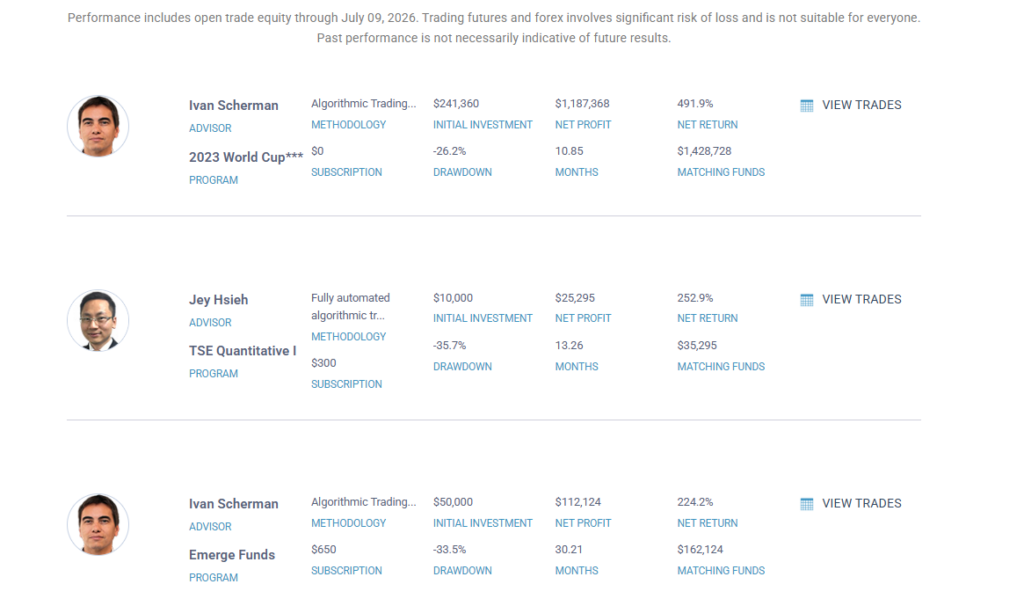
World Cup Advisor publishes live-account summaries from featured professional traders and allows subscribers to follow selected lead accounts automatically.

As of the market close on July 9, 2026, its featured accounts included the following published results:

World Cup Advisor fully automated trading statistics showing returns and published drawdowns

Examples of published automated and systematic trading results.
Featured ProgramMethodologyNet ReturnPublished DrawdownPeriod
Ivan Scherman — 2023 World CupAlgorithmic trading491.9%26.2%10.85 months
Jey Hsieh — TSE Quantitative IFully automated algorithmic trading252.9%35.7%13.26 months
Ivan Scherman — Emerge FundsAlgorithmic trading224.2%33.5%30.21 months
Daniele Sambataro — Momentum SelectionSystematic trend-following and mean reversion202.2%36.17%40.8 months

These are substantial returns and should not be dismissed as poor trading. The published figures do not demonstrate that the advisors are unskilled; quite the opposite.

The World Cup Trading Championships states that it has been attracting some of the world’s leading traders since 1983. Traders operating at this level are generally highly experienced, well-capitalized and prepared to spend years researching, testing, refining and operating their systems.

However, even at this advanced level, the published drawdowns reveal something extremely important:

A profitable automated strategy can still be completely unsuitable for a tightly constrained prop account.

Source: World Cup Advisor. Published figures may change over time and should be independently verified.

Automated Drawdown Versus Prop-Account Drawdown

The listed automated-system drawdowns range from approximately 26% to 36%.

By comparison, a nominal $50,000 futures prop evaluation may provide only around $2,000 of maximum loss capacity, which is approximately 4% of the headline account size.

Published DrawdownCompared With a 4% Loss Limit
26.2%Approximately 6.6 times the limit
35.7%Approximately 8.9 times the limit
33.5%Approximately 8.4 times the limit
36.17%Approximately 9 times the limit

That does not mean these strategies are bad.

It means they were not necessarily designed for an environment in which a relatively small peak-to-trough movement can terminate the account.

To attempt to use such a system within a 4% drawdown allowance, its position size would have to be reduced substantially. That would also reduce its expected returns, while trailing-drawdown mechanics could still create additional path-dependent risk.

Return Without Drawdown Is Only Half the Story

Retail marketing frequently concentrates attention on:

  • Percentage return.
  • Profit screenshots.
  • Winning months.
  • Backtested equity curves.
  • High win rates.
  • Short evaluation passes.

However, a percentage return has little meaning without understanding the risk required to produce it.

A strategy producing a 100% return with a 35% drawdown may be appropriate for one investor and completely unusable for another. A prop trader with only a 4% effective loss allowance does not have the freedom to sit through that same drawdown.

The most important question is not:

“How much did the robot make?”

Better questions include:

  • What maximum drawdown did it experience?
  • How long did recovery take?
  • Was the drawdown calculated from closed trades or real-time equity?
  • What happened during unfavorable market phases?
  • How much capital was required?
  • Could the trader psychologically and financially continue operating?
  • Would the strategy survive the intended prop-firm rules?
  • How frequently must the system be reviewed or reoptimized?

A strategy can eventually recover and still destroy a prop account long before that recovery occurs.

Why Prop-Account Limitations Change Everything

A nominal $50,000 prop account may sound like the trader has $50,000 available to lose. In practice, the usable risk allowance may be only $2,000.

That usable drawdown is the real account.

An intraday trailing drawdown may follow unrealized equity highs. A trade can move strongly into profit, pull back and breach the account threshold even though it might later have closed profitably.

A robot designed around normal live-account volatility may therefore be unsuitable for a prop account unless it was built and tested specifically around that firm’s current rules.

The problem is not simply whether the system is profitable eventually.

The problem is whether it survives the route between today and that eventual profit.

Why Fully Automated Trading Is Not Set and Forget

A professional automated operation may require:

  • Multiple non-correlated markets.
  • Several independent strategies.
  • System and parameter diversification.
  • Separate research, testing and production environments.
  • Reliable historical and real-time data.
  • Backtesting and replay infrastructure.
  • Forward simulation.
  • Pre-production monitoring.
  • Live execution monitoring.
  • Fail-safe controls and kill switches.
  • Continuous research as market behavior changes.
  • Ongoing human supervision and system management.

Even systems described as fully automated normally require some level of human oversight. The operator may still need to decide when to activate, reduce, pause or completely disengage the system.

The professional model is rarely:

Switch it on and forget about it.

It is closer to:

Research it, test it, supervise it, control it, diversify it, maintain it and know when to switch it off.

Full automation does not remove the work. It transfers much of the work from live decision-making into research, engineering, validation, monitoring and portfolio management.

Can the Average Retail Trader Compete With Professional System Developers?

The traders featured by services such as World Cup Advisor and Striker operate near the visible upper end of retail systematic trading.

Before assuming that a newly purchased robot can produce better results with less risk, a trader should ask an honest question:

Am I currently more experienced, better capitalized and better equipped than the traders who have spent years developing these systems?

Most retail traders are not currently equipped with the experience, capital, data, infrastructure and research capability used by leading professional system developers.

These professionals are generally not running a vendor trial for one month and hoping that the system continues producing indefinitely. They may have spent years developing rules, acquiring data, backtesting, optimizing, forward-testing, monitoring live execution and adjusting their systems as market behavior changed.

A new or currently unsuccessful trader should therefore consider:

  • Do I have the technical knowledge required to design and validate a system?
  • Do I have reliable market data and suitable testing infrastructure?
  • Do I understand overfitting, slippage, liquidity and execution risk?
  • Do I have sufficient personal risk capital?
  • Am I prepared to invest several years in research and development?
  • Can the system survive my intended prop-firm or brokerage rules?
  • Can I continue operating through an extended drawdown?

Retail trading failure rates are widely reported as high, but exact percentages vary according to the market, time period, methodology and definition of failure. The central point remains the same: neither discretionary nor automated trading becomes easy simply because software is involved.

Automation does not remove the difficulty of trading. It moves much of that difficulty into system design, data quality, validation, infrastructure, risk allocation and ongoing maintenance.

The Capital and Infrastructure Required for Serious Automated Trading

A properly structured automated operation may require significantly more than a single robot and a small trading account.

  • Substantial personal risk capital.
  • Several years of research, testing and system refinement.
  • Dedicated computers, servers, data feeds and backup infrastructure.
  • A portfolio of genuinely non-correlated strategies and asset streams.
  • Multiple accounts or brokerage relationships where appropriate.
  • Strict portfolio-level and system-level risk controls.
  • Continuous monitoring, review and development.

As an illustrative ATS planning model, a highly diversified automated operation might consider capital levels of approximately $250,000 for micro-contract portfolios or $1.5 million for E-mini portfolios when using conservative portfolio-risk limits.

These are planning examples rather than universal minimum requirements. Actual capital requirements depend on the systems, instruments, drawdowns, leverage, diversification and risk model involved.

For many retail traders, swing trading may be more compatible with full automation than short-term prop trading because it can reduce execution frequency, intraday noise and sensitivity to tight trailing-drawdown rules.

It still requires sufficient capital, robust research and careful risk management.

Why Automated Portfolio Diversification Matters

Diversification is one reason professional operators may run many systems simultaneously. One strategy may perform well while another is experiencing an unfavorable market phase.

However, genuine diversification requires capital, infrastructure and expertise. Adding several highly correlated robots to the same instrument is not necessarily diversification. They may all fail for the same reason at approximately the same time.

Ray Dalio has repeatedly emphasized the importance of combining good, risk-balanced and genuinely uncorrelated investments rather than concentrating all risk in one market or strategy.

“Strive to have 15 good uncorrelated investments that are risk balanced.”

The principle is that a well-diversified portfolio of good opportunities can produce a better return relative to risk than a concentrated portfolio whose outcomes depend on one market, one system or one economic environment.

For automated trading, diversification should not simply involve running several slightly different settings on the same instrument.

Genuine diversification may require:

  • Different instruments.
  • Different asset classes.
  • Different holding periods.
  • Different strategy families.
  • Different market regimes.
  • Independent return drivers.

Further reading: Ray Dalio — Investment Principles.

Why Hybrid Algo Trading Is More Maneuverable

A fixed automated system can be compared with a heavily loaded vehicle following a predetermined route. It may operate with a very high level of automation, but human oversight is often limited to monitoring the system and deciding when to switch it on or off.

It can perform extremely well while market conditions resemble those for which it was designed. However, when the environment changes through unexpected news, abnormal volatility, reduced liquidity or a sudden shift in market structure, the system may continue following its existing rules unless those conditions were anticipated and programmed in advance.

Hybrid algo trading gives the operator steering, brakes, navigation and the authority to change route in real time.

Trader Control Sets

  • Use purpose-built controls that provide exceptional flexibility and trading capability within the live, real-time trading environment.
  • Adjust the level of automation from full automation for selected periods to manual authorization of long, short, entry, exit, scale-in and scale-out actions.
  • Respond to moving targets while retaining control and benefiting from the combined speed of automation and the judgment of an experienced human operator.
  • Use graphical interfaces and one-click macro controls to execute complex entry, exit and order-management sequences that could take a manual trader 30 seconds or longer to perform on a basic platform.
  • Operate more like the pilot of an advanced aircraft or the driver of an intelligent vehicle than a passenger watching a fixed robot follow a predetermined route.

Risk-Avoidance Market Radar

  • Avoid major economic releases and scheduled event risk.
  • Stop trading after reaching the daily objective.
  • Reduce position size when market relationships become mixed or unclear.
  • Reject signals during low-quality conditions.
  • Select only the clearest and highest-quality opportunities.
  • Pause after abnormal volatility or unexpected market behavior.
  • Switch instruments, data series and filters in real time.
  • Change direction as market structure and conditions evolve.

External Confirmation and Intelligence Systems

  • Use additional confirmation systems, market-intelligence tools and human guidance that may not be available to a standalone algorithm or conventional trading platform.
  • Combine execution technology with broader information about news, volatility, correlations, higher-time-frame structure and current market state.
  • Use independent confirmation to help determine whether a technically valid signal is appropriate for the current trading environment.

Prop-Account Protection

  • Protect a prop account before its maximum-loss or trailing-drawdown threshold is threatened.
  • Trade with greater precision while remaining within the firm’s current risk, position and payout rules.
  • Reduce size, pause trading or reject an otherwise valid signal when the account’s remaining drawdown does not justify the risk.
  • Avoid relying on a fixed automated system that may continue trading through conditions or account limits for which it was not specifically designed.
  • Recognize that even a profitable automated system can breach a tightly constrained prop account before its longer-term statistical advantage has time to recover.

Live Brokerage Account Protection

  • Apply personal risk limits before account losses become emotionally or financially damaging.
  • Reduce exposure when volatility, correlations or account equity no longer justify the current position size.
  • Protect accumulated profits rather than allowing a robot to continue through an unfavorable market phase.
  • Retain the authority to stop, switch or modify the trading approach as personal capital and market conditions change.

This maneuverability is why we describe hybrid trading as man and machine operating in unison.

The trader is not fighting the technology. The trader is piloting it.

The ATS Hybrid Trading Environment

AFT: Execution and Trade Management

AFT is designed to provide rapid control over entries, exits, position management, dynamic stops, targets and trading-system rules.

Its purpose is not merely to place trades automatically. Its purpose is to reduce execution effort while preserving trader control.

AWT: Market Intelligence

AWT provides market context and confirmation at a glance, helping the trader assess:

  • Market direction.
  • Trend strength.
  • Volatility.
  • Structure.
  • Correlations.
  • Session conditions.
  • Higher-time-frame context.
  • Risk and opportunity.

AI and VIP Group Copilot

The AI and group environment adds further planning, education and live-market support, including:

  • Economic events.
  • Earnings and scheduled news.
  • Holidays and liquidity conditions.
  • Market correlations.
  • Higher-time-frame analysis.
  • Current trend state.
  • Risk planning.
  • Setup quality.
  • Live instructor observations.

Together, these components are designed to create a trader who is neither purely discretionary nor blindly automated.

The result is a more capable hybrid operator.

Practical Hybrid-Trading Goal States

Trading statistics should be treated as development goals, not promises.

A trader should never pursue a high win rate at the expense of excessive risk, oversized losses or poor-quality decisions. The real objective is positive expectancy combined with controlled drawdown and repeatable execution.

A practical overall ATS hybrid goal range may include:

  • Win ratio: approximately 55% to 85%.
  • Average winner relative to average loss: approximately 0.75 to 1.20.
  • Level of automation: approximately 50% to 80%.
  • Trader responsibility: context, authorization, risk and continued supervision.
  • Machine responsibility: calculation, detection, execution and management.
Where the average winner is only 0.75 times the average loss, the mathematical break-even win rate is approximately 57.1% before commissions and slippage. A 55% win rate at that reward-to-risk relationship would not be profitable.
Development StateIllustrative Win-Rate GoalAverage Winner Ă· Average LossAutomationPrimary Objective
FoundationDo not prioritize win rate initially1.00–1.2050%–60%Correct setup, execution and journaling
Developing Consistency55%–65%1.00–1.2055%–70%Establish positive expectancy
Consistent Hybrid Trader60%–75%0.85–1.1060%–75%Reduce mistakes and drawdown
Selective Advanced Trader70%–85%0.75–1.0070%–80%Trade fewer, higher-quality opportunities

The upper win-rate range should generally be associated with highly selective trading, specific market conditions and a meaningful sample size. It should not be presented as an everyday certainty.

Simplified expectancy examples before commissions and slippage include:

  • A 55% win rate with an average winner of 1.2R produces approximately +0.21R per trade.
  • A 65% win rate with an average winner of 0.9R produces approximately +0.235R per trade.
  • A 75% win rate with an average winner of 0.75R produces approximately +0.313R per trade.

This demonstrates why win rate alone does not define a successful trader.

Smaller Repeatable Objectives Can Be More Valuable

A hybrid prop trader does not necessarily need to chase spectacular daily returns.

An illustrative objective might be:

  • $100 average daily net progress.
  • Approximately $500 over five trading days.
  • Approximately $2,000 over a four-week period.

Where a firm permits multiple accounts and compliant trade copying, the same carefully controlled process may potentially be applied across several accounts.

Five accounts averaging $2,000 each would equal $10,000, but this is arithmetic rather than a performance promise.

Actual outcomes will depend on:

  • Trader performance.
  • Prop-firm rules.
  • Account survival.
  • Market conditions.
  • Trading costs and slippage.
  • Payout requirements.
  • The number of trading days.
  • Whether copying and multiple-account operation are permitted.

The purpose of the example is not to promise $10,000.

It is to show why a small, controlled and repeatable trading process can be more useful than chasing a large headline return accompanied by an unsustainable drawdown.

The Potential Capital Efficiency of Hybrid Trading

A skilled hybrid trader may be able to target a higher return relative to usable drawdown than a fully automated strategy operating on a single account.

Where prop-firm rules permit multiple accounts and compliant trade replication, a controlled hybrid process may potentially be distributed across several accounts without exposing one large personal brokerage account to the full capital requirement of a diversified automated portfolio.

Within a live brokerage account, the trader may instead scale gradually as verified statistics, account equity and personal risk tolerance permit.

This does not mean that scaling from one account to five, ten or twenty accounts is effortless or unlimited. The trader must still manage:

  • Execution accuracy.
  • Account and copier reliability.
  • Position limits.
  • Liquidity and slippage.
  • Prop-firm rules.
  • Daily and trailing drawdown.
  • Consistency across every account.
  • The psychological pressure created by larger aggregate exposure.

The trader is effectively attempting to hit a moving target while maintaining a high level of consistency and a low level of drawdown.

In our view, this combination of precision, adaptability and active risk control is where hybrid algo trading provides its greatest advantage for both retail prop traders and live-account traders.

It remains an objective rather than a guarantee, and increasing account size or the number of accounts also increases operational and financial risk.

Hybrid Trading Still Requires a Trader

Hybrid technology does not remove personal responsibility.

ATS cannot promise:

  • That every trader will succeed.
  • That every evaluation will be passed.
  • That every funded account will produce a payout.
  • That a trader will recover the cost of the system.
  • That historical or simulated results will continue.
  • That tools can compensate for undisciplined execution.

ATS can provide the framework, technology, education, workspace, support and development pathway.

The trader must still:

  • Attend and practise.
  • Follow the process.
  • Control risk.
  • Journal trades.
  • Review mistakes.
  • Build a repeatable routine.
  • Remain calm after wins and losses.
  • Avoid revenge trading.
  • Trade only suitable conditions.
  • Continue developing over time.

Technology can make a committed trader more capable. It cannot make an uncommitted trader successful.

From Zero to Hero Is a Process, Not a Promise

ATS Fast Track and Mastery are designed to help traders progress through a structured development pathway.

A practical initial horizon may be approximately three months, although individual development can take less or considerably more time.

The goal is to help the trader move through stages such as:

  1. Correct technical setup.
  2. Understanding the ATS workspace.
  3. Learning the hybrid methodology.
  4. Practising in simulation.
  5. Building a trade plan.
  6. Establishing risk controls.
  7. Producing personal statistics.
  8. Attempting an evaluation or live-account transition when ready.
  9. Working toward funded-account survival or controlled live-account growth.
  10. Working toward a first payout or sustainable live-account return.

The goal may be to reach payout capability or sustainable live-account performance and eventually recover the cost of the trader’s system and education.

However, this remains an objective rather than a guaranteed outcome.

Success depends on the trader applying the process correctly and consistently.

Learn From Traders Who Have Completed the Journey

One of the major advantages of the ATS environment is that new traders can learn from people who have already followed the pathway.

ATS invites selected traders who have progressed from beginner or struggling stages, learned the tools, used the turnkey workspace and achieved documented payout success to help newer traders.

These traders understand:

  • What it feels like to begin.
  • How evaluations are lost.
  • How discipline breaks down.
  • How a trader recovers from mistakes.
  • How to develop a repeatable routine.
  • How to move from random trading to structured execution.
  • How to protect a funded or live brokerage account.
  • How to progress toward payouts or controlled account growth.

Behind them are the system inventors, developers and experienced ATS leaders who support the coaches and continually develop the wider framework.

This creates a practical meritocracy:

Knowledge and experience move downward through the organization, while capable traders are given a pathway to move upward.

The objective is to help new traders reach levels of capability that they may not previously have believed possible.

Why We Love Hybrid Algo Trading

We are not attracted to fully automated trading simply because it removes the trader from the process.

For the active futures trader, removing the trader can also remove:

  • Context.
  • Judgment.
  • Adaptability.
  • Selectivity.
  • Accountability.
  • The ability to protect the account proactively.

Hybrid trading retains the benefits of automation without surrendering control completely.

It allows the trader to combine:

  • Algorithmic speed.
  • Dynamic calculations.
  • Structured entries.
  • Automated trade management.
  • Market intelligence.
  • Human context.
  • Real-time risk control.
  • Professional decision-making.

The objective is not to become a passenger watching a robot trade.

The objective is to become a better pilot.

Maximum Profit. Minimum Drawdown. Least Emotion.

Not guaranteed.

Not effortless.

But structured, controlled and built around the development of a capable trader.

Important Risk Disclosure

Futures trading, leveraged trading and prop-firm trading involve a significant risk of loss and are not suitable for every trader. Past, hypothetical, simulated or published performance does not guarantee future results.

Statistics, account examples, objectives, development ranges and capital illustrations shown in this article are for educational and illustrative purposes only. They are not earnings claims, promises, guarantees or assurances that any trader will achieve the same or similar results.

References to multiple accounts, trade copying, prop-firm accounts and potential account scaling are illustrative only. Availability, eligibility and permitted trading practices depend on the current rules of each firm, brokerage and jurisdiction.

Prop-firm rules, drawdown calculations, account conditions, fees and payout requirements vary and may change. Traders should verify all current rules directly with the relevant firm before trading.

Filed Under: AFT8, Hybrid Algo Trading, NinjaTrader 8, ninjatrader automated trading, prop firm trading Tagged With: AFT trading platform, AI trading copilot, algorithmic trading, ATS trading systems, automated trading, automated trading systems, AWT market intelligence, discretionary trading, futures prop firms, futures trading, hybrid algo trading, man and machine trading, prop firm trading, prop trading, risk management, systematic trading, trader development, trading automation, trading drawdown, trading psychology


🚀 Get Started 100% FREE!

Recent Posts

  • Automated Futures Trading: What Retail Traders Need to Know
  • Dispelling Prop Trading Myths and Misleading Funded-Account Claims
  • Does Trading 20 Ă— $100K Prop Accounts Really Mean You Have $2 Million in Funding?
  • The Holy Grail Automated Trading Robot vs. How Automated Futures Trading Is Done Professionally
  • Just Give Me an Algo That Works
  • Facebook
  • RSS
  • Twitter
  • YouTube


  • NinjaTrader Automated Trading
  • automated futures trading
  • automated trading systems
  • Day Trading Futures
  • Get Started Day Trading Futures
  • VIP Trading Group Live Market Trade Along
  • Secret to Day trading futures success
  • AFT8 for NinjaTrader 8
  • Futures Algo Trading Systems
  • Market News
  • NinjaTrader Free Trading Platform
  • Legal Notices
  • AFT Legal Info
  • Terms
  • FULL RISK DISCLOSURE
  • Privacy Policy
  • Cookie Usage
  • About AlgoFuturesTrader
  • Connect to AFT
  • Blog
  • Videos
  • Support
  • Contact
  • My account
  • Sitemap
  • Affiliates

Ninja Futures Trading
Algo Futures Trader Copyright Algo Trading Systems© 2026 ·
AlgoFuturesTrader.com is owned & operated by Algo Trading Systems LLC. By using this website or products & services, you are bound by our Terms & subject to US legal jurisdiction only. Errors & omissions excluded.
AFT made in England, powered by MicroTrends NinjaTrader development

Disclaimer: Trading & investment carry a high level of risk. AlgoFuturesTrader does not make recommendations for buying or selling any financial instruments, nor do we offer trading or investment advice. We are a software company, and we only provide educational information on ways to use our sophisticated Algo Futures trading tools. It is up to our customers & readers to make their own trading & investment decisions, or consult with a registered investment advisor.

Risk Disclosure: Futures, CFDs, & forex trading carry substantial risk and are not suitable for every investor. An investor could potentially lose all or more than the initial investment. Risk capital is money that can be lost without jeopardizing one's financial security or lifestyle. Only risk capital should be used for trading, and only those with sufficient risk capital should consider trading. Past performance is not necessarily indicative of future results. Please read the full risk disclosure here.

Hypothetical performance results have many inherent limitations, some of which are described below. No representation is made that any account will or is likely to achieve profits or losses similar to those shown. In fact, there are frequently sharp differences between hypothetical performance results and the actual results subsequently achieved by any particular trading program. One of the limitations of hypothetical performance results is that they are generally prepared with the benefit of hindsight. In addition, hypothetical trading does not involve financial risk, and no hypothetical trading record can completely account for the impact of financial risk in actual trading. For example, the ability to withstand losses or adhere to a particular trading program despite trading losses are material points that can adversely affect actual trading results. Numerous other factors related to the markets or the implementation of any specific trading program cannot be fully accounted for in the preparation of hypothetical performance results and can adversely affect trading results.

Testimonials appearing on this website may not be representative of other clients or customers and are not a guarantee of future performance or success.

NinjaTrader® is a registered trademark of NinjaTrader Group, LLC. No NinjaTrader company has any affiliation with the owner, developer, or provider of the products or services described herein, nor do they endorse, recommend, or approve any such product or service.

We use cookies on our website to give you the most relevant experience by remembering your preferences and repeat visits. By clicking “Accept All”, you consent to the use of ALL the cookies. However, you may visit "Cookie Settings" to provide a controlled consent.
Cookie SettingsAccept All
Manage consent

Privacy Overview

This website uses cookies to improve your experience while you navigate through the website. Out of these, the cookies that are categorized as necessary are stored on your browser as they are essential for the working of basic functionalities of the website. We also use third-party cookies that help us analyze and understand how you use this website. These cookies will be stored in your browser only with your consent. You also have the option to opt-out of these cookies. But opting out of some of these cookies may affect your browsing experience.
Necessary
Always Enabled
Necessary cookies are absolutely essential for the website to function properly. These cookies ensure basic functionalities and security features of the website, anonymously.
CookieDurationDescription
cookielawinfo-checkbox-analytics11 monthsThis cookie is set by GDPR Cookie Consent plugin. The cookie is used to store the user consent for the cookies in the category "Analytics".
cookielawinfo-checkbox-functional11 monthsThe cookie is set by GDPR cookie consent to record the user consent for the cookies in the category "Functional".
cookielawinfo-checkbox-necessary11 monthsThis cookie is set by GDPR Cookie Consent plugin. The cookies is used to store the user consent for the cookies in the category "Necessary".
cookielawinfo-checkbox-others11 monthsThis cookie is set by GDPR Cookie Consent plugin. The cookie is used to store the user consent for the cookies in the category "Other.
cookielawinfo-checkbox-performance11 monthsThis cookie is set by GDPR Cookie Consent plugin. The cookie is used to store the user consent for the cookies in the category "Performance".
viewed_cookie_policy11 monthsThe cookie is set by the GDPR Cookie Consent plugin and is used to store whether or not user has consented to the use of cookies. It does not store any personal data.
Functional
Functional cookies help to perform certain functionalities like sharing the content of the website on social media platforms, collect feedbacks, and other third-party features.
Performance
Performance cookies are used to understand and analyze the key performance indexes of the website which helps in delivering a better user experience for the visitors.
Analytics
Analytical cookies are used to understand how visitors interact with the website. These cookies help provide information on metrics the number of visitors, bounce rate, traffic source, etc.
Advertisement
Advertisement cookies are used to provide visitors with relevant ads and marketing campaigns. These cookies track visitors across websites and collect information to provide customized ads.
Others
Other uncategorized cookies are those that are being analyzed and have not been classified into a category as yet.
SAVE & ACCEPT