NinjaTrader Automated Trading by Algo Futures Trader

hybrid algorithmic automated futures trading for prop firm traders, day & swing traders

🚀 Get Started
  • 🚀Get Started
  • NinjaTrader
  • Get Funded
  • Trading Servers
  • Pricing
  • blog
  • Help

Archives for July 2026

How to Pass a Prop-Firm Evaluation with M2K Small Cap or MNQ Nasdaq Futures

July 31, 2026 by AFT

Trader using AFT hybrid trading to manage M2K and MNQ prop-firm evaluation routes
Two futures prop-firm evaluation routes: 3 M2K contracts for lower risk or 1–2 MNQ contracts for higher risk, managed through one disciplined ATS Hybrid Trading process.

How to Pass a Futures Prop-Firm Evaluation with M2K or MNQ

Passing a futures prop-firm evaluation is not about finding one perfect instrument or forcing a profit target as quickly as possible. The objective is to execute a repeatable plan, protect the permitted drawdown, and comply with every current rule until the evaluation target is reached.

The Real 50K Account Is the Drawdown Allowance

A “50K account” describes nominal buying power, not the amount available to lose. The effective account is the firm’s maximum permitted drawdown. As one current example, Topstep states that its 50K Trading Combine begins with a $2,000 Maximum Loss Limit. Other firms use different drawdown amounts, calculation methods, daily loss limits, consistency requirements and trading restrictions, so always confirm the current rules directly with your selected firm before trading.

If the usable risk allowance is $2,000, every position should be judged against that $2,000—not against the headline $50,000. A $250 loss uses 12.5% of the effective risk allowance. A $500 loss uses 25%. This is why position size, stop distance, open-trade drawdown and session loss limits matter more than the number printed on the account.

Two Valid Routes: 3 M2K or 1–2 MNQ

ATS traders can use either route. The correct choice is the instrument and risk profile that fits the trader’s tested plan, experience and ability to execute consistently. M2K is presented as the lower-risk route at three contracts; MNQ is presented as the higher-risk route at one or two contracts. Neither instrument is automatically better, and neither removes the need for a qualified setup and a predefined stop.

Comparison of two illustrative 50K futures prop-firm evaluation routes
Plan ComponentM2K RouteMNQ Route
Position Size3 M2K contracts1–2 MNQ contracts
Risk ProfileLower-risk routeHigher-risk route
Market ExposureRussell 2000 US small-cap stocksNasdaq-100 large-cap growth and technology stocks
Value per Index Point$15 total: $5 per point × 3 contracts$2 with 1 contract or $4 with 2 contracts
Minimum Tick Value$1.50 total: $0.50 × 3 contracts$0.50 with 1 contract or $1 with 2 contracts
Illustrative Structural Stop10–15 M2K points125 MNQ points
Illustrative Risk per Trade$150–$225 before fees and slippage$250 with 1 MNQ or $500 with 2 MNQ before fees and slippage
Share of a $2,000 Drawdown7.5%–11.25%12.5% with 1 MNQ or 25% with 2 MNQ
Position ManagementThree contracts permit partial exits and scalingOne contract is all-in or all-out; two permit a partial exit
Best FitTraders prioritising smaller risk units and flexible scale-outsTraders deliberately accepting greater risk for Nasdaq movement

The stop distances and dollar amounts above are educational examples, not fixed settings or trade recommendations. Market structure and volatility change. Calculate the actual risk from entry to stop before every order and include commissions, fees and possible slippage.

The Contract Math Behind Each Route

CME Group specifies M2K at $5 per Russell 2000 index point with a minimum movement of 0.10 points, equal to $0.50 per contract per tick. Three M2K contracts therefore move $15 per full index point and $1.50 per tick. A 10-point stop risks approximately $150, while a 15-point stop risks approximately $225 before trading costs and slippage.

MNQ moves $2 per Nasdaq-100 index point and $0.50 per 0.25-point tick for each contract. A 125-point stop risks approximately $250 with one MNQ or $500 with two MNQ before costs and slippage. MNQ can cover considerably more index points during an active session, which is why its smaller dollar value per point does not automatically make the complete trade lower risk.

The same $100–$250 daily objective also looks different on each route. Excluding costs, three M2K require approximately 6.7–16.7 points, one MNQ requires 50–125 points and two MNQ require 25–62.5 points. These calculations describe contract arithmetic only; they do not predict what the market will offer or imply that a trader should force a daily target.

One Evaluation Process for Both Instruments

  1. Write down the firm’s current rules. Record the profit target, maximum drawdown, daily loss limit, consistency rule, permitted trading hours, news restrictions, position limit and automation policy.
  2. Choose one primary route. Select either 3 M2K or 1–2 MNQ for the plan. Use other index futures for market context and correlation rather than hopping between instruments after every missed move.
  3. Define the risk before entry. Calculate the dollar distance from entry to the protective stop. Do not place an order merely because the contract count appears small.
  4. Set a personal session limit below the firm’s limit. Leave room for commissions, slippage, open-position movement and platform or connection problems. The firm’s liquidation threshold is an emergency boundary, not a working stop.
  5. Trade only qualified setups. Focus on one to three planned trade operations during the supported session. One clean trade may be enough; there is no obligation to trade every day.
  6. Use hybrid execution. Let the trader decide whether market conditions, direction and risk qualify while AFT handles the repetitive execution and management tasks defined in the plan.
  7. Stop when the plan says stop. End the session after the daily objective, personal loss limit, maximum number of trades or deterioration in market quality.
  8. Journal the process. Capture the chart, market context, AFT state, entry, stop, target, management decisions and whether every rule was followed.
  9. Review on schedule. Judge a statistically useful group of trades weekly and monthly. Do not rewrite a proven plan in reaction to one win or loss.
  10. Progress only after simulation proves readiness. Learn the platform and system first, then demonstrate repeatable risk control in simulation before paying for or trading an evaluation.

Why AFT Hybrid Trading Fits Prop-Firm Evaluations

AlgoFuturesTrader (AFT) combines manual, semi-automatic and fully automated entry modes with automated order, stop, target, position, risk and exit management for NinjaTrader 8. For prop-firm evaluations, the ATS approach favours hybrid trading: the trader remains responsible for market selection, timing, direction, risk and rule compliance while the system supplies consistent execution and predefined trade management.

This matters because evaluation failure is often caused by behaviour rather than a complete lack of market knowledge. FOMO creates late entries, frustration increases size, a winning trade becomes an oversized reversal and a losing trade becomes revenge trading. A hybrid workflow cannot guarantee discipline or profit, but it can make the intended rules easier to execute consistently.

AFT also allows the same underlying process to support either instrument route. The trader can use 3 M2K for the lower-risk plan or 1–2 MNQ for the higher-risk plan while retaining the same setup definitions, session controls, automated protection and review process. Learn more about the ATS Hybrid Algo Trading method.

What a Day in the ATS VIP Trade Zone Looks Like

An ATS VIP Trade Zone session supplied for this article shows that the workflow begins before the first order. At 8:15 AM CT, the ATS VIP AI Bot and Copilot prepared traders for the NYSE open with scheduled economic news, earnings risk, market-news sentiment, prior-session ETF and mega-cap performance, higher-time-frame futures structure, correlations, key levels and a written risk plan.

The session plan emphasised quality over quantity: focus on one primary instrument, use correlated markets for confirmation, take only one to three high-probability trade operations, reduce size or stand aside when correlations are mixed and never force a profit target. During the live session, the Trade Zone added real-time market structure, algorithmic signals, changing correlations and trade-management context.

At the end of the morning session, the process returned to review: record statistics, save chart and AWT screenshots, document mistakes, grade adherence to the plan rather than P&L, close the charts and reset for the next session. That complete preparation-to-review cycle is the point of ATS VIP Trading Group and the live Trade Zone. It is an environment for live-market education, independent decisions and Trade Mastery—not copy trading, guaranteed callouts or follow-the-leader trading.

A Practical 50K Evaluation Framework

Example framework to adapt to the current rules of the selected prop firm
Primary InstrumentChoose 3 M2K or 1–2 MNQ before the session
Daily Objective$100–$250 when qualified opportunities are available
Trade FrequencyOne to three planned trade operations; zero is valid
M2K Trade RiskIllustratively $150–$225 using 3 contracts and a 10–15-point stop
MNQ Trade RiskIllustratively $250 with 1 contract or $500 with 2 contracts and a 125-point stop
Session StopA personal limit set well inside the firm’s maximum threshold
Entry ModeManual or semi-automatic qualification through AFT Hybrid Trading
Trade ManagementPredefined stop, target, break-even, trailing and exit logic
ReviewScreenshot, journal, statistics and rule-compliance grade after the session

Common Reasons Traders Fail an Evaluation

  • Trading the headline account size instead of the actual drawdown allowance.
  • Choosing contract quantity before calculating the entry-to-stop risk.
  • Trying to pass in one exceptional day instead of building consistent gains.
  • Increasing from 1 MNQ to 2 MNQ after a loss without a predefined rule.
  • Increasing M2K size simply because each contract appears smaller.
  • Trading through high-impact news without a tested news-event plan.
  • Ignoring unrealised P&L when the firm monitors open-equity drawdown.
  • Taking every algorithmic signal without checking context, correlation and session quality.
  • Moving a protective stop, averaging into a losing trade or revenge trading.
  • Failing to verify whether the firm permits the selected discretionary, hybrid or automated mode.

Frequently Asked Questions

Is M2K always safer than MNQ?

No. In this plan, 3 M2K are configured as the lower-risk route and 1–2 MNQ as the higher-risk route, but actual risk always depends on contract quantity, stop distance, volatility, slippage and execution. Any instrument can become high risk when it is oversized or traded without a protective plan.

Can I use either route to pass a 50K evaluation?

Yes, provided the instrument is permitted by the firm and the complete plan complies with its current rules. The evaluation is passed by reaching the target while protecting the drawdown and meeting every objective—not by trading a particular market.

Should I use 1 or 2 MNQ contracts?

That decision should be made before the session from the planned stop and maximum acceptable dollar risk. In the illustration above, a 125-point stop risks about $250 with 1 MNQ and $500 with 2 MNQ. Two MNQ also permit a partial exit, but double the initial dollar exposure.

Why use 3 M2K contracts?

Three contracts provide a smaller risk-unit example while allowing partial exits or staged trade management. At $15 per index point for the combined position, a 10-point stop risks about $150 before costs and slippage.

Does AFT guarantee that I will pass?

No. No software, trading system, group or trader can guarantee an evaluation pass, funded account, payout or profit. AFT provides hybrid execution, automation and risk-management tools; the trader remains responsible for the plan, settings, market decisions and compliance.

Start the ATS Prop-Firm Trading Pathway

The ATS pathway combines AFT Hybrid Trading, AWT market confirmation, structured simulation, risk planning, AI assistance, the VIP Trade Zone and progressive Trade Mastery. Whether you select 3 M2K or 1–2 MNQ, the mission remains the same: trade the plan, manage risk, protect the drawdown and build a repeatable process.

Explore the ATS Get Funded pathway or learn how the ATS VIP Trading Group and live Trade Zone support futures traders through live-market preparation, analysis and review.

Sources and Further Reading

  • CME Group: Micro E-mini Russell 2000 Futures Contract Specifications
  • CME Group OpenMarkets: Micro E-mini Contract Point and Tick Values
  • Topstep: Maximum Loss Limit
  • Topstep: Trading Combine Parameters
  • CFTC: Understand Risks and Markets Before Reacting to Internet Hype
  • Algo Trading Systems: Hybrid Algo Trading
  • Algo Trading Systems: Get Funded Trading Futures
  • Algo Trading Systems: ATS Trading Groups, Trade Zone and AI Copilot
  • AlgoFuturesTrader: AFT Hybrid Automated Futures Trading for NinjaTrader 8
Risk Disclosure: Futures trading involves substantial risk and is not suitable for every investor. Prop-firm evaluations and funded accounts are governed by provider-specific rules that can change. All examples are hypothetical and provided for educational purposes only. They do not represent trading advice, a performance claim or a guarantee of passing an evaluation, receiving funding, obtaining a payout or earning a profit. Use only risk capital and verify all current rules directly with the relevant provider.

Filed Under: prop firm trading Tagged With: AFT, algofuturestrader, ATS VIP Trading Group, futures prop firms, Futures Risk Management, hybrid algo trading, M2K, Micro E-Mini Futures, MNQ, ninjaTrader, Prop-Firm Evaluation

NinjaTrader Fully Automated Futures Trading for Prop Firm Accounts

July 27, 2026 by AFT

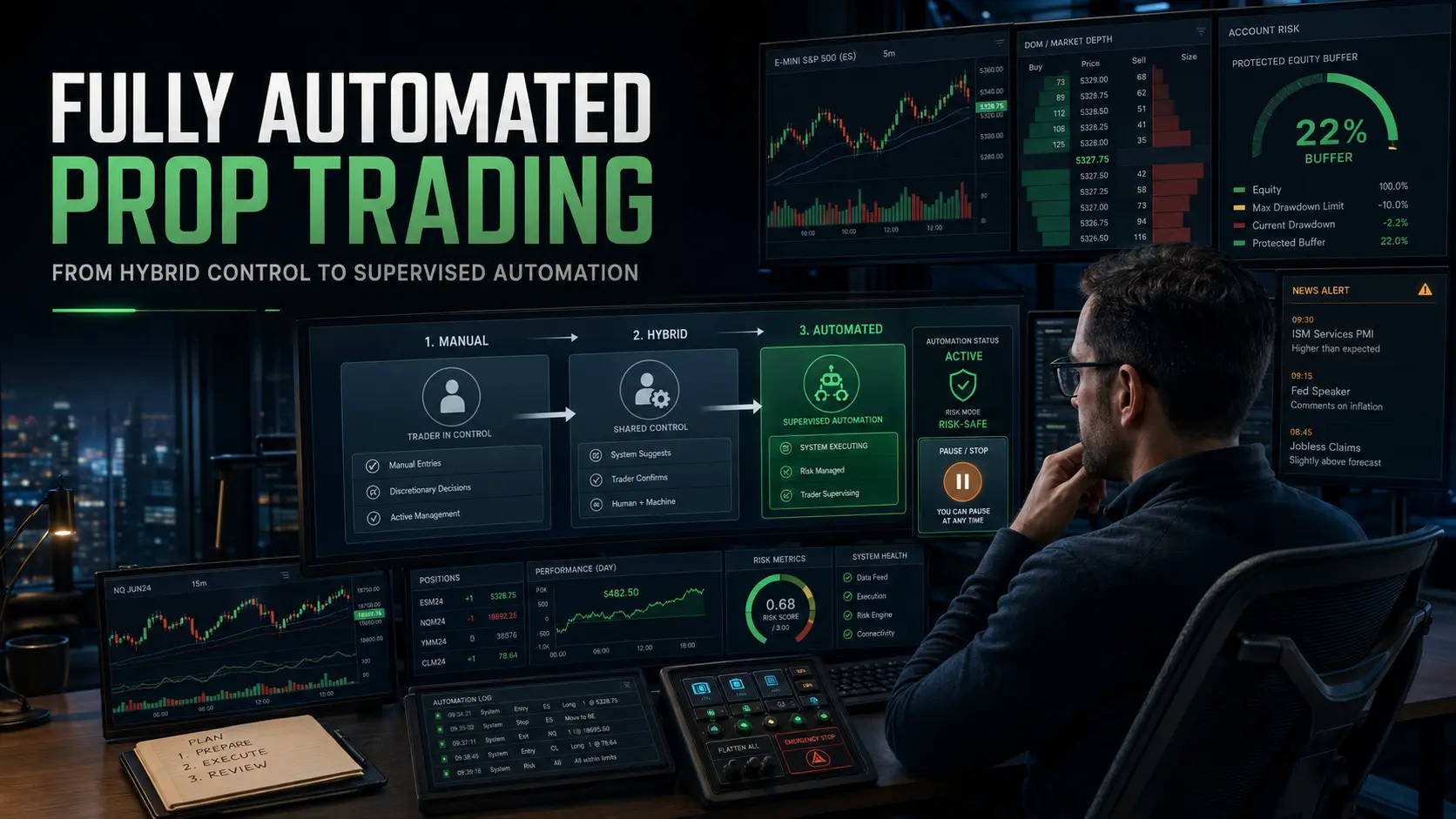
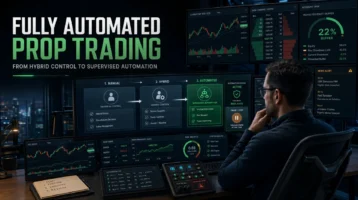
Fully automated prop-firm trading progressing from manual through hybrid control to supervised AFT automation
Progress from manual and Hybrid Algo Trading to supervised AFT automation with account-buffer protection, market alerts and operator risk controls.

Fully Automated Trading Prop Firm Accounts: How to Progress from Hybrid to Full Automation

Fully automated trading for prop firm accounts is possible with Algo Futures Trader (AFT), but the professional pathway is not to activate a universal trading robot and hope it survives. The safer and more adaptable approach is to begin with Hybrid Algo Trading, validate each element of the trading process and progressively increase automation until you reach the level appropriate for your prop firm, account rules, instrument and risk tolerance.

Can ATS Be Used for Fully Automated Prop-Firm Trading?

Yes. ATS provides purpose-built automated systems and risk controls for prop-firm evaluations, simulated-funded accounts, funded accounts and live brokerage trading. However, every deployment must be configured around the selected prop firm, account type, drawdown allowance, consistency rules, permitted automation, instrument, position size and trading session.

The objective is not uncontrolled set-and-forget trading. A professionally operated AFT system may automate approximately 90% to 95% of the practical trading process while retaining the operator controls needed to pause, restrict or exit trading when market or account conditions become unsuitable.

Automation should be earned in small, measurable steps. Begin with Hybrid Algo Trading and increase automation only after each stage has been tested, understood and validated.

Why Prop-Firm Accounts Require a Different Approach

A prop account may advertise a large nominal account size, but the amount that matters is the permitted drawdown. In practical risk terms, the drawdown allowance is the real account.

A trading system can be profitable over a long period and still breach a prop-firm account during an ordinary losing sequence. Trailing drawdown, daily loss limits, consistency rules, restricted trading periods and maximum contract limits can prevent a system from remaining active long enough for its statistical edge to develop.

Successful automated prop-firm trading therefore requires more than profitable signals. It requires a complete operating framework covering:

  • Prop-firm rules and permitted automation.
  • Maximum daily and total account risk.
  • Position sizing and contract limits.
  • Expected and worst observed drawdown.
  • Trading-session and instrument selection.
  • News, volatility and liquidity controls.
  • Contract rollover procedures.
  • Platform, connection and order monitoring.
  • Clear pause, exit and emergency-stop rules.

The Progressive Path from Hybrid to Fully Automated Trading

Step 1: Define the Prop-Firm Operating Rules

Begin by documenting the exact rules for the intended evaluation or funded account. Confirm whether automated trading, trade copying and unattended operation are permitted. Record the drawdown calculation, daily loss limit, consistency requirement, maximum position size, restricted news periods and any rules covering overnight or weekend positions.

Prop-firm policies can change, so these conditions should be verified directly with the firm before deployment and reviewed regularly.

Step 2: Start with an Official ATS Baseline

AFT provides turnkey systems and official baseline settings that can be assessed in Simulation, Market Replay and walk-forward operation. ATS automated Workspace 5 includes baseline models such as DSFG USAR, DSFG USAR GAP and WSFG USAR.

A baseline is a professional starting point, not a guaranteed universal configuration. It must be measured against the intended instrument, session, account rules and current market phase before it is considered for prop-firm deployment.

Step 3: Use Manual Entry with Automated Trade Management

The first practical stage is normally manual trade permission combined with automated order and exit management. The trader decides whether the setup and market conditions are suitable, while AFT controls the stop loss, profit targets, partial exits, trailing logic and other repetitive trade-management tasks.

This stage allows the trader to learn the signals and observe how the system behaves without surrendering control of trade selection.

Step 4: Progress to Hybrid Automated Entry and Exit

Once the trader understands the system, automated entry can be introduced under controlled conditions. The operator can enable long-only, short-only or two-way trading according to market direction, session structure and higher-timeframe bias.

AFT handles execution with machine speed and consistency, while the trader retains authority over when the system is permitted to trade. This removes much of the emotional and mechanical workload without removing human adaptability.

Step 5: Add Multi-Timeframe and Market-Context Controls

The next stage combines AFT automation with multi-timeframe confirmation, AlphaWebTrader market intelligence and AI Copilot support. The system can manage individual trades automatically while the operator assesses the wider trading environment.

At this stage, the trader should maintain statistics for each instrument, direction, setup, session and market phase. Automation should only be increased when the measured results remain compatible with the prop account’s limited drawdown allowance.

Step 6: Build an Account Buffer Before Increasing Automation

A profitable evaluation or funded account should not automatically trigger larger position sizes or less supervision. The first priority is to build a buffer between the current account equity and the applicable breach threshold.

This buffer gives the system more capacity to absorb normal losing trades, slippage and changing market conditions. It does not make the account safe or eliminate the possibility of failure. The required buffer must be based on the firm’s rules, the system’s observed drawdown, the position size and the operator’s risk limits—not an arbitrary percentage or fixed dollar target.

Until a suitable buffer exists, the trader may choose to maintain smaller size, restrict trade frequency and continue using hybrid approval rather than enabling wider automated operation.

Step 7: Increase Automation One Control at a Time

Automation can now be expanded progressively. The operator might first automate entries during one defined session, then automate directional selection, trade limits or additional approved setups. Only one material change should be introduced at a time so its effect can be measured.

If the equity curve, drawdown or execution begins to deviate materially from the validated baseline, automation should be reduced and the system returned to Simulation or hybrid control for review.

Step 8: Operate at 90% to 95% Automation with Human Oversight

The advanced objective is not necessarily 100% unattended trading. ATS can automate approximately 90% to 95% of the practical process while preserving a critical operator layer for market, account and technical risk.

The software can identify signals, place orders, manage positions, enforce trade limits and execute exits. The operator remains responsible for activating the correct system, confirming the market environment, supervising connectivity and intervening when conditions fall outside the validated operating plan.

When Should an Automated Prop Trading System Be Paused?

A fully automated futures trading system should not continue merely because the platform is running. The operator must be ready to pause new entries, reduce risk or exit positions when predefined conditions occur.

  • Abnormal price skew: Price movement, volatility, spreads or liquidity no longer resemble the conditions used to validate the system.
  • Major scheduled news: High-impact economic releases, central-bank decisions or other events can generate gaps, slippage and rapid reversals.
  • Unexpected geopolitical news: Breaking geopolitical developments can change correlations, liquidity and directional behavior without warning.
  • Exchange holidays: Shortened sessions and reduced participation can produce irregular volume and price action.
  • Contract rollovers: Volume migration between futures contracts can affect liquidity, indicators, signals and execution.
  • Technical events: Data interruptions, connection instability, platform problems, rejected orders or account synchronization errors require immediate attention.
  • Risk-limit proximity: Automation should be restricted or stopped before the account reaches its daily or total loss boundary.
  • Equity-curve deviation: Results that move materially outside the expected range may indicate a changed market phase, configuration problem or declining system edge.

Price-skew alerts, news intelligence and automated risk controls help identify these conditions, but the operator remains responsible for the final decision to continue, pause or exit.

Hybrid Algo Trading Is the Fastest Route to Higher Automation

It may appear faster to begin with full automation, but traders often progress more effectively by learning the system through controlled Hybrid Algo Trading. This reveals how signals, entries, exits and risk controls interact in live market conditions before the account depends on them completely.

The ATS model combines three complementary strengths:

  • Trader judgment: Determines market suitability, direction, risk and permission to trade.
  • AFT machine execution: Provides speed, precision, consistency and emotion-free order management.
  • AI Copilot intelligence: Supports analysis of market context, alerts, news, risk conditions and operating decisions.

Automation can then be increased according to demonstrated competence and measured results. Some traders may remain at 50% to 80% automation because that provides their preferred balance of control and efficiency. Others may progress toward 90% to 95% automation with active supervision.

A Practical Automated Prop-Firm Trading Checklist

  1. Confirm that the prop firm permits the intended form of automation.
  2. Calculate the effective drawdown allowance rather than relying on the advertised account size.
  3. Select one instrument, one trading session and one official ATS baseline.
  4. Configure daily loss, position-size, trade-frequency and account-level limits.
  5. Test in Simulation, Market Replay and walk-forward market conditions.
  6. Begin with manual permission and automated trade management.
  7. Introduce automated entries only after understanding the signals and exits.
  8. Measure win rate, risk-reward, drawdown, losing sequences, slippage and equity-curve deviation.
  9. Use conservative size when progressing into an evaluation or funded account.
  10. Build an account buffer before expanding position size or automation.
  11. Define rules for price skew, news, geopolitical events, holidays and rollovers.
  12. Monitor platform, connection, orders and account synchronization.
  13. Pause or reduce automation whenever results move outside the validated operating range.

Frequently Asked Questions

Can AFT trade a prop-firm account automatically?

Yes. AFT supports automated entry, automated trade management and fully automated trading modes. The configuration must match the selected prop firm’s rules, instrument, account limits and permitted automation conditions.

Is fully automated prop trading completely unattended?

It should not be treated as unattended set-and-forget trading. ATS may automate approximately 90% to 95% of the practical process, but an operator should remain available to supervise risk, news, market conditions, contract rollovers and technical events.

Should I begin with fully automated trading?

The preferred ATS pathway is to begin with Hybrid Algo Trading and increase automation through small, measurable steps. This allows you to understand the system, establish your own statistics and identify problems before they threaten a prop account.

How large should the prop-account buffer be?

There is no universal figure. The required buffer depends on the prop firm’s rules, the system’s observed drawdown, position size, trade frequency and the trader’s risk limits. A buffer reduces immediate pressure but cannot guarantee that an account will survive future losses.

Can automation guarantee an evaluation pass or payout?

No. Automated and hybrid trading systems can lose money, and no software can guarantee an evaluation pass, funded account or payout. Results depend on market conditions, system configuration, risk control, execution and operator decisions.

How to Get Started with Automated Prop-Firm Trading

The most adaptable route is to start with AFT turnkey workspaces, learn the ATS Hybrid Algo Trading Methodology and progressively increase automation as your experience, statistics and account buffer develop.

Review the complete answer to Can ATS be used for fully automated prop-firm trading?, or explore the ATS trading pathways for assisted onboarding, full-featured AFT access, Zero-to-Hero orientation and the tools required to develop your own hybrid or automated prop-firm trading operation.

Filed Under: AFT8, Algo Futures Trader, automated futures trading, ninjatrader algorithmic trading, ninjatrader automated trading, prop firm trading Tagged With: AFT, algo futures trader, Fully Automated Trading, Futures Trading Automation, hybrid algo trading, ninjatrader automated trading systems, Prop Firm Accounts, risk management

The Rise and Fall of Swing Trading and Day Trading: How Intraday Algorithms Rebuilt the Futures Market

July 20, 2026 by AFT

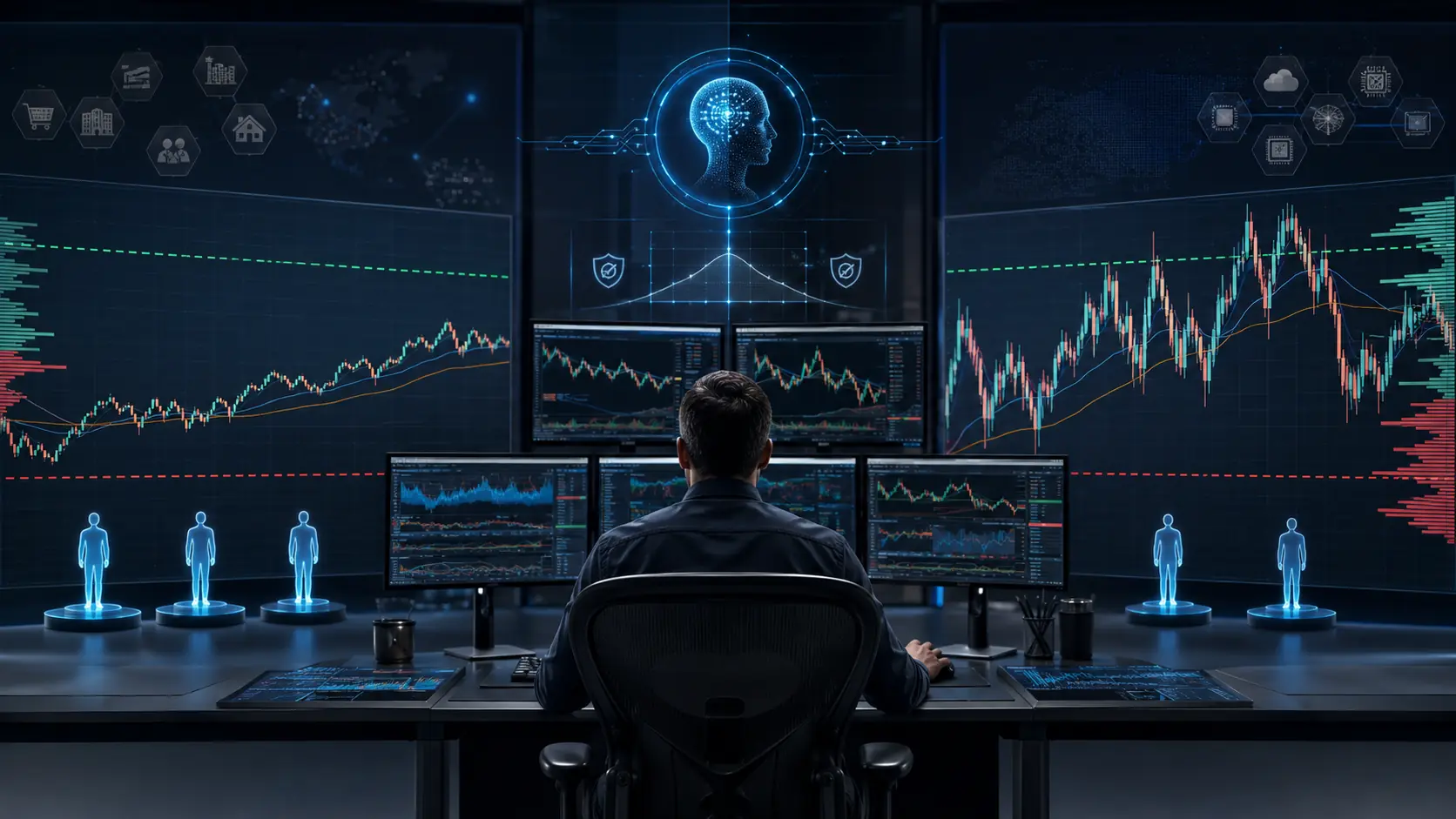
Traditional swing-trading desk transitioning into high-frequency algorithmic futures trading and institutional market networks
The transition from overnight swing-risk desks to high-turnover electronic and algorithmic futures markets

Futures volume accelerated as electronic day-trading desks and autonomous market-making algorithms began recycling the same capital repeatedly within the session. The market did not necessarily gain an equivalent amount of long-term or overnight risk capital: it gained turnover.

For much of the twentieth century, the visible market was also the market. A trader on an exchange floor, a bank dealer on a telephone or a proprietary desk watching a price screen could participate directly in price discovery. Day traders competed through local knowledge, order-flow awareness, judgment, and speed of response. Swing traders attempted to capture movements lasting several days or weeks.

That structure has been transformed. The modern market is a network of public exchanges, broker-dealer internalisers, alternative trading systems, interdealer platforms, bank liquidity pools, request-for-quote systems, and bilateral over-the-counter relationships. Much of the activity linking those venues is generated, routed, priced, hedged, and cancelled by software.

The pivotal change became visible around 2005–2006. Futures volume was rising much faster than the positions left open at the end of the day. Screen-based proprietary desks, electronic market makers, and early automated systems were taking over functions previously performed by floor locals and slower discretionary desks. The human day-trading desk was itself becoming an algorithm.

The result is not the literal death of day trading or swing trading. It is the transfer of the fastest part of the business from human judgment and overnight position-taking to high-turnover, tightly controlled, and increasingly machine-managed inventory.

The Apparent Paradox: Less Money, but More Futures Volume

The paradox disappears once four different measurements are separated:

MeasureWhat It RecordsWhat It Does Not Record
Trading volumeHow many contracts changed hands during a periodHow much exposure remained after the trades were closed
Open interestContracts still outstanding at the end of the trading dayHow many times positions were opened, transferred or closed intraday
Margin or performance-bond collateralAssets pledged to support the risk of open positionsThe full notional value of the contracts or total daily turnover
Notional valueThe referenced economic exposure of the contracts tradedCash invested in the way market capitalisation measures equity value

A futures contract is not a share purchased for its full value. Every long is matched by a short, and both sides post only the required collateral. Volume can therefore multiply without a comparable increase in open interest or cash committed overnight.

For example, 100 swing traders who each open one contract and retain it for ten days create 100 contracts of opening volume and 100 contracts of continuing open interest. By contrast, ten intraday traders completing 50 round-trip trades each can generate 1,000 contracts of single-counted volume while finishing the session with no open interest at all. The smaller day-trading group creates ten times the recorded volume but leaves no overnight position.

Volume is activity. Open interest is standing exposure. Margin is collateral. They are related, but they are not interchangeable measures of “money in the market.”

Why 2006 Matters

CME’s 2006 annual report provides unusually clear evidence of the transition. The exchange said its record volume was driven partly by faster technology and increased use of automated trading systems. It also began allowing customer firms to connect co-located servers over high-speed fibre, with anticipated order-entry latency below one millisecond.

CME Measure20052006Change
Total annual trading volume1.048 billion contracts1.341 billion contracts+28.0%
Electronic volume on CME Globex730 million contracts956 million contracts+31.0%
Year-end open interest30.083 million contracts35.107 million contracts+16.7%
Annual volume divided by year-end open interest34.8 times38.2 times+9.7%
Cash performance bonds$579 million$506 million−12.6%
Total cash and non-cash performance-bond collateralApproximately $46.39 billionApproximately $47.78 billion+3.0%

The volume-to-open-interest calculation is a simple comparison using year-end open interest, not an official CME turnover statistic. It is included to illustrate the direction of the change.

The numbers require a precise interpretation. CME open interest did not decline in 2006; it rose. Total performance-bond collateral also rose. The cash component fell because clearing firms could use securities and investment facilities as collateral, so the decline in cash alone should not be treated as proof that total risk capital left the market.

Nevertheless, activity rose much faster than standing exposure. Annual volume increased 28%, compared with a 16.7% increase in year-end open interest. A crude turnover proxy consequently rose by almost 10% in a single year. This is consistent with a market in which capital was being turned over faster and more positions were being opened and closed during the session.

The strongest asset-level evidence came from electronic markets. CME reported that electronically traded foreign-exchange volume rose 46% in 2006 while open-outcry FX volume fell 26%. E-mini equity volume increased 25%, and electronic interest-rate volume increased 34%. The exchange explicitly associated the broader growth with technological improvements and increased use of automated trading systems.

Annual volume and open interest cannot identify every trader’s holding period. They do not prove by themselves that all swing desks were replaced by day-trading desks. Combined with the migration to Globex, faster matching, automated-system participation, incentive programmes and co-location, however, they provide strong evidence that the market’s marginal unit of activity was becoming more electronic, faster and more intraday.

How Day-Trading Desks Took Over the Overnight Swing Function

The transition occurred in stages rather than in a single overnight event:

  1. Traditional swing and dealer desks held inventory. Their economic function involved accepting price risk between customer trades, sessions or market events.
  2. Electronic proprietary desks shortened the holding period. Screen-based traders and trading arcades could enter and exit more frequently, often flattening at the end of the day.
  3. Market-making algorithms automated the day desk. Software could quote both sides, hedge related products and recycle inventory many times before a human could complete one decision loop.
  4. Risk migrated rather than vanished. Longer-term exposure remained with hedgers, asset managers, hedge funds, banks and end users, while the transfer of that risk between participants became a high-speed intraday business.

The essential shift was from earning a return by holding a directional position to earning a smaller return many times by intermediating, hedging, or arbitrage flow. The former consumes time and overnight risk capacity. The latter consumes technology, message capacity, connectivity, and operational control.

This explains how exchange volume could grow without an equivalent increase in committed capital. The contract became a reusable vehicle for intraday risk transfer rather than simply a position held until the next major price movement.

Public Futures Markets Became the Hedge Engine for Private Institutional Networks

The growth in futures volume was not generated only by traders speculating directly on an exchange. Public futures order books increasingly became the immediate hedging layer for exposures created elsewhere.

A bank may execute a private client transaction in an OTC market and hedge it in public futures. An options market maker may trade an option, hedge the resulting delta in futures and rebalance repeatedly as price and volatility change. An ETF or cash-equity desk may use index futures while it assembles or unwinds a basket. A commodity dealer may negotiate a physical contract privately and transfer price risk through exchange-traded futures.

One underlying investment or commercial decision can therefore generate several futures transactions:

  1. a client creates the original exposure in a public or private venue;
  2. a bank or dealer hedges that exposure in futures;
  3. an electronic market maker takes the other side and hedges elsewhere;
  4. an arbitrage desk links the futures price to cash, ETF, options or OTC markets; and
  5. each intermediary adjusts or closes its hedge as market conditions change.

The volume recorded by the futures exchange can rise several times, even though the original economic exposure was created only once. Futures became the high-speed public transmission system connecting slower and more private pools of institutional risk.

Public Futures AssetPrivate or Institutional Exposure Commonly Hedged
Equity-index futuresCash-equity baskets, ETFs, listed and OTC options, structured products and portfolio flows
Interest-rate and Treasury futuresGovernment bonds, swaps, mortgage portfolios, corporate debt, repo and bank rate exposure
FX futuresSpot FX, forwards, swaps, options, corporate hedges and cross-border portfolios
Energy futuresPhysical production, storage, transport, refinery exposure, OTC swaps and commodity options
Agricultural and metals futuresProduction, inventories, forward contracts, merchant books and industrial consumption
Volatility and digital-asset futuresOptions books, structured volatility exposure, spot holdings and private OTC transactions

The Central Change: Human Traders Lost the Fastest Time Horizon

A human trader and a high-frequency market maker may both open and close positions within the same day, but they are not conducting the same business.

A conventional day trader normally assumes directional risk. The trader expects price to move and attempts to profit from that movement. A swing trader does the same over a longer period, accepting overnight and event risk in exchange for a larger potential move.

A high-frequency market maker is usually attempting to quote both sides, manage inventory, preserve queue position, capture spreads or rebates, and hedge related exposure across instruments or venues. It may trade thousands of times without expressing a meaningful view on where the market should close.

This is why high-frequency trading should not be described simply as very fast day trading. It is an industrial form of liquidity provision and short-horizon risk transfer, supported by direct data feeds, co-location, specialised infrastructure, automated controls and substantial capital.

Important distinction: “Unattended” does not usually mean unmonitored. Professional systems may make individual quoting and execution decisions without human approval, but firms supervise them through exposure limits, credit controls, kill switches, surveillance and operational staff.

From the Trading Pit and Telephone to Co-location and Code

1. The Human Market

Traditional exchanges concentrated participants physically. Floor brokers represented customers, specialists or designated market makers maintained markets, and independent “locals” traded for their own accounts. In foreign exchange, government bonds, corporate debt and derivatives, bank dealers made prices over the telephone and used their balance sheets to warehouse risk.

Access was scarce. Exchange membership, physical presence, dealer relationships and timely information created an economic advantage. The trader who stood closest to the flow could react before somebody outside the room.

2. Electronic Access Expanded the Market

Nasdaq began as an electronic stock market in 1971. CME Globex launched in 1992, and the E-mini S&P 500 later became a decisive product in the migration from the futures pit to the screen. CME described electronic access as a way to remove the physical capacity limit of the pit and allow customers to trade directly through clearing firms and trading software. The NYSE introduced its Hybrid Market in 2005, combining floor-based and electronic execution.

This was initially a democratising change. Electronic platforms reduced geographic barriers, extended trading hours, improved confirmation speed and gave more participants direct access to market data and execution.

3. Market Access Became a Technology Competition

Decimal pricing, electronic communication networks, faster matching engines and the implementation of Regulation NMS changed the economics of U.S. equity trading. Spreads narrowed, liquidity fragmented across venues and the value of being physically present was replaced by the value of connectivity, data and queue priority.

By 2010, the U.S. Securities and Exchange Commission described the equity market as having moved from primarily manual trading to primarily automated trading. It identified passive market making, arbitrage, structural and directional strategies as separate forms of high-frequency activity, alongside tools such as co-location and proprietary market-data feeds.

4. The Traditional Bank Desk Was Reorganised

After the global financial crisis, regulation and balance-sheet constraints altered the dealer model. The Volcker Rule generally prohibited proprietary trading by banking entities, while retaining exemptions for genuine market-making, underwriting and risk-mitigating hedging. This did not remove bank trading desks, but it narrowed the case for holding large positions purely for the bank’s own speculative return.

Risk did not disappear. Some of it moved from traditional bank balance sheets towards non-bank principal trading firms, hedge funds, electronic liquidity providers and asset managers. Bank dealers remained central where customer relationships, credit, financing, bespoke contracts and the capacity to warehouse less-liquid positions still mattered.

5. Automation Spread Beyond Equities and Futures

The same technology moved into foreign exchange, government bonds and then selected parts of corporate fixed income. The transition was fastest in standardised, liquid instruments and slowest where trades were large, irregular, bespoke or dependent on dealer balance sheets.

Five Different Trading Businesses Often Confused as One

ParticipantTypical HorizonPrimary Economic EdgeTypical InventoryMain Risk
Human day traderSeconds to hoursDirection, session structure, discretion and selective participationNormally closed by the end of the sessionFalse signals, execution cost, leverage and emotional error
Swing traderDays to weeksTrend, macroeconomic change, catalysts, positioning and behavioural persistenceCarried overnightGaps, news, changing correlations and financing cost
Traditional dealer deskMinutes to monthsCustomer flow, relationships, credit, spread and balance-sheet intermediationManaged or hedged according to customer demand and limitsInventory, counterparty, funding and regulatory-capital risk
Institutional execution algorithmMinutes to daysCompleting a parent order while limiting market impact and benchmark slippageDetermined by the investor’s larger orderInformation leakage, adverse selection and poor scheduling
High-frequency market maker or principal trading firmMicroseconds to secondsSpread capture, queue position, rapid repricing, cross-venue hedging and scaleFrequently neutralised or tightly limitedAdverse selection, latency, model failure and a rapid liquidity shock

There are also directional algorithms, statistical-arbitrage systems and event-driven systems. “Algorithmic trading” therefore describes a method of decision-making or execution, not one strategy and not one holding period.

Public Markets and Private Trading Networks

The public quotation visible on a retail screen is no longer a complete map of the market. It may be the reference price used by other venues, but the order can execute somewhere else.

Venue TypeHow It WorksTransparencyCommon Users and Assets
Lit exchange or central limit order bookDisplayed bids and offers compete under price-and-time or similar priority rulesHigh pre-trade transparency, subject to order types and data-access differencesEquities, ETFs, futures, listed options and some digital assets
Exchange auction or block facilityOrders cross through an auction or a privately negotiated block is reported to the exchangeLimited before execution; reported according to venue rulesEquity opening and closing auctions, options auctions, futures blocks and exchange-for-related-position trades
Alternative trading system or dark poolEligible orders interact away from a registered public exchangeLittle or no displayed pre-trade interest; securities trades remain subject to reporting requirementsInstitutional equity orders, midpoint trading, blocks and selected fixed-income instruments
Wholesaler or dealer internaliserA broker-dealer executes against its own liquidity or matches flow internallyPrivate before execution, with applicable post-trade reportingRetail equities and options; bank activity in FX, bonds and derivatives
Single-dealer platformOne bank or liquidity provider streams prices directly to approved clientsPrivate and relationship-basedForeign exchange, rates, credit and structured products
Multi-dealer or request-for-quote platformA customer requests or receives prices from several dealersParticipants see selected quotes; the wider market may see only post-trade dataGovernment and corporate bonds, FX, swaps and institutional derivatives
Interdealer broker networkDealers and principal trading firms trade with one another, often anonymouslyWholesale access with limited public pre-trade visibilityGovernment bonds, FX and interest-rate products
Bilateral OTC or voice marketTwo parties negotiate price, size, credit and contract terms directlyPrivate negotiation with asset-specific reportingLarge or bespoke FX derivatives, bonds, swaps, physical commodities and structured trades
Decentralised protocol or automated market makerSmart contracts match orders or price liquidity pools under programmed rulesPublic blockchain records, but execution conditions differ from an exchange order bookDigital assets and tokenised instruments

Private does not necessarily mean secret or unregulated. It usually means that trading interest is not displayed to the whole market before execution, access is restricted, or the transaction is negotiated bilaterally. Post-trade publication, regulatory reporting and clearing obligations depend on the asset and jurisdiction.

As of May 2026, the SEC continued to maintain a formal list of regulated alternative trading systems. In a June 2026 proposal, the Commission also noted that U.S. equity fragmentation now reflects both a proliferation of displayed venues and the division of activity between exchanges and off-exchange trading. The modern equity market is therefore public and private at the same time.

Which Asset Types Are Most Automated?

The governing rule is straightforward: automation is strongest where products are standardised, continuously traded, data-rich and easy to hedge. Human and dealer intermediation remain stronger where instruments are heterogeneous, infrequently traded, credit-sensitive or negotiated in large size.

Asset TypeMain Price-Formation VenuePrivate or Institutional LayerDegree of Short-Horizon AutomationWhere Humans Still Matter
Large-cap equities and ETFsFragmented public exchange order booksATSs, dark pools and wholesalersVery highPortfolio decisions, catalysts, block execution and longer-horizon positioning
Equity index, interest-rate and major FX futuresCentralised exchange order booksBlocks, spreads and exchange-for-related-position facilitiesVery high in the most liquid contractsDirectional risk, roll management, event interpretation and less-liquid maturities
Energy, metals and agricultural futuresExchange order booksBlocks, physical-market relationships and OTC hedgesHigh in benchmark contracts but uneven across productsPhysical supply, location, quality, seasonality and commercial hedging
Listed optionsMultiple exchange order books and auctionsDealer and wholesaler liquidity, including complex-order mechanismsVery high in quotation and hedgingVolatility views, structure selection, large orders and complex risk transfer
Spot FX and FX derivativesDecentralised OTC dealer and electronic venuesSingle-dealer platforms, multi-dealer platforms, internal pools and voice tradingHigh in liquid spot pairs; mixed in derivativesLarge trades, credit relationships and bespoke forwards, swaps and options
Benchmark government bondsElectronic interdealer and dealer-to-client platformsInterdealer networks, RFQ systems and bilateral dealer booksHigh in on-the-run securities and related futuresOff-the-run issues, balance-sheet capacity, blocks and relative-value positioning
Corporate and municipal bondsDealer-to-client RFQ and bilateral OTC marketsDealer inventories, institutional platforms and relationship networksModerate and highly unevenCredit analysis, finding liquidity, negotiation and large or unusual issues
OTC swaps and structured derivativesElectronic execution where mandated or practical, otherwise bilateralBanks, swap execution facilities, interdealer brokers and clearing networksHigh for standardised pricing; lower for bespoke structuringCredit, collateral, legal terms, structuring and balance-sheet use
Digital assetsCentralised exchange order books and on-chain protocolsOTC desks, internal market makers and private liquidity relationshipsVery high but fragmented across venuesCustody, venue selection, protocol risk and longer-horizon thesis

The differences are visible in official research. A CFTC study of CME data found extensive automation across futures, with the greatest presence in liquid FX, equity-index and interest-rate products, while physical commodity contracts retained more manual participation. In U.S. Treasury cash trading, Federal Reserve research found principal trading firms dominant on electronic interdealer venues, while primary and other dealers remained dominant across the Treasury market overall.

Foreign exchange demonstrates why electronic does not mean exchange-traded. The 2025 BIS Triennial Survey found that 59% of FX trading was electronic in April 2025, but the market remained fragmented across direct and brokered channels. Voice execution remained important for large spot trades and bespoke derivatives.

Fixed income shows the opposite edge of the spectrum. Automation is well established in futures and liquid benchmark government bonds, but high-yield and less-liquid corporate bonds still depend more heavily on dealers, RFQs and relationships. The less interchangeable the instrument, the less complete the replacement of the human desk.

What Actually Fell?

The decline was concentrated in specific functions rather than in trading as a whole:

  • The floor scalper lost the physical information advantage. Electronic access replaced the exchange seat with connectivity and software.
  • The manual trader lost the latency contest. A person cannot repeatedly reprice, cancel and hedge across several venues at machine speed.
  • The traditional proprietary bank desk became more constrained. Regulation, capital requirements and risk limits reduced some forms of balance-sheet speculation, although market-making remained.
  • Voice dealing declined in standardised and liquid products. It survived where size, discretion, credit and custom terms justify negotiation.
  • The visible exchange stopped representing the entire liquidity pool. Internalisation, ATSs, dealer platforms and bilateral networks became part of the execution landscape.

The fastest and most repetitive parts of the traditional desk were easiest to automate. Judgement-intensive, relationship-intensive and balance-sheet-intensive functions were more resistant.

Did Algorithmic Market Making Improve the Market?

The evidence is mixed but not evenly balanced. Automation has generally reduced transaction costs, accelerated price adjustment and increased quoted liquidity in normal conditions. CFTC research using account-level futures data found that greater high-frequency participation was associated with improved traded spreads and lower price impact. It also found that aggressive directional trading used by high-frequency firms to reduce inventory could damage market quality.

This is the central trade-off. Electronic liquidity is fast and competitive, but it can also be conditional. A traditional dealer may use capital and customer relationships to hold risk through a disturbance. A voluntary electronic market maker can widen its quotes, reduce size or withdraw when volatility, adverse selection or inventory risk breaches its limits.

Therefore, a narrow spread in calm conditions should not be confused with guaranteed depth during stress. Modern markets may be highly liquid on average while becoming fragile at precisely the moment everybody wants to trade.

Why Swing Trading Survived Better Than Traditional Day Trading

Automation attacks the shortest horizon first. If the expected opportunity lasts milliseconds, infrastructure determines who can capture it. If it lasts several minutes, execution still matters enormously. If it develops over days or weeks, latency becomes a much smaller part of the result.

Swing traders remain exposed to institutional algorithms, but they are not normally competing for the same spread or the same queue position. Their potential edge must come from slower information: macroeconomic change, earnings, policy, supply and demand, positioning, capital flows, sentiment or a persistent trend.

Day trading has also survived, but its viable role has narrowed. A human day trader is unlikely to beat a professional market maker at continuous two-sided quotation. The remaining advantage is selectivity: choosing an instrument, session, setup and risk level, and then choosing not to trade when conditions are unsuitable.

This has encouraged a hybrid model in which the human controls context, direction and permission while software manages scanning, order placement, exits, risk limits and repetitive execution. The human does not attempt to become the matching engine; the machine does not need to own every strategic decision.

The Modern Hierarchy of Market Power

  1. At microsecond and millisecond horizons, infrastructure dominates. Exchanges, high-frequency market makers, principal trading firms and automated dealer systems set the pace.
  2. At intraday horizons, systems and humans overlap. Execution algorithms, systematic funds, bank desks, prop firms and selective discretionary traders compete around news, liquidity and session structure.
  3. At multi-day and multi-week horizons, interpretation becomes more important. Asset managers, hedge funds, macro traders and swing traders accept more time and event risk in pursuit of larger moves.
  4. In illiquid or bespoke instruments, relationships and balance sheets still matter. Human sales traders, dealers, structurers and institutional networks remain central.

The faster the strategy, the more it has become a technology and capital business. The less standardised the asset, the more the traditional desk survives.

Conclusion: Trading Did Not Die; Its Competitive Boundary Moved

The rise of electronic and high-frequency trading did not abolish day trading or swing trading. It removed much of the easy economic space that once existed between slow information, wide spreads and limited market access.

Traditional human desks no longer control every stage of price discovery. Public exchanges now interact with private liquidity pools, bank platforms, dealer networks and automated market makers. The same instrument may be priced publicly, executed privately, hedged on another venue and cleared somewhere else.

For the modern trader, the decisive question is no longer simply whether a market will rise or fall. It is also: Who forms the price, on which venue, over what time horizon, with what information and at what execution speed?

At the shortest horizons, the answer is increasingly the machine. At longer horizons and in less-standardised markets, human judgement, relationships and controlled risk remain very much alive.

Sources and Further Reading

  • Chicago Mercantile Exchange Holdings: 2006 Annual Report
  • CME Group: Understanding Futures Open Interest
  • U.S. Securities and Exchange Commission: Concept Release on Equity Market Structure
  • U.S. Securities and Exchange Commission: Regulation NMS Final Rule
  • U.S. Securities and Exchange Commission: 2026 Proposal on the Trade-Through Rule and Market Fragmentation
  • U.S. Securities and Exchange Commission: Alternative Trading System List
  • U.S. Commodity Futures Trading Commission: Automated Trading in Futures Markets
  • U.S. Commodity Futures Trading Commission: High-Frequency Trading and Market Quality
  • Federal Reserve: Principal Trading Firm Activity in Treasury Cash Markets
  • Federal Reserve: Final Rules to Implement the Volcker Rule
  • Bank for International Settlements: The FX Trade Execution Landscape Through the 2025 Triennial Survey
  • Bank for International Settlements: Electronic Trading in Fixed-Income Markets
  • CME Group: Twenty Years of CME Globex
  • New York Stock Exchange: History of the NYSE

Filed Under: Algo Futures Trader, automated algorithmic trading, automated futures trading system, futures automated trading, ninjatrader algorithmic trading Tagged With: algorithmic trading, automated trading, CME Globex, day trading, electronic trading, futures trading, futures volume, high-frequency trading, institutional trading, market making, Market Structure, open interest, private trading venues, swing trading, trading desks

🔥 ATS Hybrid Algo Futures Trading & Mastery Special Offer Save 53%!

July 12, 2026 by AFT

SOLD OUT – 

🏆 Talk to us

Get the complete ATS Hybrid Algo Trading ecosystem, Fast Track onboarding, one-to-one VIP Mastery, AI Copilot, trading groups, professional support, and first-year annual services for maximum value and maximum savings.

Limited Availability: Fast Track and VIP Mastery seats are limited by the number of traders the ATS team can personally support. When the remaining seats are filled, this offer may be withdrawn without notice.

Choose Your ATS Universal Trading & Mastery Package

Choose Micro Futures with ATS Universal Premium or access all supported Futures instruments and two-PC licensing with ATS Universal Ultimate.

ATS Universal Premium

Complete Micro Futures Trading & Mastery Package

Designed for traders who want the complete ATS ecosystem for Micro Futures trading with AFT, AWT, AI Copilot, trading groups, assisted onboarding, and one-to-one VIP Mastery.

Algo Futures Trader Premium — $1,900 Value

  • Full AFT hybrid algo trading features
  • Micro Futures instruments
  • One-PC desktop licence
  • One-time AFT licence

Alpha Web Trader Premium — $600 Value

  • Web, desktop, and mobile access
  • Real-time signals and advanced technicals
  • Cloud-based confirmation and decision-support tools
  • The first annual term included

ATS Trading Groups & AI Copilot — $1,800 Value

  • ATS VIP Trading Group
  • AI Trading Copilot
  • ATS Support Group
  • Algo Signal Trader
  • Alpha Trader News

Fast Track Zero to Hero — $495 Value

  • Assisted ATS installation and setup
  • One Get Started remote session
  • Four Zero-to-Hero one-to-one meetings
  • Guided training through Stages 1–5
  • Turnkey workspace and trade-plan guidance

One-to-One VIP Mastery — $945 Value

  • Three months of VIP Mastery
  • Twelve one-to-one meetings
  • Weekly coaching and progress reviews
  • Trading-plan, statistics, and journaling support

VIP Priority Support — $495 Value

  • 24/7 AI Help Agent
  • Help articles, videos, forums, and groups
  • Human-agent assistance
  • Priority support access

Year-One Annual Maintenance Included

  • First-year annual ATS services included
  • VIP Priority Support included for Year 1
  • Upgrade Assurance
  • Optional annual renewal after Year 1: $500

Premium Package Retail Value

$6,235

Save 53% — $3,335

$2,900

One-Time Package Price

Buy ATS Universal Premium

ATS Universal Ultimate

Complete All-Futures Trading & Mastery Package

Designed for traders who want the complete ATS ecosystem for All Futures trading with AFT, AWT, AI Copilot, trading groups, assisted onboarding, and one-to-one VIP Mastery.

Algo Futures Trader Ultimate — $2,900 Value

  • Full AFT hybrid algo trading features
  • All supported Futures instruments
  • Two-PC desktop licence
  • One-time AFT licence

Alpha Web Trader Ultimate — $800 Value

  • Web, desktop, and mobile access
  • Real-time signals and advanced technicals
  • Cloud-based confirmation and decision-support tools
  • First annual term included

ATS Trading Groups & AI Copilot — $1,800 Value

  • ATS VIP Trading Group
  • AI Trading Copilot
  • ATS Support Group
  • Algo Signal Trader
  • Alpha Trader News

Fast Track Zero to Hero — $495 Value

  • Assisted ATS installation and setup
  • One Get Started remote session
  • Four Zero-to-Hero one-to-one meetings
  • Guided training through Stages 1–5
  • Turnkey workspace and trade-plan guidance

One-to-One VIP Mastery — $945 Value

  • Three months of VIP Mastery
  • Twelve one-to-one meetings
  • Weekly coaching and progress reviews
  • Trading-plan, statistics, and journaling support

VIP Priority Support — $495 Value

  • 24/7 AI Help Agent
  • Help articles, videos, forums, and groups
  • Human-agent assistance
  • Priority support access

Year-One Annual Maintenance Included

  • First-year annual ATS services included
  • VIP Priority Support included for Year 1
  • Upgrade Assurance
  • Optional annual renewal after Year 1: $600

Ultimate Package Retail Value

$7,435

Save 53% — $3,940

$3,495

One-Time Package Price

Buy ATS Universal Ultimate


View More Information

⚡ Fast Track Zero to Hero

Not Ready to Go All In? Take the first step with Fast Track Zero to Hero — 30-Day Access. Get 30-day access to the ATS ecosystem with assisted setup, onboarding, ATS trading systems, turnkey workspaces, AI Copilot, trading groups, and one-to-one guidance through the structured five-stage pathway.

RRP: $790 — Your Price: $495 — SAVE 37%

View More Information
👉 Get Started — $495

Flexible Payment Options

Buy Now, Pay Later: Installment plans may be available through Amazon, Klarna, or Affirm, subject to provider eligibility, approval, location, and currency.
Monthly Payments: Payment terms from 1 to 36 months may be displayed during checkout, where available, depending on the country.
Obligation-Free: The Discovery meeting is 100% free, with no obligation to buy. View any package price to review secure payment options, enter an eligible promotional code, and explore available payment plans before completing your purchase.

One-Time Licence and Annual Services Explained

The package price includes a one-time AFT desktop licence together with the first annual term of AWT, ATS trading groups, AI Copilot services, and VIP Priority Support. Fast Track and VIP Mastery are assisted services delivered during their stated service periods.
Annual renewal after Year 1 is optional. Traders who do not renew may continue using their qualifying one-time AFT desktop licence forever with unlimited updates, but access to annual cloud services, trading groups, support services, Upgrade Assurance, and future major product versions requires annual renewal: Premium $500 and Ultimate $600 – both of which can be paid in whole or by monthly plan.

Limited Seats!

Fast Track onboarding and VIP Mastery require direct assistance from the ATS team. Availability is therefore limited to the number of traders the team can personally onboard, train, and support. Once the available places are filled, this package, pricing, or included assisted services may be changed or withdrawn without notice.

Need Help Deciding?

Not Sure Which ATS Package Is Right for you, or just want more information?
Book a free, obligation-free ATS Discovery Meeting to discuss your experience, trading goals, preferred instruments, prop-firm or live-account plans, the most suitable ATS pathway, and a deep dive into available payment options.

🏆 Book Your Free Discovery Meeting

Filed Under: Algo Futures Trader, automated trading ninjatrader, Hybrid Algo Trading, prop firm trading Tagged With: ATS Trade Mastery, Fast Track Zero To Hero, prop firm trading

ATS Discontinues Monthly and Quarterly Product Leases

July 12, 2026 by AFT

Effective July 12, 2026, Algo Trading Systems has discontinued monthly and quarterly lease options across all ATS products.

Vastly Simplified ATS Pricing Is Now in Effect

ATS has simplified its product pricing and licensing structure to make it easier for traders to understand their options, own the technology they use, and plan for the long term.

Monthly and quarterly leases are no longer available for new purchases. For ATS desktop applications, including Algo Futures Trader (AFT), previous lease options have been superseded by a One-Time license.

One-Time Licensing for AFT Desktop Applications

Traders purchasing AFT desktop applications can now obtain a One-Time license rather than continuing to make monthly or quarterly lease payments.

The One-Time license provides ongoing access to the purchased product version and may be combined with optional Annual Maintenance.

Optional Annual Maintenance may include:

  • Upgrade assurance for eligible future product versions
  • Product updates and continued development benefits
  • Priority or VIP help and support
  • Access to additional maintenance benefits available with the applicable package

The precise products, services, and support benefits included will depend on the selected ATS license and maintenance package.

What Happens to Existing Monthly and Quarterly Leases?

Existing customers with an active monthly, quarterly, or other recurring ATS lease may continue using that lease while it remains active and in good standing.

ATS will not automatically cancel an existing active lease solely because this policy has changed.

However, once an existing lease is cancelled, terminated, allowed to expire or otherwise ended by the customer, the discontinued monthly or quarterly lease option will no longer be available for renewal or reactivation.

The customer will then need to select from the ATS products, licenses, subscriptions or packages available under the new pricing structure.

Why ATS Is Simplifying Its Pricing

The previous combination of free access, short-term trials, monthly leases, quarterly leases, annual plans and multiple product tiers created unnecessary complexity for customers and the ATS team.

The simplified structure is designed to provide clearer product ownership, fewer overlapping options, more transparent upgrade pathways, and a stronger long-term relationship between ATS and committed traders.

This change forms part of a wider update to ATS access, licensing and customer-support policies during July and August 2026.

Additional Reading About ATS Policy Changes

  • ATS Discontinues All Self-Assisted Free Trials
  • ATS Freemium Trading Access Will End in August 2026

Existing Customers

Existing customers do not need to take immediate action while their current lease remains active. Customers considering cancellation should understand that the discontinued monthly or quarterly lease will not be available again after it ends.

Customers who want to review One-Time licensing, Annual Maintenance, upgrade assurance, or available ATS packages should visit ATS pricing.

Policy effective date: July 12, 2026.

Filed Under: AFT8, ATS News & Policy Updates, NinjaTrader 8, ninjatrader automated trading Tagged With: AFT Licensing, algo futures trader, Annual Maintenance, ATS News, ATS Policy Update, ATS Pricing, ATS Products, Existing ATS Customers, Futures Trading Software, Monthly Leases Discontinued, One-Time License, Quarterly Leases Discontinued, Trading Software Licensing, Upgrade Assurance

ATS Discontinues All Self-Assisted Free Trials

July 12, 2026 by AFT

Algo Trading Systems has discontinued all Self-Assisted free trials. New traders must now attend an ATS Discovery Meeting before entering an assisted onboarding, training, and trading pathway. This policy change follows an extensive review of trader participation, platform usage, onboarding results, support requirements, repeated license-trial abuse, and concerns regarding unauthorized copying and misuse by third-party vendors within the trading ecosystem.

Our internal review found that approximately 80% of Self-Assisted trial traders did not read, use, or experience the complete ATS Hybrid Algo Trading ecosystem and were unable to follow the guidance, instructions, and required onboarding process.

What Replaces the Self-Assisted 7-Day Free Trial?

  • Assisted Fast Track Zero to Hero with 30-day access to ATS Ultimate

Why ATS Discontinued Self-Assisted Free Trials

ATS is not simply an algorithm that a trader downloads, switches on, and expects to generate immediate daily, weekly, or monthly profits. ATS provides a complete Hybrid Algo Trading framework that combines Algo Futures Trader, Alpha Web Trader, turnkey workspaces, staged education, AI Copilot guidance, trading groups, trader controls, risk management, and ongoing mastery.

Many traders downloaded AFT, opened a turnkey workspace, and expected the algorithm to begin generating immediate profits or automatically pass a prop-firm evaluation without completing the required installation, orientation, education, practice, risk-control, and trade-planning stages.

  • Many traders could not connect to Discord or locate the ATS groups.
  • Many could not find or follow the Zero to Hero training pathway.
  • Most did not attend the ATS VIP Trading Group or experience the AI Trading Copilot.
  • Many did not use Alpha Web Trader through its web or desktop applications.
  • Some could not download or correctly install the required AFT turnkey workspaces.
  • Many did not progress through Zero to Hero Stages 1 to 5.
  • Some contacted the help desk without completing the available orientation, setup materials, or guided training.

As a result, most Self-Assisted traders never received a complete or accurate experience of ATS technology, methodology, education, support, and Hybrid Algo Trading capabilities.

Filed Under: AFT8, Hybrid Algo Trading Tagged With: AI trading copilot, algo futures trader, Alpha Web Trader, Assisted Onboarding, ATS Discovery Meeting, ATS Fast Track, ATS News, ATS News & Updates, ATS Policy Update, Free Trial Discontinued, Futures Trading Education, hybrid algo trading, prop trading, Self-Assisted Trials, VIP Mastery, zero to hero

  • 1
  • 2
  • 3
  • Next Page »
  • NinjaTrader Automated Trading
  • automated futures trading
  • automated trading systems
  • Day Trading Futures
  • Get Started Day Trading Futures
  • VIP Trading Group Live Market Trade Along
  • Secret to Day trading futures success
  • AFT8 for NinjaTrader 8
  • Futures Algo Trading Systems
  • Market News
  • NinjaTrader Free Trading Platform
  • Legal Notices
  • AFT Legal Info
  • Terms
  • FULL RISK DISCLOSURE
  • Privacy Policy
  • Cookie Usage
  • About AlgoFuturesTrader
  • Connect to AFT
  • Blog
  • Videos
  • Support
  • Contact
  • My account
  • Sitemap
  • Affiliates

Ninja Futures Trading
Algo Futures Trader Copyright Algo Trading Systems© 2026 ·
AlgoFuturesTrader.com is owned & operated by Algo Trading Systems LLC. By using this website or products & services, you are bound by our Terms & subject to US legal jurisdiction only. Errors & omissions excluded.
AFT made in England, powered by MicroTrends NinjaTrader development

Disclaimer: Trading & investment carry a high level of risk. AlgoFuturesTrader does not make recommendations for buying or selling any financial instruments, nor do we offer trading or investment advice. We are a software company, and we only provide educational information on ways to use our sophisticated Algo Futures trading tools. It is up to our customers & readers to make their own trading & investment decisions, or consult with a registered investment advisor.

Risk Disclosure: Futures, CFDs, & forex trading carry substantial risk and are not suitable for every investor. An investor could potentially lose all or more than the initial investment. Risk capital is money that can be lost without jeopardizing one's financial security or lifestyle. Only risk capital should be used for trading, and only those with sufficient risk capital should consider trading. Past performance is not necessarily indicative of future results. Please read the full risk disclosure here.

Hypothetical performance results have many inherent limitations, some of which are described below. No representation is made that any account will or is likely to achieve profits or losses similar to those shown. In fact, there are frequently sharp differences between hypothetical performance results and the actual results subsequently achieved by any particular trading program. One of the limitations of hypothetical performance results is that they are generally prepared with the benefit of hindsight. In addition, hypothetical trading does not involve financial risk, and no hypothetical trading record can completely account for the impact of financial risk in actual trading. For example, the ability to withstand losses or adhere to a particular trading program despite trading losses are material points that can adversely affect actual trading results. Numerous other factors related to the markets or the implementation of any specific trading program cannot be fully accounted for in the preparation of hypothetical performance results and can adversely affect trading results.

Testimonials appearing on this website may not be representative of other clients or customers and are not a guarantee of future performance or success.

NinjaTrader® is a registered trademark of NinjaTrader Group, LLC. No NinjaTrader company has any affiliation with the owner, developer, or provider of the products or services described herein, nor do they endorse, recommend, or approve any such product or service.

We use cookies on our website to give you the most relevant experience by remembering your preferences and repeat visits. By clicking “Accept All”, you consent to the use of ALL the cookies. However, you may visit "Cookie Settings" to provide a controlled consent.
Cookie SettingsAccept All
Manage consent

Privacy Overview

This website uses cookies to improve your experience while you navigate through the website. Out of these, the cookies that are categorized as necessary are stored on your browser as they are essential for the working of basic functionalities of the website. We also use third-party cookies that help us analyze and understand how you use this website. These cookies will be stored in your browser only with your consent. You also have the option to opt-out of these cookies. But opting out of some of these cookies may affect your browsing experience.
Necessary
Always Enabled
Necessary cookies are absolutely essential for the website to function properly. These cookies ensure basic functionalities and security features of the website, anonymously.
CookieDurationDescription
cookielawinfo-checkbox-analytics11 monthsThis cookie is set by GDPR Cookie Consent plugin. The cookie is used to store the user consent for the cookies in the category "Analytics".
cookielawinfo-checkbox-functional11 monthsThe cookie is set by GDPR cookie consent to record the user consent for the cookies in the category "Functional".
cookielawinfo-checkbox-necessary11 monthsThis cookie is set by GDPR Cookie Consent plugin. The cookies is used to store the user consent for the cookies in the category "Necessary".
cookielawinfo-checkbox-others11 monthsThis cookie is set by GDPR Cookie Consent plugin. The cookie is used to store the user consent for the cookies in the category "Other.
cookielawinfo-checkbox-performance11 monthsThis cookie is set by GDPR Cookie Consent plugin. The cookie is used to store the user consent for the cookies in the category "Performance".
viewed_cookie_policy11 monthsThe cookie is set by the GDPR Cookie Consent plugin and is used to store whether or not user has consented to the use of cookies. It does not store any personal data.
Functional
Functional cookies help to perform certain functionalities like sharing the content of the website on social media platforms, collect feedbacks, and other third-party features.
Performance
Performance cookies are used to understand and analyze the key performance indexes of the website which helps in delivering a better user experience for the visitors.
Analytics
Analytical cookies are used to understand how visitors interact with the website. These cookies help provide information on metrics the number of visitors, bounce rate, traffic source, etc.
Advertisement
Advertisement cookies are used to provide visitors with relevant ads and marketing campaigns. These cookies track visitors across websites and collect information to provide customized ads.
Others
Other uncategorized cookies are those that are being analyzed and have not been classified into a category as yet.
SAVE & ACCEPT