NinjaTrader Automated Trading by Algo Futures Trader

hybrid algorithmic automated futures trading for prop firm traders, day & swing traders

  • 🚀Get Started
  • NinjaTrader
  • Get Funded
  • Trading Servers
  • Pricing
  • blog
  • Help

NinjaTrader Automated Trading and Non-Correlated Asset Streams

October 28, 2025 by AFT

Selection process for Automated Trading Non-Correlated Asset Streams

A practical guide to portfolio construction, position sizing, and the Zero-to-Hero path from hybrid to fully automated trading.

Contents

  1. What Is an Asset Stream?
  2. Position Sizing Across Asset Streams
  3. Fund-of-Funds Sizing & Expectancy
  4. The Purpose of Zero-to-Hero Stages
  5. Market Phases, Instrument Choice & Bias
  6. Building a Non-Correlated Automated Portfolio
  7. System Selection for Automation
  8. Selection Criteria & Market Phase Awareness
  9. From Hybrid to Fully Automated
  10. Conclusion

What Is an Asset Stream?

An asset stream is the combination of a system and an instrument, typically operated in its own account. Thinking in asset streams (rather than instruments alone) clarifies risk, correlation, behavior, and scaling. In practice, this often means one account per base system to keep execution and performance cleanly isolated.

Position Sizing Across Asset Streams

Position sizing should be weighted or dynamic by volatility, tick value, and stop distance—never flat across the board. Normalization examples like NQ × 3 ≈ RTY × 12 help align exposure and risk across diverse markets.

Fund-of-Funds Sizing & Expectancy

Use a fund-of-funds approach: treat each supported system/instrument stream as a sub-allocation within the portfolio.

  • Supported instruments (with AFT Cloud Data): use dynamic position sizing (lot size adapts to volatility and stop distance), which yields a normalized profit/risk view.
  • Unsupported/outlier instruments (no AFT Cloud Data): use static lot sizing. Here, do not judge by raw $ P&L across a basket—this is not normalized. Evaluate via expectancy (win rate, average win, average loss) to understand true edge.

Key takeaway: Static-lot testing is fine if you judge by expectancy, not dollars. Dynamic sizing provides the cleaner, comparable lens across streams.

The Purpose of Zero-to-Hero Stages

Zero-to-Hero is not a shortcut to full automation. Stages are designed for hybrid trading first. The DSFG baseline is intentionally unfiltered: no brakes, no optimization, no selective logic. Its job is to reveal raw system behavior across market phases—not to be run fully automated in live accounts.

Market Phases, Instrument Choice & Bias

DSFG shows phase and cycle. A winning streak can seduce you into overconfidence; a losing run can provoke abandonment—both are recency bias. Low-probability instruments are excluded from baselines for a reason: they can shine in favorable phases, but lack consistency across regimes. Reserve them for hybrid operation where you control when and why to engage.

Building a Non-Correlated Automated Portfolio

A basket of non-correlated Asset streams could consist of 4–5 high-probability instruments to 8, for example:

  • RTY
  • FDAX
  • CL
  • GC
  • ZC or ZS

BTC and NQ are highly volatile—best used in hybrid or gap-aware strategies. Instruments with severe gap risk—e.g., NG, FDAX, HG—should be run session-only and flattened pre-close. Others can run Sunday to Friday with relatively lower gap exposure.

System Selection for Automation

Better candidates for automation include WSFG and DSFG + GAP. Plain DSFG is best for hybrid learning unless you add brakes/filters/optimizations.

Due diligence: Run any candidate system in SIM for 6–12 months. One-month tests invite curve-fitting and recency bias. Prefer diversity of systems across high-probability instruments rather than chasing uncorrelated instruments on a single setup.

Selection Criteria & Market Phase Awareness

The other critical caveat is having a selection criteria or quant model—a basic guide such as ATR, volume behavior, or news-cycle impact. Without it, you risk adding low-probability instruments that can gap violently, especially when using a system baseline intended for hybrid trading or as a metric benchmark to compare your optimized variants against.

Short-term tests—such as one month—only reflect the current price cycle and phase, leading again to recency bias. Proper evaluation requires 6 to 12 months of runtime to reveal how each system and instrument behaves through full rotations of market conditions.

Low-probability instruments can appear high-probability for a time due to fundamental shifts, seasonals, or policy cycles. For example, Gold (GC) has transitioned from a mean-reversion instrument to a breakout-trading contender following policy-driven macro changes. Such shifts highlight the need to understand why an asset stream is performing and when to deploy or shelve it.

Guidance: Always define when to use and when not to use an asset stream. Outliers can remain part of your portfolio but should be activated under the right conditions—a form of strategic “launch control.”

From Hybrid to Fully Automated

All traders should complete the Zero-to-Hero stages before unlocking automated baselines:

  • First 90 days: operate in hybrid mode, compare variants to baselines, and formalize a trade plan.
  • After 90 days: unlock Automated Trading Baseline Workspaces (Level 5) and begin a 6–12 month automation journey.
Hybrid day traders
50–80% automated; human discretion for pauses, direction filters, and session management.
Swing traders
80–90% automated; ~10% human oversight for drawdown brakes, rollovers, or tech caveats.

Conclusion

Automation shouldn’t remove the trader; it should elevate the trader. By mastering hybrid operation first, you’ll know what to optimize, when to pause, and how to size intelligently. A portfolio of non-correlated asset streams—backed by dynamic sizing, expectancy awareness, quant-driven selection, and multi-system diversity—offers the most reliable path to long-term consistency.

↑ Back to top

Filed Under: AFT8, Algo Futures Trader, automated futures trading, fully automated trading system Tagged With: NinjaTrader 8, ninjatrader automated trading, ninjatrader trading bot, ninjatrader trading systems


🚀 Get Started 100% FREE!

AFT8 Update version 20251024 released new indicator and algo entry module

October 25, 2025 by AFT

AFT8 update version 20251024 has been released for NinjaTrader 8

Installers

  • ATS Desktop installers are upgraded to support all Windows OS 64Bit, and Arm64-bit CPU chipsets, such as Surface Pro 2025 Arm64 support Windows 11 Home.

Algos – Automated trading Systems

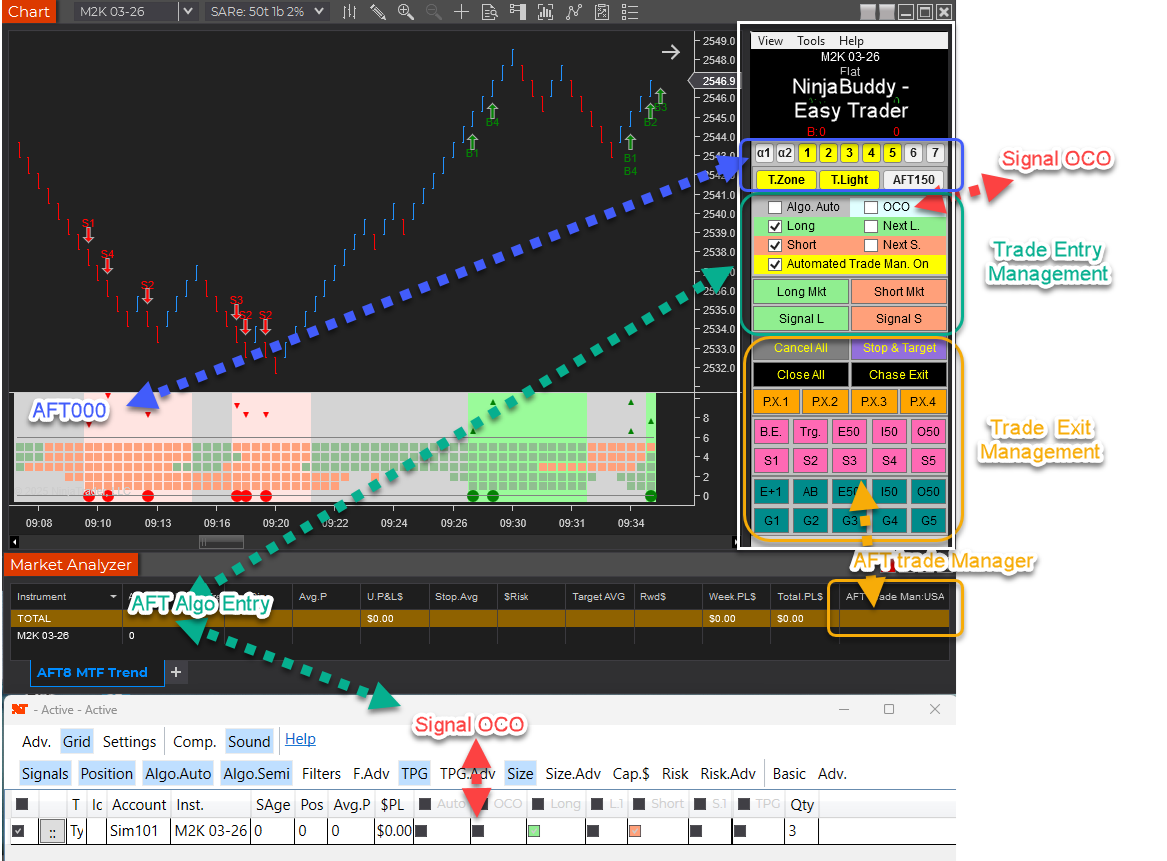
  • Algo Entry Mode – 13 – AFT000 Hybrid Algo Trader signals

Indicators

  • AFT000 Hybrid Algo Chart Trader
    • Programmable Signals 1 to 7
    • Alpha Signals 1 to 2
    • Traffic light filters
    • Pending the Easy Trader NinjaBuddy GUI

Features availability  and Licensing

  • AFT000 access:
    • requires AFT or ATS Essentials/Premium/Ultimate  monthly, annual, or  lifetime current and lifetime renewal
    • Subscriptions & Lifetime renewals are available in ‘My Pricing’ in the ATS universal account
  • AFT000 features:
    • Turnkey Workspaces
    • Easy Trader NinjaBuddy GUI

Filed Under: AFT8, automated futures trading, ninjatrader algorithmic trading, ninjatrader automated trading Tagged With: AFT8 update, AFT8Update, NinjaTrader 8


🚀 Get Started 100% FREE!

AFT8 Releasd version 2025.10.3.1 for NinjaTrader 8 – Short Trail Trigger Fix + Intelli-Stop Enhancements

October 3, 2025 by AFT

aft intellistop min distance to price governor

AFT 2025.10.3.1 — Short Trail Trigger Fix + IntelliStop Enhancements

Release date: 3 Oct 2025 • Version: 2025.10.3.1

This update fixes a rare trailing-stop issue in choppy/fast markets and upgrades IntelliStop so profitable runners can breathe past 100% of the Session Fib Grid and reach 150–200% on strong moves.

Quick Summary

  • Short Trail Trigger: Fixed. Prior behavior could “chase” price and miss the trigger around the T2 (~50%) zone when USAR bands skewed wider in fast markets. Also applies to longs.
  • IntelliStop: Minimum % margin corrected and behavior refined. Trails engage noticeably above ~75% profit of a 100%-equivalent move and hold up to a ~20% offset, avoiding premature stop-ins.
  • Outcome: More consistent trails and better probability of capturing extended moves beyond 100% (e.g., 150–200% runs).
aft8 short trail last optimized triggers
aft intellistop min distance to price governor

What Was Fixed

In earlier builds, the stop trail reference included the full width of the dynamic USAR band. During choppy/fast conditions, the band could expand, causing the trail trigger to drift from the intended target area. Practically, this showed up around the T2 target (~50%) region stretching out toward 60%+, so the trail often didn’t trigger in time. This behavior affected both short and long positions. The new logic decouples the trigger from that skew so it fires reliably.

IntelliStop: Smarter Trailing Behavior

  • Minimum % Margin Fix: Ensures the trail doesn’t crash into price when profit accelerates.
  • Engages Above ~75% Profit: On a 100% Fib Grid–equivalent move, the IntelliStop now trails in noticeably above ~75%, not earlier.
  • Holds a ~20% Offset: The trail will maintain up to ~20% distance from current price, allowing healthy continuation through 100% and into 150–200% extensions when momentum persists.
Why this matters: Early, overly tight trails frequently cut winners short. This refinement keeps risk contained while letting strong trends do the work.

Trader Impact

  • Consistency: Trails trigger as expected in volatile/choppy phases.
  • Profit Capture: Higher odds of catching extended runs beyond the 100% level.
  • Smoother Management: Less micromanagement needed during fast markets.

Behavior Example

Before: In a fast, two-sided session, the USAR band widens. The short trail “chases” the expanding band near T2 (~50%), drifting toward 60%+ and failing to arm the trail in time.

Now: The trigger is stable. Once profit reaches ~75% of a 100% move, IntelliStop begins to trail with breathing room (up to ~20% offset), often letting the position push through 100% and into 150–200% when trend pressure continues.

Changelog (2025.10.3.1)

  • Fix: Short trail trigger corrected for dynamic USAR band skew (also improves longs).
  • Fix: IntelliStop minimum % margin and trail engagement logic refined.
  • Improve: Trailing offset behavior capped (~20%) to avoid price collision while preserving extension potential.

Update Notes

  • Recommended: Restart NinjaTrader after installing the update.
  • Best practice: Verify your stop/target templates and instrument tick sizes are correct for your account and prop-firm rules.
  • Reminder: Settings and methods are for educational purposes. Markets carry risk; trade your plan.

Disclaimer

Trading futures and derivatives involves substantial risk and is not suitable for every investor. Performance is not guaranteed. Examples are for illustration only and are not financial advice. Use proper risk controls and follow your prop firm or broker rules.

Filed Under: AFT8, automated futures trading, fully automated trading system, NinjaTrader 8 Tagged With: AFT8, AFT8 Release, AFT8 update, aft8release, AFT8Update, ninjatrader automated trading systems


🚀 Get Started 100% FREE!

Mastering Trader Psychology and NLP: A Book List for Trading Success

January 13, 2025 by AFT


Mastering Trader Psychology and NLP


Mastering Trader Psychology and NLP

Trading is as much about mastering your mind as it is about analyzing markets. To thrive, traders need to overcome emotional hurdles, maintain discipline, and develop a winning mindset. This blog explores how trader psychology and Neuro-Linguistic Programming (NLP) can transform your approach—and provides a curated book list to guide you.


Why Psychology and NLP Matter in Trading

  1. The Psychological Battle
    • Fear, greed, and overconfidence derail even the best strategies.
    • Maintaining discipline in volatile markets requires mental resilience.
  2. The Role of NLP in Trading
    • NLP helps rewire thought patterns to eliminate self-sabotaging behaviors.
    • Techniques like visualization and affirmations enhance focus and confidence.

Top Books on Trader Psychology

1. “Trading in the Zone” by Mark Douglas

This classic explores the mental framework behind consistent trading success. Douglas emphasizes understanding probabilities, managing emotions, and cultivating a winning mindset.

  • Key Takeaway: Develop a belief system that aligns with market realities.

2. “The Disciplined Trader” by Mark Douglas

Another masterpiece by Douglas, this book focuses on self-control and overcoming the psychological barriers that hinder profitability.

  • Key Takeaway: Discipline is the cornerstone of successful trading.

3. “Thinking, Fast and Slow” by Daniel Kahneman

While not trading-specific, this book by a Nobel laureate delves into cognitive biases and decision-making processes that are crucial for traders.

  • Key Takeaway: Recognize and mitigate cognitive biases for better decisions.

4. “Mindset: The New Psychology of Success” by Carol S. Dweck

Dweck’s exploration of the growth mindset applies directly to trading, encouraging traders to view challenges and losses as opportunities to grow.

  • Key Takeaway: Embrace a mindset of learning and adaptability.

5. “Atomic Habits” by James Clear

Clear’s strategies for habit formation can help traders establish routines that foster consistent performance.

  • Key Takeaway: Small changes in habits lead to significant improvements.

6. “The Psychology of Trading” by Brett N. Steenbarger

This book combines trading psychology with practical techniques for improving performance. Steenbarger offers insights into managing stress and staying focused.

  • Key Takeaway: Treat trading as a performance activity and train accordingly.

Top Books on NLP for Traders

1. “NLP: The Essential Guide to Neuro-Linguistic Programming” by Tom Hoobyar, Tom Dotz, and Susan Sanders

This comprehensive guide explains how NLP techniques can reprogram your thought patterns and behaviors for success.

  • Key Takeaway: Use NLP to build confidence and eliminate fear in trading.

2. “Unlimited Power” by Tony Robbins

Robbins explores NLP techniques for achieving personal mastery. His teachings on focus, visualization, and anchoring are invaluable for traders.

  • Key Takeaway: Master your mental state to perform under pressure.

3. “Frogs into Princes” by Richard Bandler and John Grinder

Written by the co-founders of NLP, this book introduces the foundational principles of the discipline.

  • Key Takeaway: Change your internal dialogue to achieve peak performance.

4. “NLP for Beginners: An Idiot-Proof Guide to Neuro-Linguistic Programming” by Shlomo Vaknin

This beginner-friendly book is perfect for traders new to NLP. It explains practical tools to improve focus, confidence, and decision-making.

  • Key Takeaway: Simple NLP techniques can create powerful mental shifts.

5. “The Secrets of Successful Trading: The Behavioral Edge” by Branden Lee

A unique blend of trading psychology and NLP, this book helps traders align their subconscious behaviors with their goals.

  • Key Takeaway: Behavioral alignment is key to trading success.

Applying Psychology and NLP in Trading

  1. Develop Subconscious Competence
    • Repetition and structured drills transform conscious strategies into automatic responses.
  2. Master Emotional Regulation
    • Use mindfulness techniques and NLP tools like anchoring to stay calm under pressure.
  3. Adopt a Growth Mindset
    • View losses as opportunities to refine your approach, not as failures.
  4. Create and Reinforce Habits
    • Establish daily routines that support disciplined trading.

The ATS Edge: Neuro Linguistic Trading

Our Zero to Hero Program incorporates trading psychology and NLP principles into a 360-degree framework called Neuro Linguistic Trading (NLT). By combining structured repetition, automated systems, and tailored mentorship, ATS helps traders:

  • Build mental resilience.
  • Internalize effective habits.
  • Achieve subconscious competence for faster, instinctive decisions.

Conclusion

Mastering trader psychology and NLP is essential for consistent trading success. Whether you’re battling emotional swings or striving for peak performance, the books listed here offer invaluable insights and tools. Combine these lessons with ATS’s Neuro Linguistic Trading approach, and you’ll be well on your way to transforming your trading journey.


Filed Under: AFT8, Algo Futures Trader, automated futures trading, automated trading ninjatrader, ninjatrader automated trading Tagged With: automated futures trading, automated futures trading software, automated futures trading strategies, automated futures trading system, automated futures trading systems, Automated Trading NinjaTrader, automated trading with ninjatrader, best automated futures trading software, fully automated trading system, futures algo trading, futures algorithmic trading, futures automated trading, futures trading algorithms, ninjatrader algorithmic trading, ninjatrader automated trading, ninjatrader automated trading systems, ninjatrader trading bot, ninjatrader trading systems


🚀 Get Started 100% FREE!

How ATS Changed the Retail Trading Ecosystem

January 5, 2025 by AFT

The retail trading landscape has evolved dramatically over the past decade. Amid these changes, AlgoTrading Trading Systems (ATS)  has emerged as a major innovator. By combining technology, education, and market access, ATS has helped retail traders achieve better results with fewer trading pitfalls. Here is how ATS has transformed the way trading is approached in the retail space:


1. Pioneering Hybrid Trading Systems and Methods

  • Max Profit, Min Drawdown, Least Emotion One of the core breakthroughs of ATS CEO Tom Leeson is the development of hybrid trading systems from 2006 that blend traditional discretionary analysis with algorithmic precision. The overarching goal: maximize potential profit, minimize drawdown, and reduce the emotional stress that often derails traders.
  • Decades of Hands-On Experience These systems did not spring up overnight. Instead, ATS’s approach is the result of years of iterative learning, constant feedback, and real-world testing. By synthesizing proven methods with modern technology, ATS provides traders with robust tools that adapt well to fluctuating market conditions.
  • Real-Time Adaptability Hybrid trading systems stand out for their ability to rapidly incorporate new data and evolve. This dynamic capability ensures that strategies remain relevant in both trending and volatile markets.

2. Providing Access for All Traders

  • Free, Long-Term Trials with a “Zero to Hero” Program A significant barrier to entry for retail traders is often the cost of professional tools and training. ATS disrupts this model by offering extended, free trials so that aspiring and intermediate traders can test the platform risk-free. This “zero to hero” initiative democratizes trading and helps participants build confidence before committing financially.
  • Lowering the Entry Barriers By eliminating high initial fees and providing sophisticated tools at no cost for a trial period, ATS lowers the financial bar for new traders to develop skills, practice strategies, and see results in real-time market conditions.
  • Focus on Skill Development The structured training programs emphasize both theoretical and practical knowledge. Rather than merely handing traders a set of tools, ATS guides them toward proficiency, helping them understand how strategies work and how to adapt as markets shift.

3. 360-Degree Trading: Systems, Education, Support, and AI

  • All-In-One Ecosystem ATS offers a full suite of resources: trading systems, ongoing education, technical and emotional support, plus community engagement. By weaving these pillars into a single platform, ATS ensures that traders have everything they need—no more piecemeal solutions or juggling multiple vendors.
  • AI Copilot for Enhanced Insights One of the most forward-thinking aspects of ATS is its AI Copilot feature, which uses artificial intelligence to assist traders with real-time market analysis, risk assessment, and even personalized strategy suggestions. This AI-driven guidance helps keep human bias in check and allows for more informed decision-making.
  • Building a High Trading IQ Community Central to ATS’s vision is cultivating a network of knowledgeable, well-equipped traders. Through online forums, webinars, and mentorship, traders can continually enhance their skills, share insights, and tap into a supportive environment geared toward collective success.

Why It Matters

By integrating technology, education, and a community-driven ethos, ATS has effectively shifted retail trading practices from a “lone-wolf” approach to a collaborative, data-driven experience. The result is a new generation of traders who are not just skilled with market techniques but also supported by cutting-edge tools and a like-minded community.

Key Takeaways

  1. Hybrid System Innovation – ATS bridges the gap between discretionary and algorithmic trading with an emphasis on stable growth and minimal emotional interference.
  2. Open Access – Free, long-term trials and structured mentorship lower the entry barrier for new traders.
  3. Comprehensive Support – Education, AI-powered tools, and a supportive community create a holistic environment for sustainable success.

Conclusion

ATS’s multifaceted approach—encompassing cutting-edge trading systems, robust education programs, and AI-based co-pilot features—has set a new standard in retail trading. By focusing on accessibility and continuous improvement, ATS helps traders of all levels develop the skills and confidence needed to succeed in today’s rapidly evolving markets.

Filed Under: Algo Futures Trader, automated futures trading, Automated Trading Videos, futures automated trading Tagged With: automated futures trading, automated futures trading software, automated futures trading strategies, automated futures trading system, automated futures trading systems, Automated Trading NinjaTrader, automated trading with ninjatrader, best automated futures trading software, fully automated trading system, futures algo trading, futures algorithmic trading, futures automated trading, futures trading algorithms, ninjatrader algorithmic trading, ninjatrader automated trading, ninjatrader automated trading systems, ninjatrader trading bot, ninjatrader trading systems


🚀 Get Started 100% FREE!

Why Don’t You Just Trade Fully Automated Trading Systems?

January 5, 2025 by AFT

In the modern trading landscape, the allure of fully automated trading systems is strong. With promises of hands-free profits and sophisticated algorithms, it’s easy to understand why traders might gravitate toward this approach. However, the reality of fully automated trading systems (ATS) is more complex. Let’s explore why traders often favor hybrid automated trading systems, such as those leveraging AFT (Algo Futures Trading) and AWT (AlphaWebTrader), for a more robust, adaptable trading strategy.

The Reality of Fully Automated Trading Systems

Lack of Market Adaptability

Fully automated systems rely on preprogrammed rules and historical data. While these rules can be effective in specific market conditions, they often fail to adapt to unforeseen changes, such as major economic events, news catalysts, or shifts in market sentiment. Markets are dynamic, and rigid systems can struggle to keep up.

Prop Firm Constraints

Prop firms, which offer traders access to funded accounts, typically prohibit 100% automated trading. This restriction exists because fully automated systems can quickly breach drawdown limits due to their inability to pause or recalibrate during volatile phases. Hybrid systems provide a manual override capability, aligning better with these rules.

The Drawback of Black Box Systems

Many fully automated systems are “black boxes,” offering no transparency into their logic. Traders using these systems are left to trust algorithms they don’t understand, making it challenging to diagnose issues or improve performance during losing streaks.

Risk of Over-Optimization

Fully automated systems often fall victim to over-optimization, tailoring their strategies to fit historical data too precisely. This can lead to poor performance in live markets where conditions deviate from the backtested scenarios.

Why Hybrid Automated Trading Systems Are Superior

Dynamic Decision-Making

Hybrid systems empower traders to leverage automated signals for consistency while retaining the ability to intervene based on market context. For instance, with AFT and AWT, traders can follow algo signals while using their judgment to adjust trades during pivotal moments.

Enhanced Control

Hybrid trading blends the precision of automation with the control of manual trading. Systems like AFT + AWT allow traders to configure algo signals, filters, and exits or even inject their own logic into the framework. This flexibility makes hybrid systems adaptable to diverse trading styles and market conditions.

Compliance with Prop Firm Rules

Hybrid trading aligns well with prop firm guidelines. A trader can combine systematic signals with manual execution, reducing the risk of breaching drawdown limits and ensuring compliance with firm regulations.

Improved Risk Management

Hybrid systems enable traders to manage risks more effectively by manually overriding or modifying trades in response to unforeseen events. Automation handles repetitive tasks, while traders focus on high-level decision-making.

Scalability and Growth

Hybrid systems, like those powered by AFT and AWT, provide a pathway for traders to evolve. Beginners can start with semi-automated setups, manually taking systematic signals, and progressively transition to fully automated strategies for specific markets or sessions.

How AFT + AWT Combine the Best of Both Worlds

  • Algo Signals + Human Insight: AFT provides systematic trading signals, while AWT offers tools like TradeViewPoint and Trendo to monitor market conditions and correlations.
  • Customizable Automation: Traders can build and refine their strategies by adding filters, adjusting parameters, or incorporating custom logic into the baseline settings.
  • Learning Through Execution: Hybrid trading encourages traders to learn market behavior through hands-on experience, fostering a deeper understanding of when to trade and when to step aside.

Conclusion

While fully automated trading systems may seem like the ultimate solution, their limitations in adaptability, transparency, and risk management often make them unsuitable for long-term success. 80% of traders lose at day trading manually, and up to 95% of day traders lose at fully automated trading!

Hybrid automated trading systems, such as those utilizing AFT + AWT, provide the perfect balance of automation and human intelligence, offering flexibility, control, and scalability. Our VIP Trading group can surpass 66% winners versus losers, compared to the standard retail world of 20% wins. Need we say more? AFT + AWT were purpose-built for hybrid trading specifically as we want the maximum profit with the least drawdown systems.

By combining the best of both worlds, traders can harness the power of automation while retaining the discretion to navigate the complexities of modern markets. Whether you’re seeking consistency, compliance, or growth, a hybrid approach paves the way for sustainable trading success.

Filed Under: AFT8, Algo Futures Trader, automated futures trading, automated trading ninjatrader, fully automated trading system, ninjatrader automated trading Tagged With: automated futures trading, automated futures trading software, automated futures trading strategies, automated futures trading system, automated futures trading systems, Automated Trading NinjaTrader, automated trading with ninjatrader, best automated futures trading software, fully automated trading system, futures algo trading, futures algorithmic trading, futures automated trading, futures trading algorithms, ninjatrader algorithmic trading, ninjatrader automated trading, ninjatrader automated trading systems, ninjatrader trading bot, ninjatrader trading systems


🚀 Get Started 100% FREE!

  • « Previous Page
  • 1
  • 2
  • 3
  • Next Page »

Recent Posts

  • Why ATS Does Not Recommend Fully Unattended Automated Trading for Prop Firms
  • A Guide to Trading a $50K Futures Prop-Firm Account
  • The Best Path to Getting Funded Trading Futures
  • AFT8 Performance Tweaks for NinjaTrader 8.1.7
  • AFT Lifetime (One-Time Purchase) License Terms Updated
  • Facebook
  • RSS
  • Twitter
  • YouTube


  • NinjaTrader Automated Trading
  • automated futures trading
  • automated trading systems
  • Day Trading Futures
  • Get Started Day Trading Futures
  • VIP Trading Group Live Market Trade Along
  • Secret to Day trading futures success
  • AFT8 for NinjaTrader 8
  • Futures Algo Trading Systems
  • Market News
  • NinjaTrader Free Trading Platform
  • Legal Notices
  • AFT Legal Info
  • Terms
  • FULL RISK DISCLOSURE
  • Privacy Policy
  • Cookie Usage
  • About AlgoFuturesTrader
  • Connect to AFT
  • Blog
  • Videos
  • Support
  • Contact
  • My account
  • Sitemap
  • Affiliates

Ninja Futures Trading
Algo Futures Trader Copyright Algo Trading Systems© 2026 ¡
AlgoFuturesTrader.com is owned & operated by Algo Trading Systems LLC. By using this website or products & services, you are bound by our Terms & subject to US legal jurisdiction only. Errors & omissions excluded.
AFT made in England, powered by MicroTrends NinjaTrader development

Disclaimer: Trading & investment carry a high level of risk. AlgoFuturesTrader does not make recommendations for buying or selling any financial instruments, nor do we offer trading or investment advice. We are a software company, and we only provide educational information on ways to use our sophisticated Algo Futures trading tools. It is up to our customers & readers to make their own trading & investment decisions, or consult with a registered investment advisor.

Risk Disclosure: Futures, CFDs, & forex trading carry substantial risk and are not suitable for every investor. An investor could potentially lose all or more than the initial investment. Risk capital is money that can be lost without jeopardizing one's financial security or lifestyle. Only risk capital should be used for trading, and only those with sufficient risk capital should consider trading. Past performance is not necessarily indicative of future results. Please read the full risk disclosure here.

Hypothetical performance results have many inherent limitations, some of which are described below. No representation is made that any account will or is likely to achieve profits or losses similar to those shown. In fact, there are frequently sharp differences between hypothetical performance results and the actual results subsequently achieved by any particular trading program. One of the limitations of hypothetical performance results is that they are generally prepared with the benefit of hindsight. In addition, hypothetical trading does not involve financial risk, and no hypothetical trading record can completely account for the impact of financial risk in actual trading. For example, the ability to withstand losses or adhere to a particular trading program despite trading losses are material points that can adversely affect actual trading results. Numerous other factors related to the markets or the implementation of any specific trading program cannot be fully accounted for in the preparation of hypothetical performance results and can adversely affect trading results.

Testimonials appearing on this website may not be representative of other clients or customers and are not a guarantee of future performance or success.

NinjaTraderÂŽ is a registered trademark of NinjaTrader Group, LLC. No NinjaTrader company has any affiliation with the owner, developer, or provider of the products or services described herein, nor do they endorse, recommend, or approve any such product or service.

We use cookies on our website to give you the most relevant experience by remembering your preferences and repeat visits. By clicking “Accept All”, you consent to the use of ALL the cookies. However, you may visit "Cookie Settings" to provide a controlled consent.
Cookie SettingsAccept All
Manage consent

Privacy Overview

This website uses cookies to improve your experience while you navigate through the website. Out of these, the cookies that are categorized as necessary are stored on your browser as they are essential for the working of basic functionalities of the website. We also use third-party cookies that help us analyze and understand how you use this website. These cookies will be stored in your browser only with your consent. You also have the option to opt-out of these cookies. But opting out of some of these cookies may affect your browsing experience.
Necessary
Always Enabled
Necessary cookies are absolutely essential for the website to function properly. These cookies ensure basic functionalities and security features of the website, anonymously.
CookieDurationDescription
cookielawinfo-checkbox-analytics11 monthsThis cookie is set by GDPR Cookie Consent plugin. The cookie is used to store the user consent for the cookies in the category "Analytics".
cookielawinfo-checkbox-functional11 monthsThe cookie is set by GDPR cookie consent to record the user consent for the cookies in the category "Functional".
cookielawinfo-checkbox-necessary11 monthsThis cookie is set by GDPR Cookie Consent plugin. The cookies is used to store the user consent for the cookies in the category "Necessary".
cookielawinfo-checkbox-others11 monthsThis cookie is set by GDPR Cookie Consent plugin. The cookie is used to store the user consent for the cookies in the category "Other.
cookielawinfo-checkbox-performance11 monthsThis cookie is set by GDPR Cookie Consent plugin. The cookie is used to store the user consent for the cookies in the category "Performance".
viewed_cookie_policy11 monthsThe cookie is set by the GDPR Cookie Consent plugin and is used to store whether or not user has consented to the use of cookies. It does not store any personal data.
Functional
Functional cookies help to perform certain functionalities like sharing the content of the website on social media platforms, collect feedbacks, and other third-party features.
Performance
Performance cookies are used to understand and analyze the key performance indexes of the website which helps in delivering a better user experience for the visitors.
Analytics
Analytical cookies are used to understand how visitors interact with the website. These cookies help provide information on metrics the number of visitors, bounce rate, traffic source, etc.
Advertisement
Advertisement cookies are used to provide visitors with relevant ads and marketing campaigns. These cookies track visitors across websites and collect information to provide customized ads.
Others
Other uncategorized cookies are those that are being analyzed and have not been classified into a category as yet.
SAVE & ACCEPT