NinjaTrader Automated Trading by Algo Futures Trader

hybrid algorithmic automated futures trading for prop firm traders, day & swing traders

🚀 Get Started
  • 🚀Get Started
  • NinjaTrader
  • Get Funded
  • Trading Servers
  • Pricing
  • blog
  • Help

AFT8 Risk Control Practical Ways to Reduce Risk

February 18, 2026 by AFT

Managing Risk to Reduce Exposure and risk of ruin

Risk can be controlled in multiple ways inside the AFT8 framework. One or more of the approaches below can
significantly reduce and manage exposure, especially during evaluation or performance phases.

1) Increase the Account Size (Capital Allocation)

A larger account (for example, 100K vs 50K in prop environments) automatically reduces
percentage-based drawdown pressure and allows more flexibility in stop placement and trade management.

2) Use Fewer Lots Per Trade (Lower % Risk Per Trade)

Reducing position size is the most direct way to control risk. If a default turnkey workspace uses
3 lots, you may choose to use 1–2 lots based on your account size and risk tolerance.

3) Reduce Risk After Entry (R50 / E50 / I50)

Once the Trade Manager has placed stops:

  • Click R50% on the Algo Trade Manager Controller to reduce stop size by 50%.
  • Or click E50 / I50 on the NinjaBuddy UI to reduce risk by 50%.

This immediately compresses exposure without needing to manually adjust the stop.

4) Wait for Efficient Entry Prices

Avoid chasing signals. Instead:

  • Wait for pullbacks.
  • Enter at technically efficient prices.
  • Avoid entries that are extended far from structure.

Better price = smaller stop required = lower risk.

5) Use Smaller Bars for Entry Triggers

Smaller timeframe bars often allow the entry trigger to occur closer to the actual market price.
This reduces the distance between entry and stop placement.

6) Use Order Types at Technical Levels

Instead of market entries:

  • Use an Algo Entry limit order price when appropriate.
  • Use manual limit orders at technical levels.
  • Allow pullbacks to enter you.
  • Reduce slippage risk.
  • Use stop or OCO entry types at levels for efficient entry.

7) Reduce Stop Size in Settings

Inside AFT8 Trade Manager settings, you can reduce stop size.

Example (Session Breakout):

  • Default stop: 20% grid (wider structure stop)
  • Reduced stop: 10% grid (tighter stop)

Smaller grid percentage = smaller initial risk.

8) Use Dynamic Lots

Enable the Dynamic Lots feature to allocate a defined percentage of the account as maximum exposure.
This helps prevent over-sizing relative to account equity.

9) Use Partial Exit (PX1)

Use PX1 to close one lot without moving the stop.

Click PX on the Algo Trade Manager Controller or NinjaBuddy to reduce open exposure without changing
the stop structure.

  • Reduces open exposure
  • Lowers emotional pressure
  • Allows the remaining position to run

10) Monitor Liquidity and Slippage

Always consider:

  • Market liquidity
  • Time of day
  • News volatility

Poor liquidity increases slippage and can widen effective risk beyond the intended stop.

Final Notes

Risk management is not a single setting — it is a layered structure.

The most professional approach is to:

  • Control size
  • Control stop structure
  • Control entry efficiency
  • Control execution

Multiple small improvements combined create a meaningful reduction in total risk.
Filed Under: AFT8, automated trading ninjatrader, fully automated trading system, ninjatrader automated trading Tagged With: risk control, risk management

AFT8 turnkey workspaces emini micro indices Multi Time Frame Trend Correlation TTF indicator and AWT trend

June 15, 2025 by AFT

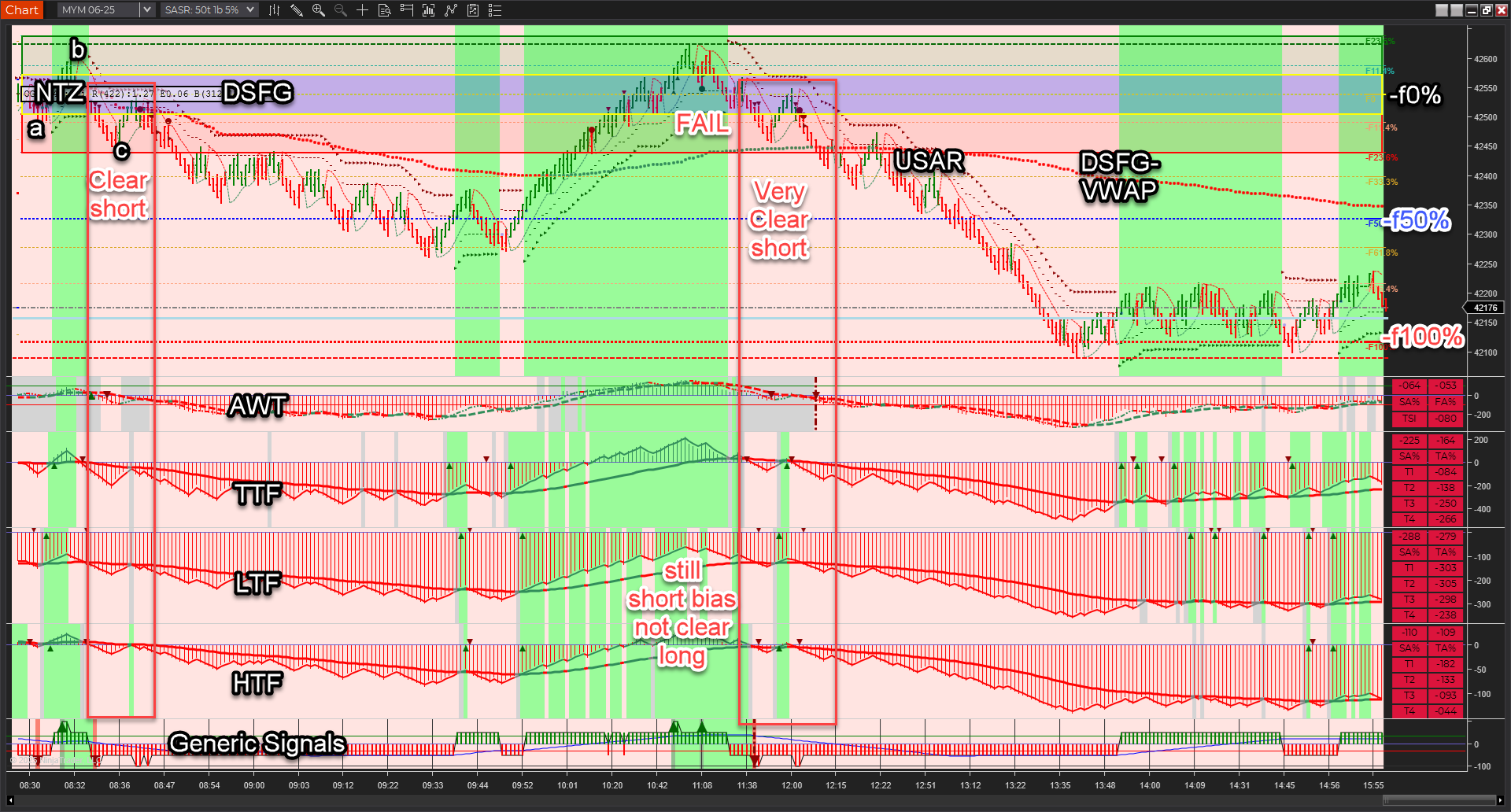
AFT8 Session Open Breakout Trading Chart
AFT8 Session-Open Breakout Trading Chart

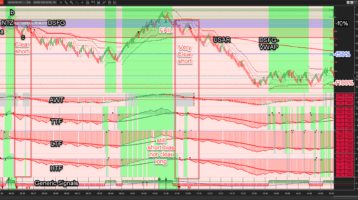
AFT8 Session-Open Breakout Trading Chart showing all four trend-bias elements—AWT, plus locally generated TTF, LTF, and HTF aggregate trends

AFT8 Workspaces 4 has been updated to include two new workspaces:

  • AFT8-SFG Breakout Trader-Basic-004
  • AFT8-Trend-Scalper-Basic-004
  • Download from your ATS Universal Account:
    https://algotradingsystems.net/
  • Run the installer and restart NinjaTrader 8.
  • The workspaces will appear under Control Center > Workspaces.
  • Make sure you download historical data for the multi-time-frame data series via
    Tools > Historical Data:

    • Minutes – 7 days
    • Tick – 7 days
    • Daily – 7 days

Multi-Time-Frame Bias Filters

A series of timeframes and configurable trend-bias components are aggregated into a
smoothed moving-average series, giving an at-a-glance view of trend across the chart.
Default settings:

  • TTF (Trading Time Frame):
    • 3 min – 21-period smoothed exponential trend
    • 5 min – 21-period smoothed exponential trend
    • 15 min – 21-period smoothed exponential trend
    • 30 min – 21-period smoothed exponential trend
  • LTF (Lower Time Frame):
    • 60 min – 21-period smoothed exponential trend
    • 90 min – 21-period smoothed exponential trend
    • 120 min – 21-period smoothed exponential trend
    • 240 min – 21-period smoothed exponential trend
  • HTF (Higher Time Frame):
    • 360 min – 21-period smoothed exponential trend
    • 480 min – 21-period smoothed exponential trend
    • 720 min – 21-period smoothed exponential trend
    • 1440 min – 21-period smoothed exponential trend

Trend-Bias Power – Trend as a %

Trend Bias Power is a proprietary formula that adapts to volatility and expresses trend strength as a percentage. It derives from the MT Framework (2009) by MicroTrends. The turnkey periods (5, 10, 21, 34, 50/55, 100, 200) are battle-tested in hedge-fund and retail environments, ready to confirm or filter day-trading and swing entries.

AFT Turnkey Workspaces 4

Workspaces 4 add AWT and TTF by default; LTF and HTF are optional and are generally not required unless by preference and trade plan
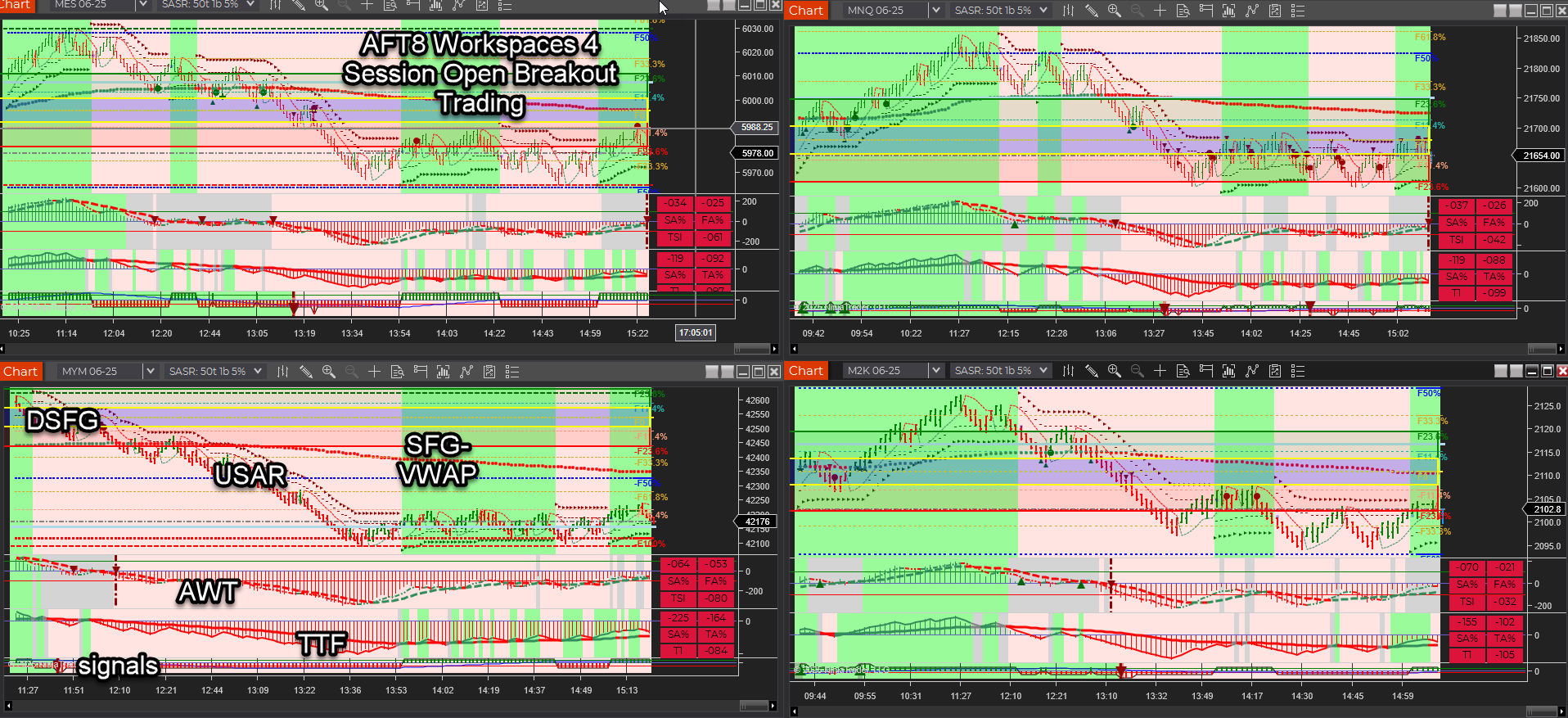
AFT8 Workspaces 4 – Session-Open Breakout Trading Charts for E-mini µ-indices futures

AFT8 Workspaces 4 – Session-Open Breakout Trading Charts for E-mini micro indices futures

AFT8 Workspaces 3 – Session-Open Breakout Trading Charts for E-mini µ-indices futures

AFT8 Workspaces 3 – Session-Open Breakout Trading Charts for E-mini micro-indices futures
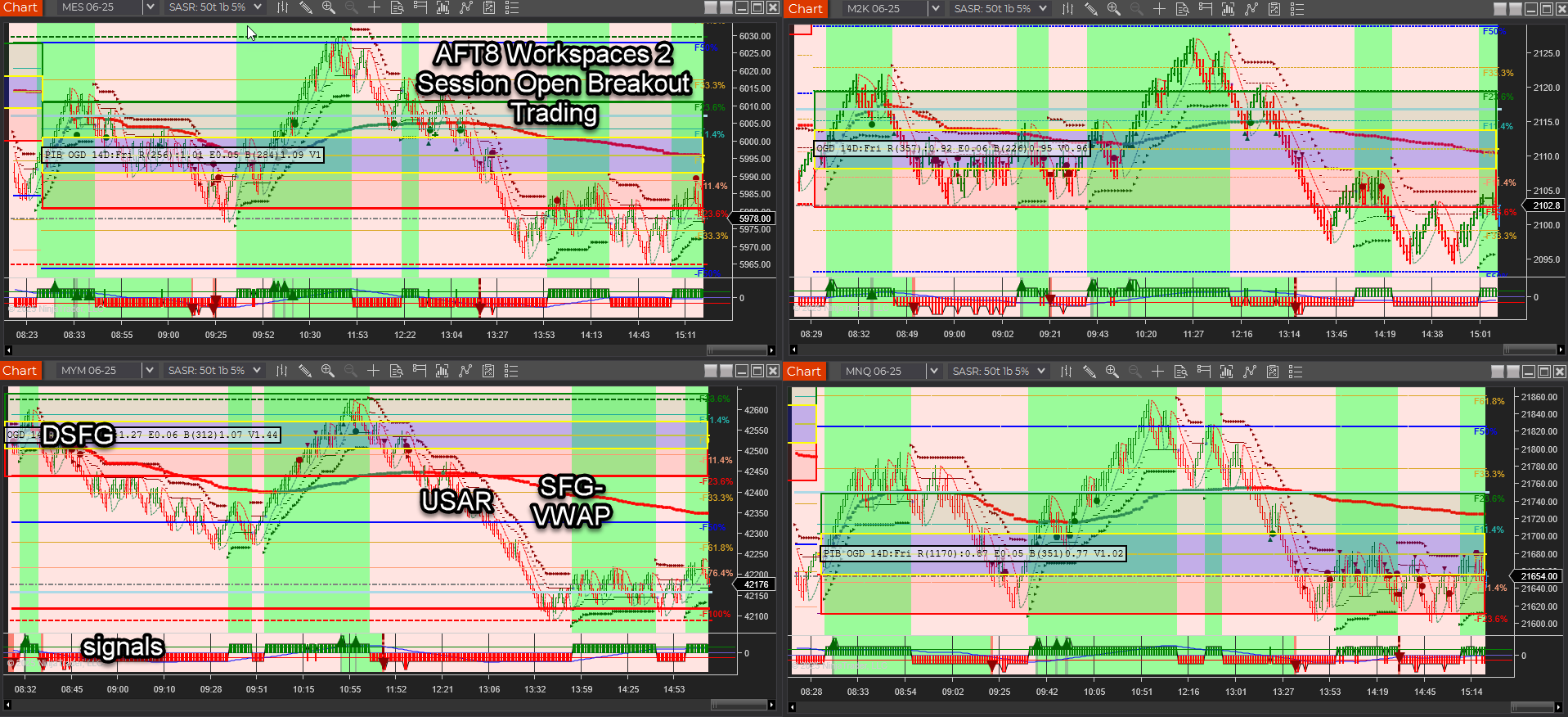
AFT8 Workspaces 2 – Session-Open Breakout Trading Charts for E-mini µ-indices futures

AFT8 Workspaces 2 – Session-Open Breakout Trading Charts for E-mini micro-indices futures

Filed Under: AFT8, aft8 turnkey workspaces, automated trading ninjatrader Tagged With: automated futures trading, ninjatrader automated trading, ninjatrader trading bot, NinjaTrader workspaces

Flexible Position Sizing & Scaling with AFT8

June 4, 2025 by AFT

AFT8 offers three distinct ways to size and scale positions, allowing traders to manage entries and exits in stages rather than all at once. These modes are:

  1. All-In, Scale-Out
  2. All-In, All-Out
  3. Scale-In, Scale-Out

Each method breaks trades into tranches—entering or exiting partial positions—so you can control how much capital is at risk at different points. This incremental approach helps lock in profits or curb losses as the market moves. While all three are available, most traders use “All-In, Scale-Out” or “All-In, All-Out” for simplicity. “Scale-In, Scale-Out” is reserved for experienced traders comfortable with building into a position and managing multiple exit levels. AFT8’s Algo Trade Manager handles all scaling once you’ve chosen your mode, though scaling in must be initiated manually to keep risk in check.


1. All-In, Scale-Out

  • How You Enter: As soon as your entry conditions trigger, AFT8 commits the entire intended position at once. You receive your full number of contracts or shares in a single fill.
  • How You Exit: Rather than closing everything at once, you set predetermined exit points. For example, you might take 50% off at the first profit target, 25% at a second level, and allow the remaining 25% to ride to the final objective. AFT8 automatically submits the staggered exit orders behind the scenes.
  • Why Use It: This technique secures partial profit early while still leaving room to catch larger trends. As the price moves in your favor, you shave off risk rather than waiting for a single exit signal. It’s particularly useful when you believe in a strong trend but want to lock in gains gradually.

2. All-In, All-Out

  • How You Enter: Identical to “All-In, Scale-Out,” you buy or sell the full position immediately upon signal.
  • How You Exit: You close out 100% of the position in one go when your exit parameters are met—no partial exits, no staggered targets.
  • Why Use It: For traders who prefer the cleanest possible execution, this mode keeps things simple. You commit all capital up front and exit on a single signal, eliminating the complexity of managing multiple orders. It’s ideal when you want a straightforward, no-nonsense entry and exit.

3. Scale-In, Scale-Out

Also known as position compounding, this method is best suited for advanced traders.

  • How You Enter: Instead of jumping in at full size, you build your position over multiple steps. For instance, you might initiate 25% of your total allocation when the first momentum threshold is met, then add another 25% if price confirms strength at a higher level, and continue until you’re fully invested. You decide the increments and price levels in AFT8’s position size settings.
  • How You Exit: Your exits are also staggered. You might take 20% off at an early profit point, another 30% if the market retests a key level, and then let the final 50% ride until your maximum target or stop is hit. AFT8’s Algo Trade Manager automatically places these exit orders according to your rules.
  • Why Use It: By scaling in, you reduce the risk of entering on a false breakout or sudden pullback. Scaling out then locks in gains in stages, so a reversal can’t erase all your profits. This dual-stage approach gives you maximum control over both entry and exit risk.

How AFT8 Manages Scale-In/Scale-Out:
Once your initial signal fires, AFT8 handles each tranche automatically. If you prefer to add manually, you can still use NinjaTrader 8’s Chart Trader, order tickets, or DOM to increase your position; AFT8 will immediately queue up the corresponding exits. Note that scaling in is disabled by default to prevent inexperienced traders from overleveraging. Only advanced users who fully understand the risks should enable it.


How to Choose Between Them

  • All-In, Scale-Out is ideal if you have very high conviction in your signal but still want to lock in profits gradually.
  • All-In, All-Out works best when you want a clear, unambiguous entry and exit—no partials.
  • Scale-In, Scale-Out is for highly dynamic markets where you’re uncertain about the signal’s strength; it lets you dial into the position as confirmation builds and peel off profits in stages.

In AFT8, you configure these modes under the “Position Sizing and Scaling” section of your strategy. Position amounts are defined in the Algo Entry settings, while exit tranches are set up in the Algo Trade Manager.

Filed Under: AFT8, automated futures trading system, automated trading ninjatrader, ninjatrader automated trading Tagged With: automated futures trading, NinjaTrader 8, risk management

AFT8 new trade copier feature 21 account multi-shot trade entry

February 24, 2025 by AFT

Trade Copier System 21 Multi Shot

Introducing the Next Generation of Trade Copier for NinjaTrader

Tired of slippage and unreliable trade copiers that clog up your trading for prop firm trading multiple accounts? We’ve got a breakthrough solution for you!

Most third-party trade copiers are plagued by:

  • Inefficient order listening: They must listen for each fill or update, then copy, create, and submit new orders—introducing lag and slippage.
  • Poorly written, multithreaded code: Race conditions, locks, and jams can bring NinjaTrader to a halt, forcing frequent restarts.
  • Low-latency limitations: The serial, one-order-at-a-time approach delays execution and can lead to missed opportunities and slippage.

Trade copiers available as NinjaTrader 8 add-ins are often poor in quality—they tend to jam, slow down NT8, and suffer from high latency. This is because they have to wait, listen, filter orders, and then act by copying the orders and sending them to each account round-robin… yawn… how slow can you go?—about as efficient as waiting for a bus. Frankly, that’s not impressive.

As always, we’re ahead of the curve, setting trends that the ecosystem eventually follows—hybrid trading, Fib Grid, ATR bars/self-adapting bars, just to name a few. Now, our latest breakthrough is the Multi-Shot system: a revolutionary 21-shot trader that fires trades simultaneously into 21 accounts at the same time with ultra-low latency. This system takes the fastest route, eliminates NT8 jams, avoids waiting for the bus, and minimizes slippage to the absolute minimum. All orders are instantaneous in parallel—firing all at once is now possible with AFT8.

The Multi-Shot Entry Advantage – Simplicity + Lowest Latency Fills

Trade Copier System 21 Multi Shot

Our new Multi-Shot Entry feature takes an entirely different, more efficient approach:

  • Single Trigger: Pull the trigger once, and all selected sub-accounts fire orders simultaneously.
  • Low Latency and Reliability: No waiting on a round-robin approach—think of it like a multi-barrel shotgun firing every chamber at once.
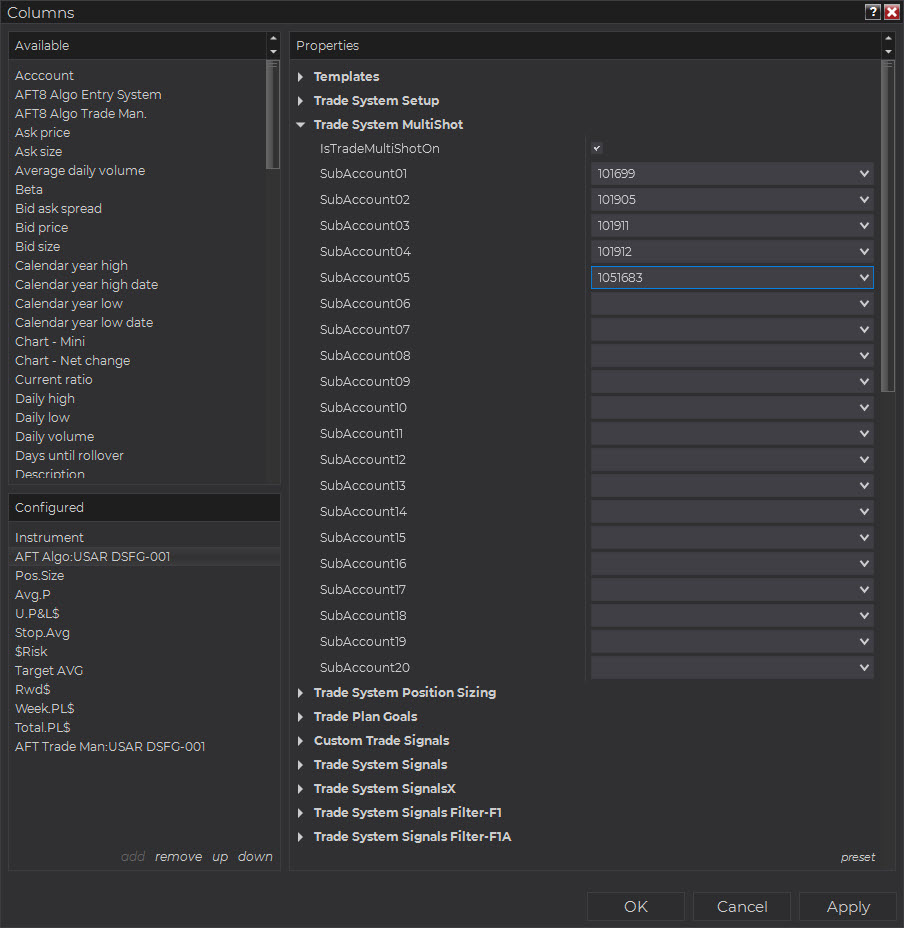
  • Scale Easily: Trade one “leader” account (e.g., on SIM) and instantly replicate the same trades across up to 20 sub-accounts without the usual trade copier overhead.
  • 21 Parallel Accounts: One leader account and 20 sub-accounts with instant order submission in each in parallel—20 times quicker than a trade copier!
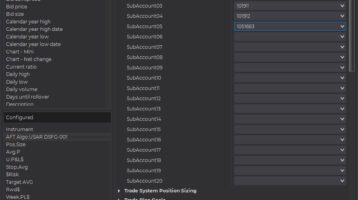
  • Simple Config: Simply select your accounts in the Trade entry algo “Trade System MultiShot” section and enable “IsTradeMultiShotOn” trades will be mirrored.

Flexible Exit Management

We’re also developing two styles of trade exit management:

  1. Per-Account Trade Managers
    • Each account can have a dedicated “Algo Trade Manager”, allowing fully symmetrical or asymmetrical rules and profit targets.
  2. Leader/Follower Exit Management
    • A single manager/mirror that controls all 20 accounts uniformly, just like a traditional trade copier—only vastly more efficient.

Release and Availability

  • We will begin rolling out Community Technology Previews (CTPs) to our VIP members—those in the “CTP” role—very soon this week.
  • The Multi-Shot Entry feature will be released first, followed by the enhanced exit control system.
  • These features will be available to monthly/annual subscribers and to lifetime members (within their first year), or those who renew their yearly maintenance subscription for AFT or ATS.
  • Subscription levels: Algo Trading premium or ultimate on AFT or ATS universal combo.
  • Optional Annual Renewal: For traders who let their annual renewal lapse Click here for price details

Stay tuned for more details on how you can dramatically reduce latency and trade more efficiently across multiple accounts—all without slowing down NinjaTrader or dealing with trade copier headaches.

But let’s be clear—this isn’t just another trade copier. This is a Multi-Shot Trader. We’ve redefined the traditional leader-follower model from the trade copier world into a concept of a primary account with sub-accounts—a complete shift from how copying trades has worked until now. In the race of the tortoise and the hare, the hare finally wins. In trading, faster is better, and less is more.

Questions or Feedback?
If you’d like to learn more about the upcoming CTP program for VIP members or have any questions about multi-account trade management, feel free to reach out to our support team. We’re excited to bring you these new capabilities and look forward to improving your trading experience!

Filed Under: AFT8, automated trade management, automated trading ninjatrader, NinjaTrader 8 Tagged With: AFT8 Release, AFT8 update, aft8release, AFT8Update, Multi Shot Trader, Trade Copier

Mastering Trader Psychology and NLP: A Book List for Trading Success

January 13, 2025 by AFT


Mastering Trader Psychology and NLP


Mastering Trader Psychology and NLP

Trading is as much about mastering your mind as it is about analyzing markets. To thrive, traders need to overcome emotional hurdles, maintain discipline, and develop a winning mindset. This blog explores how trader psychology and Neuro-Linguistic Programming (NLP) can transform your approach—and provides a curated book list to guide you.


Why Psychology and NLP Matter in Trading

  1. The Psychological Battle
    • Fear, greed, and overconfidence derail even the best strategies.
    • Maintaining discipline in volatile markets requires mental resilience.
  2. The Role of NLP in Trading
    • NLP helps rewire thought patterns to eliminate self-sabotaging behaviors.
    • Techniques like visualization and affirmations enhance focus and confidence.

Top Books on Trader Psychology

1. “Trading in the Zone” by Mark Douglas

This classic explores the mental framework behind consistent trading success. Douglas emphasizes understanding probabilities, managing emotions, and cultivating a winning mindset.

  • Key Takeaway: Develop a belief system that aligns with market realities.

2. “The Disciplined Trader” by Mark Douglas

Another masterpiece by Douglas, this book focuses on self-control and overcoming the psychological barriers that hinder profitability.

  • Key Takeaway: Discipline is the cornerstone of successful trading.

3. “Thinking, Fast and Slow” by Daniel Kahneman

While not trading-specific, this book by a Nobel laureate delves into cognitive biases and decision-making processes that are crucial for traders.

  • Key Takeaway: Recognize and mitigate cognitive biases for better decisions.

4. “Mindset: The New Psychology of Success” by Carol S. Dweck

Dweck’s exploration of the growth mindset applies directly to trading, encouraging traders to view challenges and losses as opportunities to grow.

  • Key Takeaway: Embrace a mindset of learning and adaptability.

5. “Atomic Habits” by James Clear

Clear’s strategies for habit formation can help traders establish routines that foster consistent performance.

  • Key Takeaway: Small changes in habits lead to significant improvements.

6. “The Psychology of Trading” by Brett N. Steenbarger

This book combines trading psychology with practical techniques for improving performance. Steenbarger offers insights into managing stress and staying focused.

  • Key Takeaway: Treat trading as a performance activity and train accordingly.

Top Books on NLP for Traders

1. “NLP: The Essential Guide to Neuro-Linguistic Programming” by Tom Hoobyar, Tom Dotz, and Susan Sanders

This comprehensive guide explains how NLP techniques can reprogram your thought patterns and behaviors for success.

  • Key Takeaway: Use NLP to build confidence and eliminate fear in trading.

2. “Unlimited Power” by Tony Robbins

Robbins explores NLP techniques for achieving personal mastery. His teachings on focus, visualization, and anchoring are invaluable for traders.

  • Key Takeaway: Master your mental state to perform under pressure.

3. “Frogs into Princes” by Richard Bandler and John Grinder

Written by the co-founders of NLP, this book introduces the foundational principles of the discipline.

  • Key Takeaway: Change your internal dialogue to achieve peak performance.

4. “NLP for Beginners: An Idiot-Proof Guide to Neuro-Linguistic Programming” by Shlomo Vaknin

This beginner-friendly book is perfect for traders new to NLP. It explains practical tools to improve focus, confidence, and decision-making.

  • Key Takeaway: Simple NLP techniques can create powerful mental shifts.

5. “The Secrets of Successful Trading: The Behavioral Edge” by Branden Lee

A unique blend of trading psychology and NLP, this book helps traders align their subconscious behaviors with their goals.

  • Key Takeaway: Behavioral alignment is key to trading success.

Applying Psychology and NLP in Trading

  1. Develop Subconscious Competence
    • Repetition and structured drills transform conscious strategies into automatic responses.
  2. Master Emotional Regulation
    • Use mindfulness techniques and NLP tools like anchoring to stay calm under pressure.
  3. Adopt a Growth Mindset
    • View losses as opportunities to refine your approach, not as failures.
  4. Create and Reinforce Habits
    • Establish daily routines that support disciplined trading.

The ATS Edge: Neuro Linguistic Trading

Our Zero to Hero Program incorporates trading psychology and NLP principles into a 360-degree framework called Neuro Linguistic Trading (NLT). By combining structured repetition, automated systems, and tailored mentorship, ATS helps traders:

  • Build mental resilience.
  • Internalize effective habits.
  • Achieve subconscious competence for faster, instinctive decisions.

Conclusion

Mastering trader psychology and NLP is essential for consistent trading success. Whether you’re battling emotional swings or striving for peak performance, the books listed here offer invaluable insights and tools. Combine these lessons with ATS’s Neuro Linguistic Trading approach, and you’ll be well on your way to transforming your trading journey.


Filed Under: AFT8, Algo Futures Trader, automated futures trading, automated trading ninjatrader, ninjatrader automated trading Tagged With: automated futures trading, automated futures trading software, automated futures trading strategies, automated futures trading system, automated futures trading systems, Automated Trading NinjaTrader, automated trading with ninjatrader, best automated futures trading software, fully automated trading system, futures algo trading, futures algorithmic trading, futures automated trading, futures trading algorithms, ninjatrader algorithmic trading, ninjatrader automated trading, ninjatrader automated trading systems, ninjatrader trading bot, ninjatrader trading systems

Prop Firm Trader Get Funded Accelerator

January 5, 2025 by AFT


Prop Firm Trading Benefits and Get Funded Accelerator

Prop Firms: Key Resources and Benefits

Proprietary trading firms provide traders with several key resources and benefits designed to support trading activity and maximize potential profitability. Here’s what they typically offer:

  1. Trading Capital: Prop firms fund traders with significant amounts of capital, allowing them to trade larger positions than they could with their own funds.
  2. Profit Sharing: Traders earn a percentage of the profits they generate, often between 70% and 90%, while the prop firm keeps a smaller cut.
  3. Risk Management Rules: To protect their capital, prop firms set clear rules regarding maximum daily loss, drawdowns, and position sizing. Traders must adhere to these rules to remain funded.
  4. Access to Technology: Many prop firms provide advanced trading platforms, proprietary tools, and software to help traders execute and manage trades efficiently.
  5. Training and Resources: Some firms offer training programs, mentorship, or access to educational materials for new traders to develop their skills.
  6. Evaluation Programs: To qualify for funding, traders often participate in evaluation phases where they must meet specific performance targets while adhering to risk parameters.
  7. Leverage: Prop firms offer high leverage, allowing traders to control larger positions with smaller amounts of initial capital.
  8. Community and Networking: Traders gain access to a network of professionals and peers for collaboration, sharing strategies, and gaining insights.
  9. Performance Feedback: Many firms provide analytics and feedback on a trader’s performance to help them improve over time.
  10. No Personal Risk: Traders use the firm’s capital, so they don’t risk their own money. However, they may need to pay for evaluations or monthly platform fees.

Getting Funded Prop Firm Trading

Getting capital from a prop firm is a huge step—but it’s only the beginning. Passing the evaluation can be a challenge in itself, and many traders who do get funded end up losing their accounts soon after. Without a clear strategy, every trade feels like a gamble.

Prop firms provide the capital, but not a roadmap. If this sounds familiar, the Get Funded Accelerator is here to bridge that gap.

What’s Holding Traders Back?

  • ❌ Struggling to pass tough evaluations without guidance
  • ❌ Losing funding soon after they get it
  • ❌ Trading without a proven strategy to maintain a funded account
  • ❌ Feeling stuck under pressure, unsure of the best moves

How the Get Funded Accelerator Solves It:

  • âś… 100% Free trial for eval/live trading prop firms
  • âś… 100% Free trading reviews and prop firm discovery
  • âś… Proven methods to pass evaluations and get paid!
  • âś… Long-term strategies to protect and grow your funding
  • âś… Step-by-step guidance on risk management and smart trading decisions
  • âś… A roadmap to consistent results and regular payouts
  • âś… Turnkey trading systems tuned to prop firm trading

Ready to break the cycle and trade with clarity and confidence? Click here to learn more about the Get Funded Accelerator and take the next big step in your trading journey!


Filed Under: AFT8, Algo Futures Trader, automated trade management, automated trading ninjatrader, ninjatrader automated trading Tagged With: automated futures trading, automated futures trading software, automated futures trading strategies, automated futures trading system, automated futures trading systems, Automated Trading NinjaTrader, automated trading with ninjatrader, best automated futures trading software, fully automated trading system, futures algo trading, futures algorithmic trading, futures automated trading, futures trading algorithms, ninjatrader algorithmic trading, ninjatrader automated trading, ninjatrader automated trading systems, ninjatrader trading bot, ninjatrader trading systems

  • « Previous Page
  • 1
  • 2
  • 3
  • 4
  • Next Page »
  • NinjaTrader Automated Trading
  • automated futures trading
  • automated trading systems
  • Day Trading Futures
  • Get Started Day Trading Futures
  • VIP Trading Group Live Market Trade Along
  • Secret to Day trading futures success
  • AFT8 for NinjaTrader 8
  • Futures Algo Trading Systems
  • Market News
  • NinjaTrader Free Trading Platform
  • Legal Notices
  • AFT Legal Info
  • Terms
  • FULL RISK DISCLOSURE
  • Privacy Policy
  • Cookie Usage
  • About AlgoFuturesTrader
  • Connect to AFT
  • Blog
  • Videos
  • Support
  • Contact
  • My account
  • Sitemap
  • Affiliates

Ninja Futures Trading
Algo Futures Trader Copyright Algo Trading Systems© 2026 ·
AlgoFuturesTrader.com is owned & operated by Algo Trading Systems LLC. By using this website or products & services, you are bound by our Terms & subject to US legal jurisdiction only. Errors & omissions excluded.
AFT made in England, powered by MicroTrends NinjaTrader development

Disclaimer: Trading & investment carry a high level of risk. AlgoFuturesTrader does not make recommendations for buying or selling any financial instruments, nor do we offer trading or investment advice. We are a software company, and we only provide educational information on ways to use our sophisticated Algo Futures trading tools. It is up to our customers & readers to make their own trading & investment decisions, or consult with a registered investment advisor.

Risk Disclosure: Futures, CFDs, & forex trading carry substantial risk and are not suitable for every investor. An investor could potentially lose all or more than the initial investment. Risk capital is money that can be lost without jeopardizing one's financial security or lifestyle. Only risk capital should be used for trading, and only those with sufficient risk capital should consider trading. Past performance is not necessarily indicative of future results. Please read the full risk disclosure here.

Hypothetical performance results have many inherent limitations, some of which are described below. No representation is made that any account will or is likely to achieve profits or losses similar to those shown. In fact, there are frequently sharp differences between hypothetical performance results and the actual results subsequently achieved by any particular trading program. One of the limitations of hypothetical performance results is that they are generally prepared with the benefit of hindsight. In addition, hypothetical trading does not involve financial risk, and no hypothetical trading record can completely account for the impact of financial risk in actual trading. For example, the ability to withstand losses or adhere to a particular trading program despite trading losses are material points that can adversely affect actual trading results. Numerous other factors related to the markets or the implementation of any specific trading program cannot be fully accounted for in the preparation of hypothetical performance results and can adversely affect trading results.

Testimonials appearing on this website may not be representative of other clients or customers and are not a guarantee of future performance or success.

NinjaTrader® is a registered trademark of NinjaTrader Group, LLC. No NinjaTrader company has any affiliation with the owner, developer, or provider of the products or services described herein, nor do they endorse, recommend, or approve any such product or service.

We use cookies on our website to give you the most relevant experience by remembering your preferences and repeat visits. By clicking “Accept All”, you consent to the use of ALL the cookies. However, you may visit "Cookie Settings" to provide a controlled consent.
Cookie SettingsAccept All
Manage consent

Privacy Overview

This website uses cookies to improve your experience while you navigate through the website. Out of these, the cookies that are categorized as necessary are stored on your browser as they are essential for the working of basic functionalities of the website. We also use third-party cookies that help us analyze and understand how you use this website. These cookies will be stored in your browser only with your consent. You also have the option to opt-out of these cookies. But opting out of some of these cookies may affect your browsing experience.
Necessary
Always Enabled
Necessary cookies are absolutely essential for the website to function properly. These cookies ensure basic functionalities and security features of the website, anonymously.
CookieDurationDescription
cookielawinfo-checkbox-analytics11 monthsThis cookie is set by GDPR Cookie Consent plugin. The cookie is used to store the user consent for the cookies in the category "Analytics".
cookielawinfo-checkbox-functional11 monthsThe cookie is set by GDPR cookie consent to record the user consent for the cookies in the category "Functional".
cookielawinfo-checkbox-necessary11 monthsThis cookie is set by GDPR Cookie Consent plugin. The cookies is used to store the user consent for the cookies in the category "Necessary".
cookielawinfo-checkbox-others11 monthsThis cookie is set by GDPR Cookie Consent plugin. The cookie is used to store the user consent for the cookies in the category "Other.
cookielawinfo-checkbox-performance11 monthsThis cookie is set by GDPR Cookie Consent plugin. The cookie is used to store the user consent for the cookies in the category "Performance".
viewed_cookie_policy11 monthsThe cookie is set by the GDPR Cookie Consent plugin and is used to store whether or not user has consented to the use of cookies. It does not store any personal data.
Functional
Functional cookies help to perform certain functionalities like sharing the content of the website on social media platforms, collect feedbacks, and other third-party features.
Performance
Performance cookies are used to understand and analyze the key performance indexes of the website which helps in delivering a better user experience for the visitors.
Analytics
Analytical cookies are used to understand how visitors interact with the website. These cookies help provide information on metrics the number of visitors, bounce rate, traffic source, etc.
Advertisement
Advertisement cookies are used to provide visitors with relevant ads and marketing campaigns. These cookies track visitors across websites and collect information to provide customized ads.
Others
Other uncategorized cookies are those that are being analyzed and have not been classified into a category as yet.
SAVE & ACCEPT